
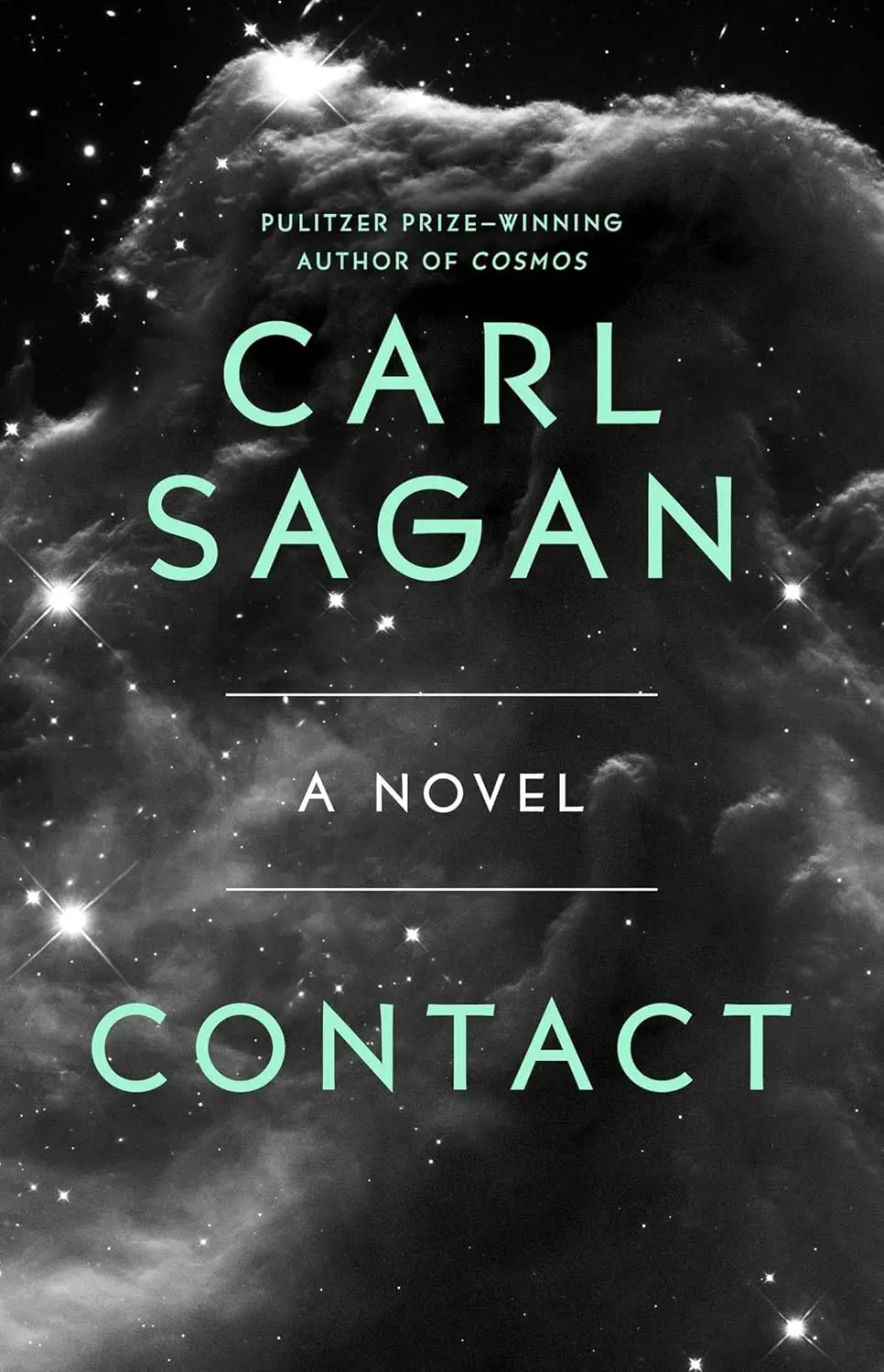
Contact is Carl Sagan’s only novel, published in 1985, and it reads like a thought experiment by a scientist who spent his career thinking about the possibility of life elsewhere in the universe. The story follows Ellie Arroway, a radio astronomer who detects a signal from the star Vega that contains instructions for building a machine of unknown purpose.
The novel is driven by ideas more than by action. Sagan uses the detection and decoding of the alien message to explore how different institutions would react: the scientific community, governments, religious organizations, the media, and the military. The political negotiations over who gets to use the machine, and who gets to go if it turns out to be a transport device, feel realistic and well-observed.
Arroway herself is a well-drawn character, a woman in a male-dominated field who has had to fight for every bit of credibility. Her relationships, both personal and professional, are handled with more nuance than you might expect from a scientist-turned-novelist. The book also spends time on the tension between science and faith, with Sagan giving religious perspectives more respect than his reputation as a skeptic might suggest.
The science in the book is solid. Sagan understood radio astronomy, signal processing, and the physics of interstellar communication, and the technical details feel earned rather than invented. The ending ventures into territory that is more philosophical than scientific, which divided readers at the time and still does.
For founders and science-minded readers, Contact offers a model of what it looks like to think through a complex problem from multiple angles simultaneously. Sagan considers the technical, political, social, and personal dimensions of the same event, which is the kind of multi-layered thinking that building a company also requires.
The 1997 film adaptation starring Jodie Foster is well-known, but the novel goes deeper on nearly every topic and is worth reading independently of the movie.
