
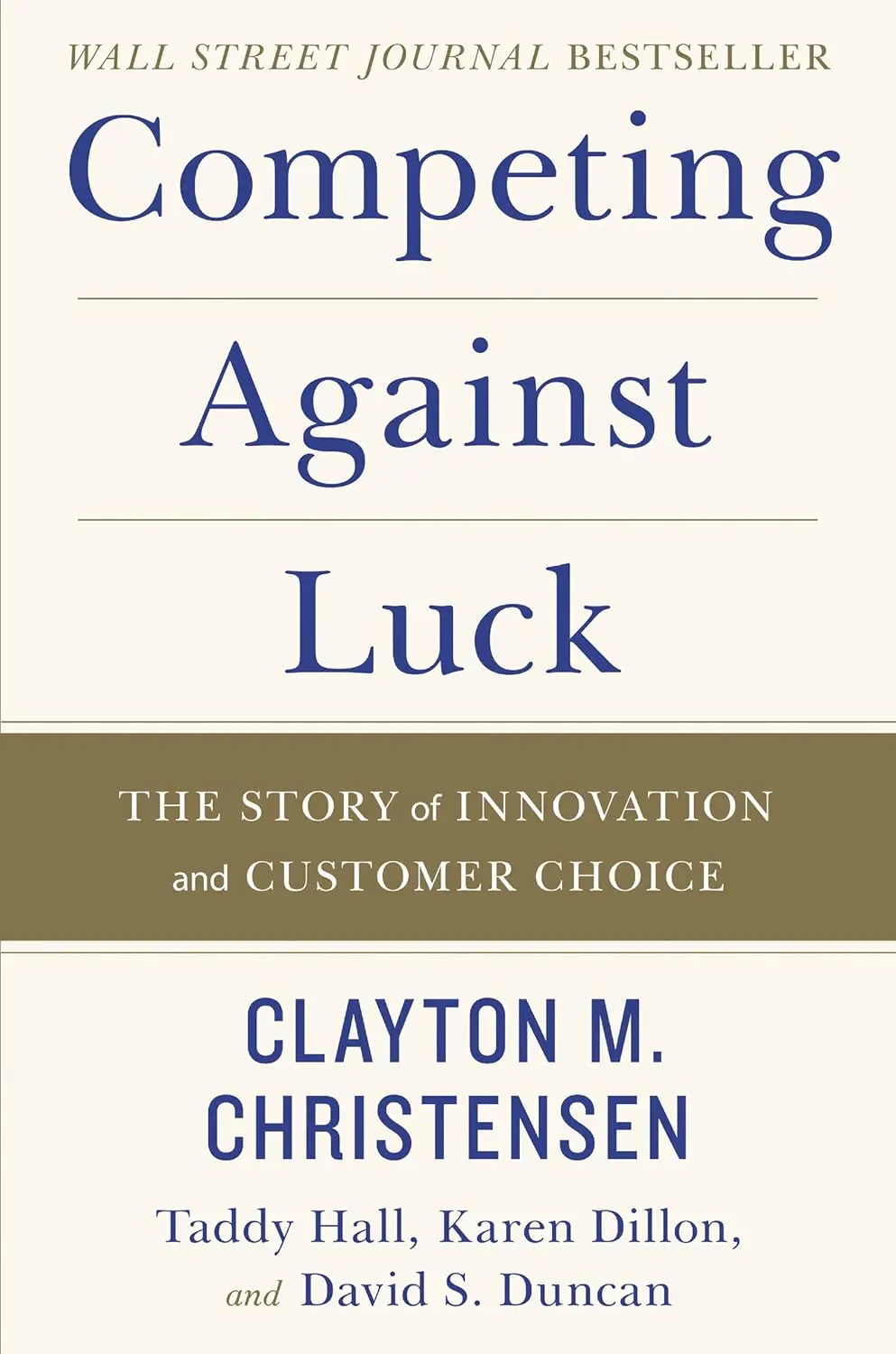
Competing Against Luck picks up where The Innovator’s Dilemma left off. Where the earlier book explained why companies fail, this one explains what they should do instead. The answer is the “Jobs to Be Done” framework, which Christensen had been developing for years.
The theory is that customers do not buy products because of who they are (demographics) or what the product does (features). They “hire” products to make progress in a specific situation. A fast-food chain trying to sell more milkshakes discovered that most morning purchases were made by commuters who needed something to eat during a long, boring drive. They were not hiring a milkshake to compete with other milkshakes. They were hiring it to compete with bagels, bananas, and boredom.
Once you understand the job, product decisions become clearer. The milkshake needed to be thick (so it lasted the whole commute), fit in a cup holder, and come with a straw. The job defined the specification.
Christensen applies this to multiple case studies: Intuit’s QuickBooks, Southern New Hampshire University’s online enrollment growth, and American Girl dolls. In each case, the company succeeded by understanding what job customers were trying to do, not just what they said they wanted.
The book also addresses how to identify jobs in practice. Christensen recommends looking for workarounds (what are people cobbling together because no good solution exists?), nonconsumption (who is not using anything at all and why?), and compensating behaviors (what extra steps do people take to make an inadequate product work?).
For founders, the Jobs to Be Done framework is one of the most useful tools for product development available. It reframes every product decision around the question “what progress is the customer trying to make?” rather than “what features should we build?” That single reframe prevents a lot of wasted effort.
Satya Nadella has cited Christensen’s work. At about 290 pages, the book is clearly written and well-organized. If you only read one Christensen book, this may be more immediately useful than The Innovator’s Dilemma because it tells you what to do, not just what to avoid.
