
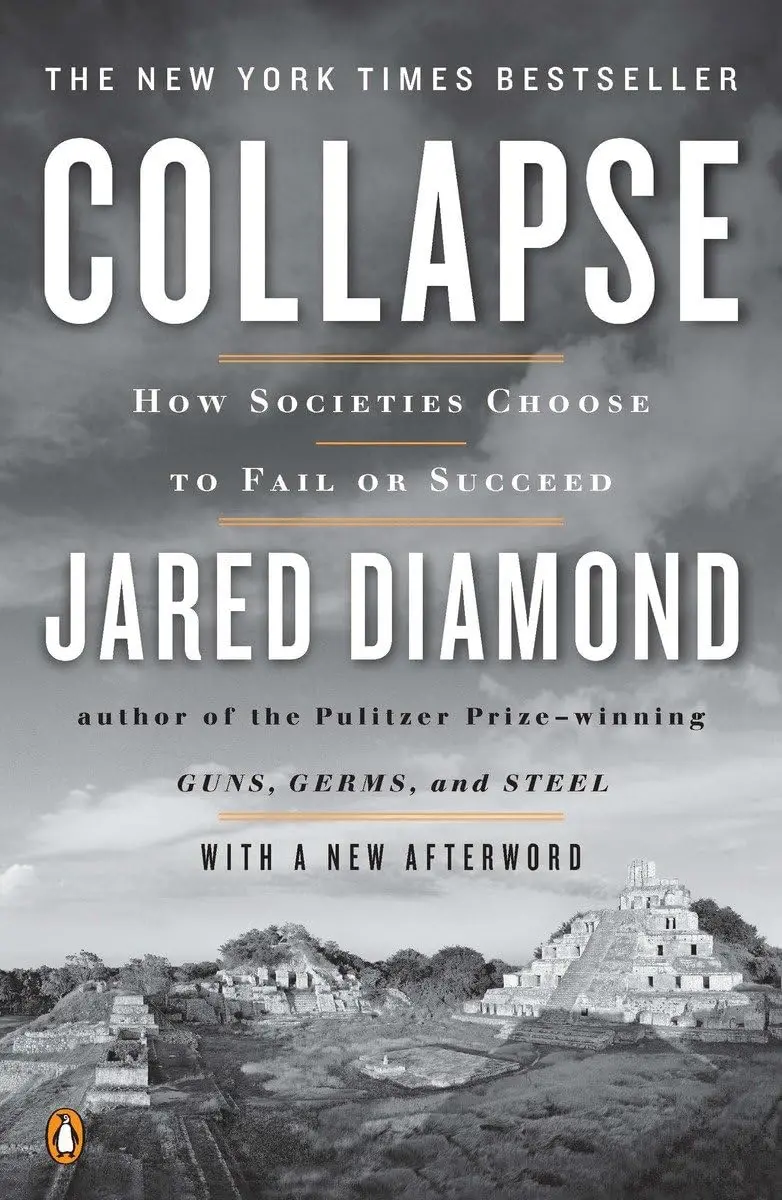
Guns, Germs, and Steel asked why some civilizations conquered others. Collapse asks the darker follow-up: why do some civilizations destroy themselves?
Jared Diamond examines a series of past and present societies that either collapsed or came close. Easter Island, whose inhabitants cut down every tree on the island until they could no longer build canoes, grow crops, or sustain their population. The Maya, who flourished for centuries and then abandoned their cities. The Norse settlers of Greenland, who starved to death while surrounded by fish they refused to eat because their culture considered fishing beneath them. The Anasazi of the American Southwest, who depleted their environment beyond recovery.
Diamond identifies five factors that determine whether a society survives or collapses: environmental damage, climate change, hostile neighbors, loss of trading partners, and the society’s response to its problems. The last factor is the one Diamond cares about most. Environmental crises are not automatically fatal. Some societies recognize the problem and adapt. Others do not. The question is why.
The most chilling chapter covers the Norse in Greenland. They arrived around 984 AD and survived for about 450 years. They raised cattle, built churches, and traded with Europe. As the climate cooled during the Little Ice Age, their pastures shrank and their cattle weakened. The Inuit, who had adapted to Arctic conditions over thousands of years, thrived nearby by hunting seals and fish. The Norse refused to adopt Inuit techniques. They considered themselves superior. They starved.
Diamond also examines modern societies. He compares Haiti and the Dominican Republic, which share the same island but have had radically different environmental outcomes. He looks at China, Australia, and the Bitterroot Valley of Montana, each facing ecological pressures with varying degrees of awareness and response.
The book has been criticized for oversimplifying the causes of collapse. Some archaeologists argue that Diamond places too much weight on environmental factors and not enough on political, economic, and cultural ones. Others have challenged specific claims, particularly about Easter Island, where recent research suggests European contact and disease played a larger role than Diamond acknowledges.
Diamond writes well and moves between deep history and contemporary reporting with ease. The book is long, over 500 pages, and some chapters spend more time on ecological detail than general readers may want. But the central question, why do societies sometimes make decisions that are obviously catastrophic in hindsight, is one that never stops being relevant.
