
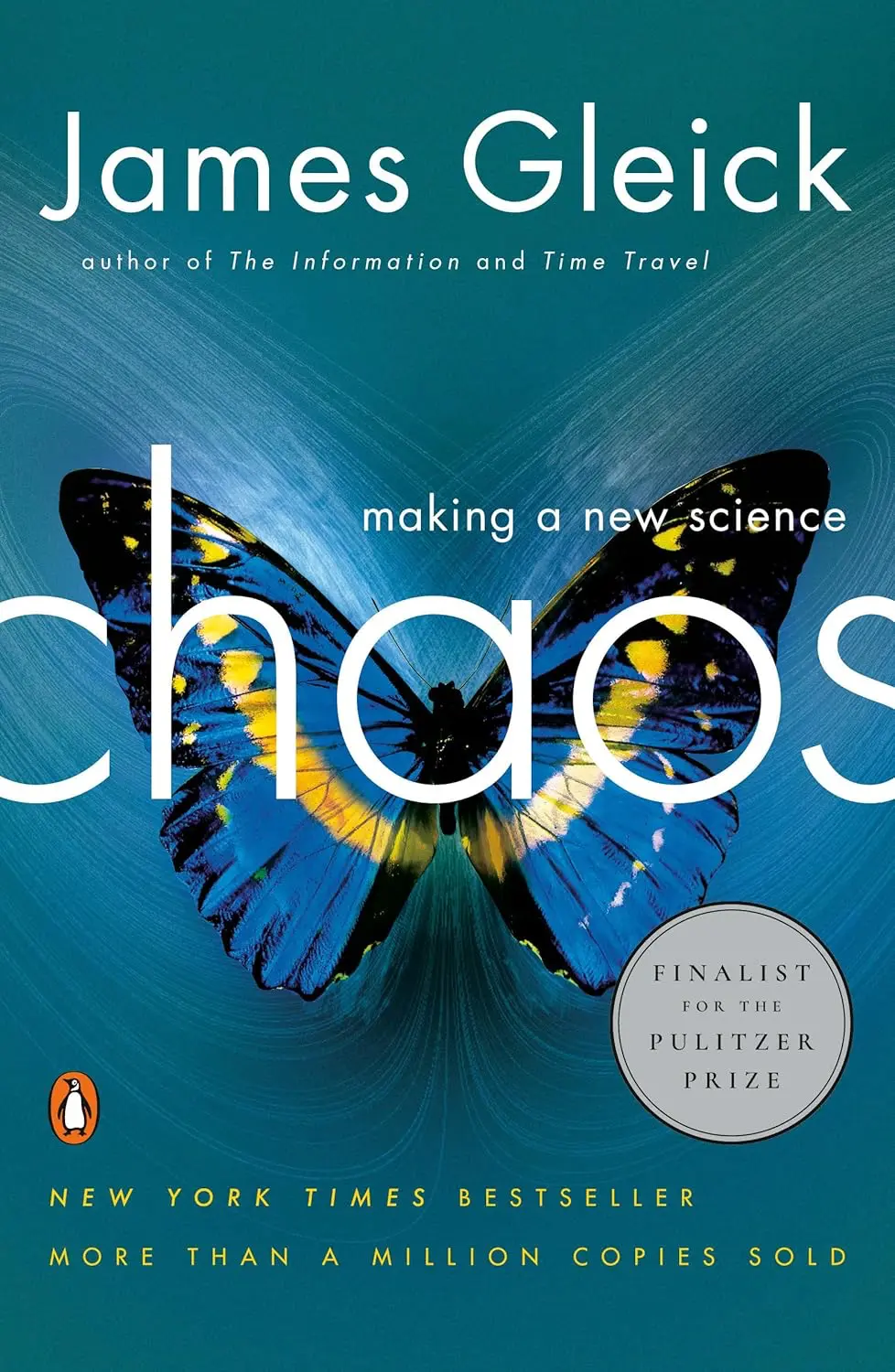
Chaos is James Gleick’s account of how a new branch of science emerged from the realization that simple, deterministic systems can produce behavior that looks random and is effectively unpredictable. The book was published in 1987, when chaos theory was still relatively new, and Gleick captures the excitement of the scientists who were working out the implications.
The story begins with Edward Lorenz, a meteorologist who discovered in the early 1960s that tiny rounding errors in his weather simulations produced completely different forecasts. This became known as the “butterfly effect,” the idea that a butterfly flapping its wings in Brazil could theoretically set off a tornado in Texas. Lorenz’s discovery was an early signal that determinism and predictability are not the same thing.
From there, Gleick profiles the scientists who developed chaos theory across multiple fields: Benoit Mandelbrot and fractal geometry, Mitchell Feigenbaum and the universality of certain mathematical constants, Robert May and population biology, and others. The book shows how researchers in different disciplines were independently discovering similar patterns, and how the new science of chaos connected weather, fluid dynamics, biology, and mathematics in unexpected ways.
For founders, the direct business applications are limited, but the mental model is valuable. Chaos theory teaches that complex systems are sensitive to initial conditions, that small changes can have large effects, and that prediction becomes impossible beyond a certain point. Anyone running a company in a competitive market, where small decisions compound in unpredictable ways, will recognize the pattern.
Gleick is one of the best popular science writers, and Chaos is his most famous book. The writing is clear without oversimplifying the math, and the character portraits of the scientists are vivid. The book is nearly 40 years old now but holds up well because the underlying ideas haven’t changed, and the stories of their discovery remain compelling.
