
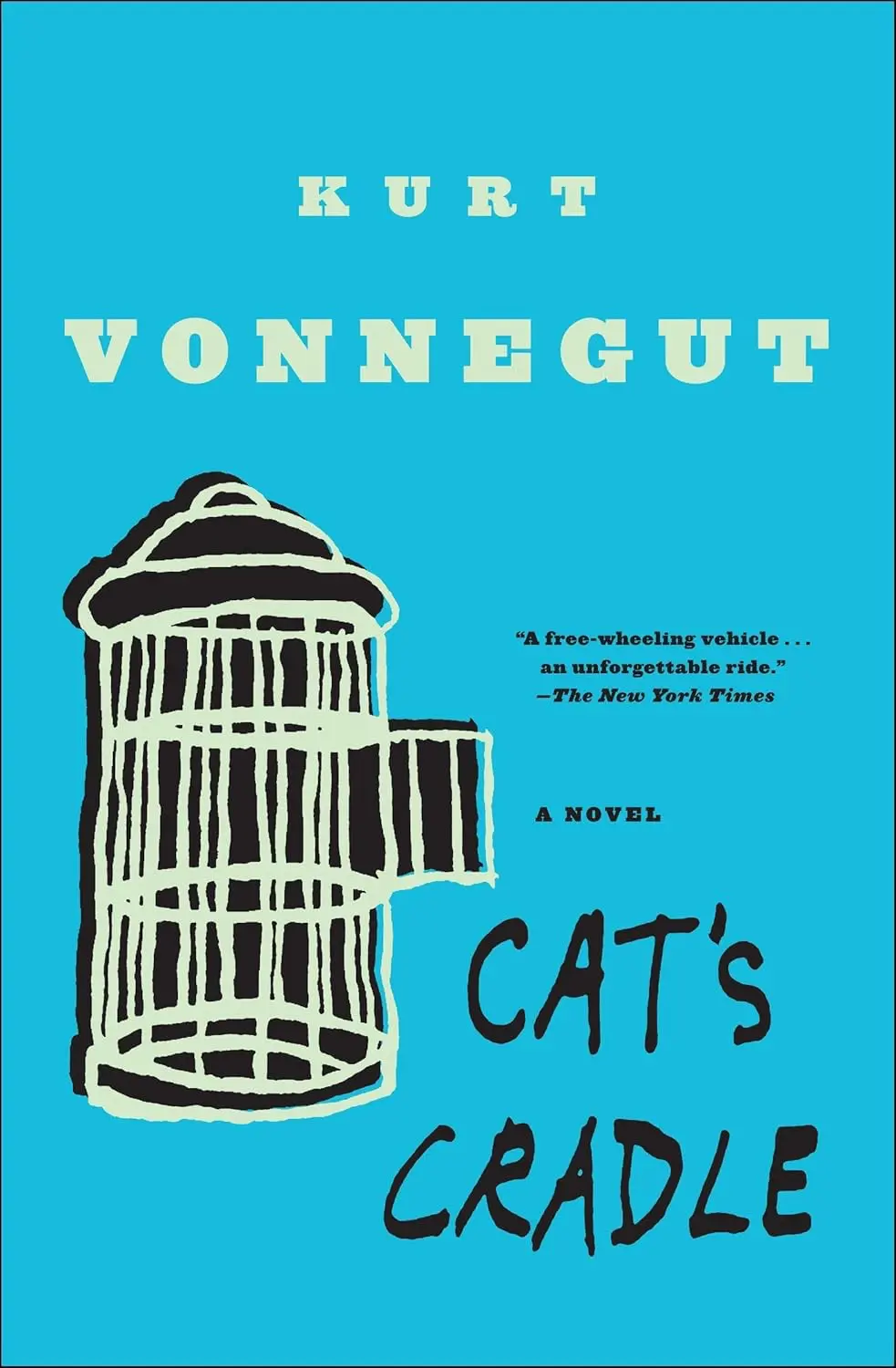
Cat’s Cradle is one of Kurt Vonnegut’s most read novels, and it’s a good entry point into his work. The narrator, a writer named John, sets out to write a book about what the creators of the atomic bomb were doing on the day Hiroshima was bombed. His research leads him to the fictional Dr. Felix Hoenikker, one of the bomb’s developers, and eventually to a substance called ice-nine: a form of water that freezes at room temperature and, upon contact with regular water, converts it to ice-nine as well.
The novel is structured as a series of very short chapters, some less than a page long, which gives it a rapid, almost breathless pace. Vonnegut uses this structure to jump between scenes, timelines, and ideas without ever lingering too long on any one thing. The effect is a book that covers an enormous amount of ground in under 300 pages.
Religion plays a major role. On the fictional Caribbean island of San Lorenzo, where much of the action takes place, the population follows Bokononism, a religion whose founder openly admits it is built entirely on lies, but argues that those lies are useful because they give people comfort and community. Vonnegut uses Bokononism to satirize organized religion, but also to acknowledge the human need for meaning, even manufactured meaning.
The humor is dark throughout. Vonnegut treats the end of the world with the same dry, deadpan tone he applies to everything else. Characters die, civilizations collapse, and the narrator observes it all with a kind of bemused detachment that is Vonnegut’s signature.
For founders and business readers, the book is not directly applicable, but its themes about unintended consequences of technology, institutional absurdity, and the gap between what people say they believe and how they actually behave are relevant to anyone operating within complex organizations.
The writing is lean, funny, and deceptively simple. Vonnegut makes it look easy, which is part of what makes him so hard to imitate. If you haven’t read Vonnegut, this or Slaughterhouse-Five is the place to start.
