
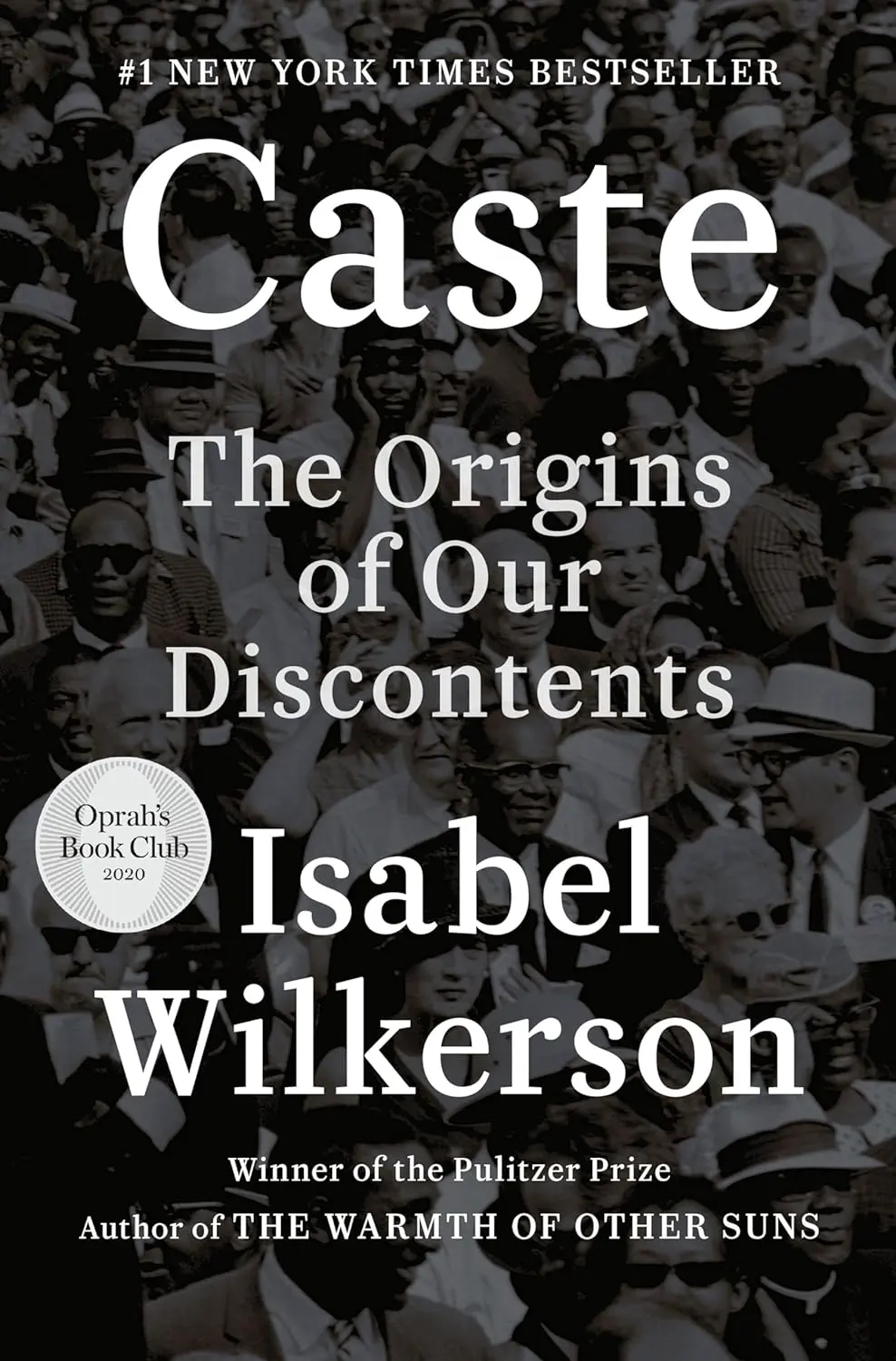
Isabel Wilkerson won a Pulitzer Prize at the New York Times in 1994, the first Black woman to do so in journalism. Her first book, The Warmth of Other Suns, traced the Great Migration of Black Americans from the South and took fifteen years to research. Caste, her second book, published in 2020, builds on that work by proposing a framework that goes beyond race to explain the hierarchies that structure American society.
Wilkerson’s central claim is that the United States operates on a caste system. Race is the visible marker, but the underlying mechanics are older and more rigid than the word racism usually implies. She defines caste as a fixed ranking of human value that determines who gets what, who can do what, and who is treated as fully human. She argues this system was built into the country at its founding and has maintained itself through laws, customs, violence, and unspoken social rules ever since.
To make her case, she compares the American system with two others: the caste hierarchy of India, which dates back thousands of years and assigns social position at birth, and the racial classification system that Nazi Germany built in the 1930s. One of the book’s most striking sections documents how Nazi researchers studied American race laws, particularly Jim Crow legislation, when designing the Nuremberg Laws. They found some American statutes too extreme for their purposes, particularly the one-drop rule that classified anyone with any Black ancestry as Black.
Wilkerson identifies eight pillars that she says underpin all three caste systems: divine will and laws of nature, heredity, endogamy (control of marriage and mating), purity versus pollution, occupational hierarchy, dehumanization and stigma, terror as enforcement, and inherent superiority versus inherent inferiority. She examines each pillar with historical evidence and personal stories, including her own experiences as a Black woman in professional settings where her presence was unexpected.
The book is not a policy manual. Wilkerson does not spend much time on legislative fixes or organizational reform. Her project is diagnostic. She wants to change the lens through which Americans understand the hierarchy they live in, on the theory that you cannot fix a system you have not accurately identified. The shift from “racism” to “caste” is meant to remove the debate about individual intent and focus attention on structural position.
Oprah Winfrey selected the book for her book club. Ava DuVernay adapted it into the 2023 film Origin. For founders and leaders building organizations, the book raises uncomfortable questions about whose talent gets overlooked, whose authority gets questioned by default, and how invisible hierarchies shape team dynamics in ways that diversity initiatives alone do not address.
