
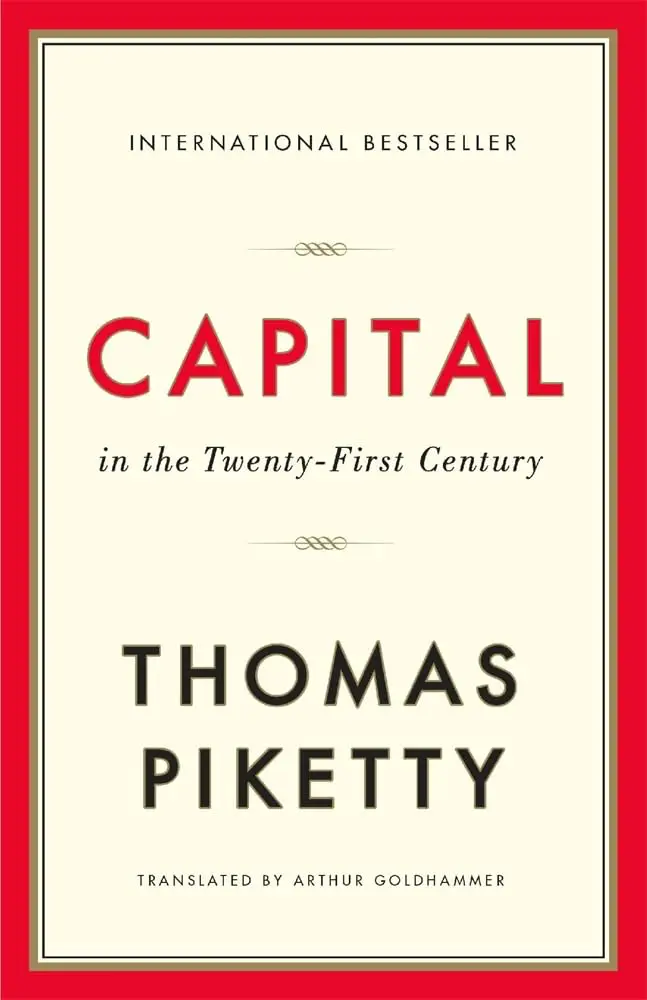
Piketty, a French economist, assembled the largest historical dataset on wealth and income inequality ever compiled. The data covers tax records, estate records, and national accounts spanning two centuries and twenty countries. From this data, he draws a central conclusion: when the rate of return on capital (r) exceeds the rate of economic growth (g), wealth concentrates in fewer hands over time.
This is not a moral argument. It is a mathematical observation. If capital earns 5% per year and the economy grows at 2%, people who already own capital accumulate wealth faster than the economy as a whole. Over decades and centuries, this gap compounds. The brief period of relatively low inequality in the mid-20th century, which many economists treated as the normal state of capitalism, was actually an exception caused by two world wars and their political aftermath.
Piketty’s policy proposals (a global wealth tax, more progressive income taxes) are controversial, and many economists disagree with both his diagnosis and his prescriptions. Critics argue that his data has methodological problems, that he underestimates the role of human capital (education and skills), and that a global wealth tax is politically impossible.
The book is long at about 700 pages, and parts of it are dense with economic data. Piketty writes clearly for an economist, but readers without a background in economics may find the middle sections slow. The historical chapters, covering how wealth was distributed in 19th-century France and England, are surprisingly engaging.
For business readers, the book’s relevance is in understanding the structural forces shaping the economy you operate in. If Piketty is right that inequality is the default tendency of capitalism, this affects consumer markets (who can afford what), labor markets (wage dynamics), and political environments (populist backlash). Whether you agree with his conclusions or not, the data he assembled is hard to ignore.
Bill Gates has engaged with the book publicly, agreeing with the data but disagreeing with some of the policy recommendations. It became an unlikely bestseller when published in English in 2014.
