
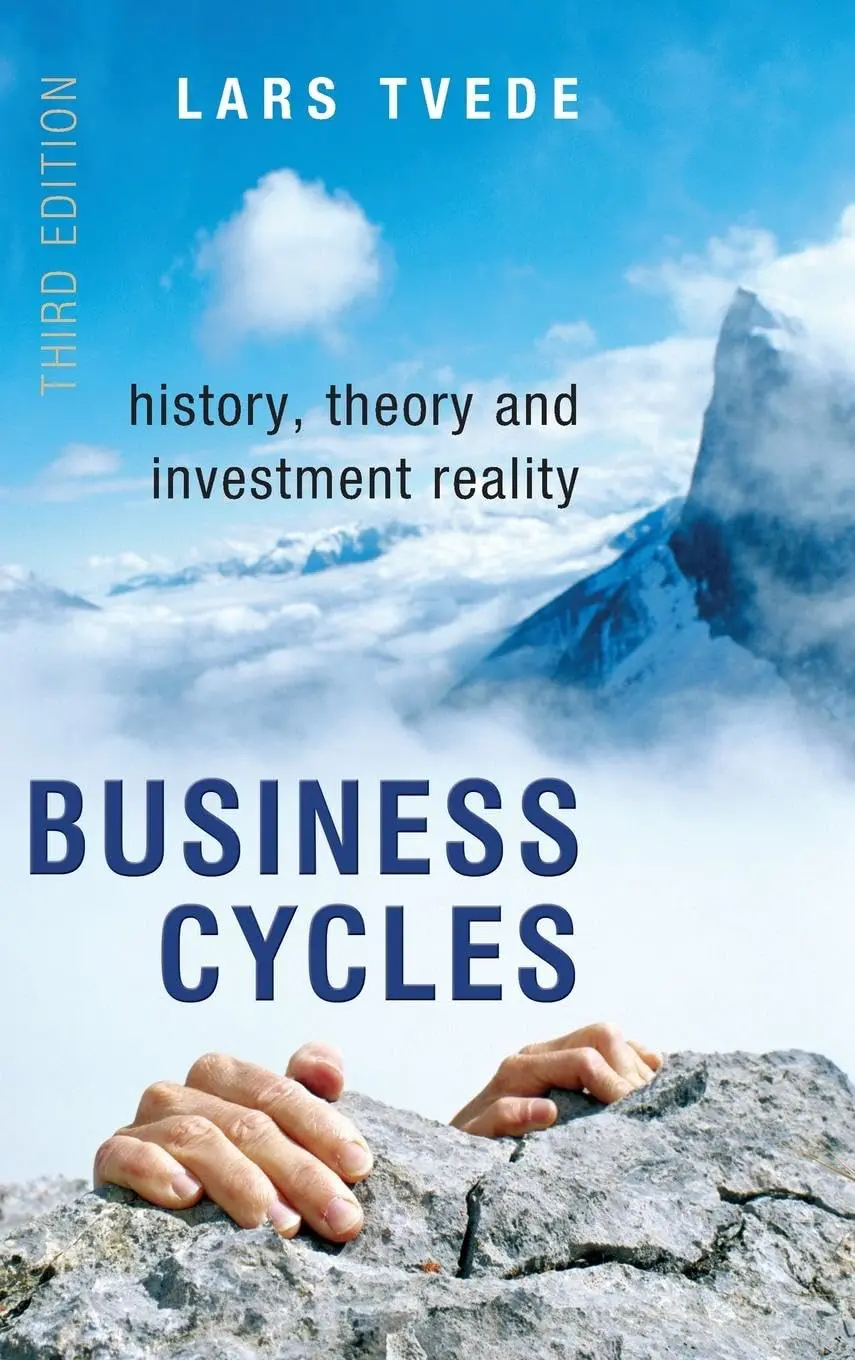
Economies expand and contract. This has been true for as long as market economies have existed, and people have been trying to figure out why for just as long. Lars Tvede starts with John Law, the Scottish gambler who convinced the French government to back paper currency in the early 1700s, triggering one of history’s first speculative manias, and works forward through Adam Smith, David Ricardo, Henry Thornton, Joseph Schumpeter, Irving Fisher, John Maynard Keynes, Friedrich von Mises, and Milton Friedman. Each economist gets treated as a character in a larger story, with Tvede providing the biographical detail and historical context that standard economics textbooks leave out.
Tvede is not an academic economist. He holds an engineering degree and a commerce degree, spent eleven years in derivatives trading and investment banking, then moved into tech startups. He later co-founded a venture capital fund. This background shows in how he writes: the book is built for practitioners, not theorists. He wants readers to understand cycles well enough to use them.
The book identifies five main drivers of business cycles: interest payments, asset prices, building construction, capital spending, and inventories. Each driver operates on a different timescale. Inventory cycles are short, typically lasting three to five years. Capital investment cycles run longer. Property and construction cycles stretch across decades. Understanding which cycle is currently dominant, and where in its arc it sits, is what separates informed investors and business operators from those who get blindsided by downturns they did not see coming.
The later chapters turn directly practical. Tvede walks through how stocks, bonds, gold, real estate, commodities, hedge funds, private equity, and even art and collectibles behave at different points in different types of cycles. Some asset classes lead the cycle. Others lag. Knowing the pattern, while never a guarantee, gives an edge that most market participants lack simply because they do not think in terms of cycles at all.
Tvede also covers the evolution of modern macroeconomic modeling, from early Keynesian equations through the discovery of deterministic chaos and nonlinear dynamics in economics. He explains how central banks attempt to manage cycles and where those attempts tend to fail.
The Economist reviewed the book favorably and listed it as an example of how to write readable economics. Jack Ma has cited it as a recommendation. At nearly 500 pages, it is a long read, but Tvede keeps the writing conversational and uses illustrations and anecdotes throughout. For anyone running a business or managing capital through volatile markets, the framework for understanding why economies turn, and when, is worth the time.
