
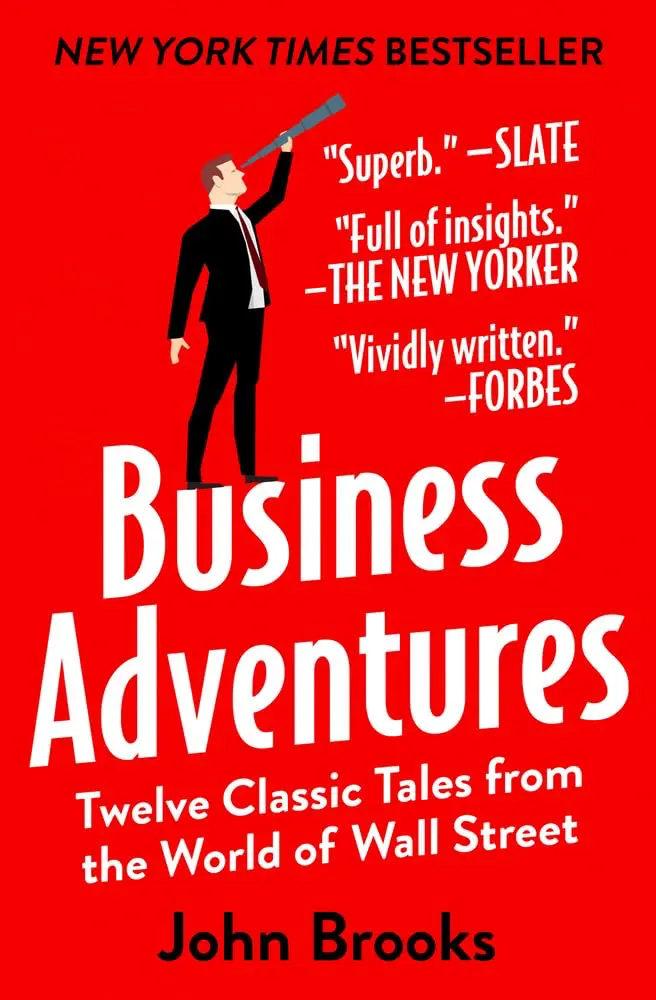
Business Adventures is a collection of twelve long-form journalism pieces John Brooks wrote for The New Yorker between the late 1950s and late 1960s. The book went out of print for decades before being reissued after Bill Gates wrote about it in 2014, calling it the best business book he had ever read.
The stories cover: the 1962 stock market crash (and the psychology of panic), the rise and fall of the Edsel (Ford’s most famous product failure), the Piggly Wiggly stock corner (an early short squeeze), Xerox’s fight to defend its patents, federal income tax policy, GE’s price-fixing scandal, and several others.
Brooks wrote these as narrative journalism, not as case studies with tidy lessons. The people in these stories make decisions under uncertainty, often badly. Companies that seem unstoppable collapse because of a single misjudgment. Individuals who should know better get swept up in crowd behavior. The recurring theme is that the human elements of business (ego, fear, groupthink, overconfidence) have not changed in decades, even as the technology and scale have.
The writing is precise and unhurried in a way that business writing no longer tends to be. Brooks takes time with scenes, lets characters reveal themselves through dialogue, and trusts the reader to draw conclusions. It reads more like literary nonfiction than a management book.
For founders, the value is in the pattern recognition. The Edsel chapter alone is a study in how a well-funded company with talented people can build a product nobody wants. The stock market chapters show how herd behavior creates and destroys value in ways that have nothing to do with fundamentals. These dynamics repeat constantly, and recognizing them is a competitive advantage.
Warren Buffett lent his personal copy to Bill Gates, who then promoted it. The book does not offer frameworks or advice. It offers stories that make you smarter about how businesses actually work, which may be more valuable.
