
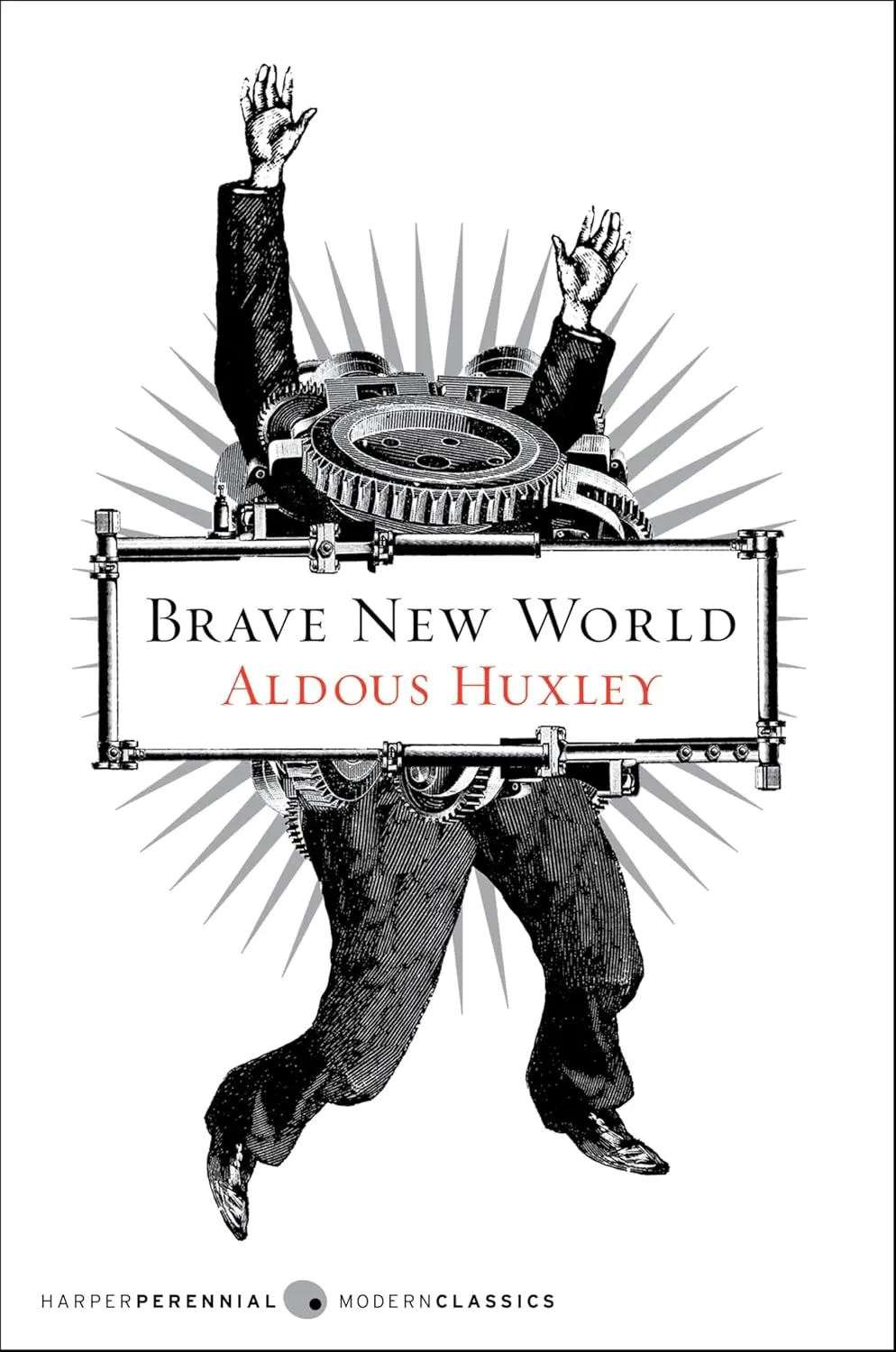
Brave New World is set in a future World State where humans are grown in laboratories, genetically engineered for specific social classes, and conditioned from birth to accept their roles. There is no war, no poverty, and no unhappiness, because unhappiness has been designed out of the system. People take a drug called soma whenever they feel anything unpleasant. Monogamy is considered antisocial. Consumption is mandatory. Everyone is entertained, medicated, and satisfied.
The plot follows Bernard Marx, a psychologist who feels vaguely dissatisfied with this paradise, and John “the Savage,” who grew up on a reservation outside the World State and encounters its society for the first time. Through John’s outsider perspective, Huxley examines what gets lost when you eliminate suffering: art, love, meaning, genuine human connection, and the right to be unhappy.
The book is often compared to George Orwell’s 1984, but the mechanism of control is opposite. Orwell’s dystopia controls through fear and surveillance. Huxley’s controls through pleasure and distraction. As media critic Neil Postman later argued, Huxley’s version may be the more prescient warning for modern democracies: people do not need to be oppressed if they can be kept entertained.
For business readers, the book raises questions about technology’s role in shaping behavior. The World State is, in a sense, the ultimate consumer economy: everyone is engineered to want what the economy produces, and the economy produces what everyone is engineered to want. That feedback loop is not entirely fictional. Companies that build products designed to maximize engagement are working with similar (if less extreme) dynamics.
The novel is short, under 300 pages, and Huxley’s prose is sharp and occasionally darkly funny. The satire of social conditioning, mass consumption, and the worship of comfort hits differently in the age of social media and algorithmic feeds than it did in 1932. It is one of those books that becomes more relevant as technology advances, not less.
