
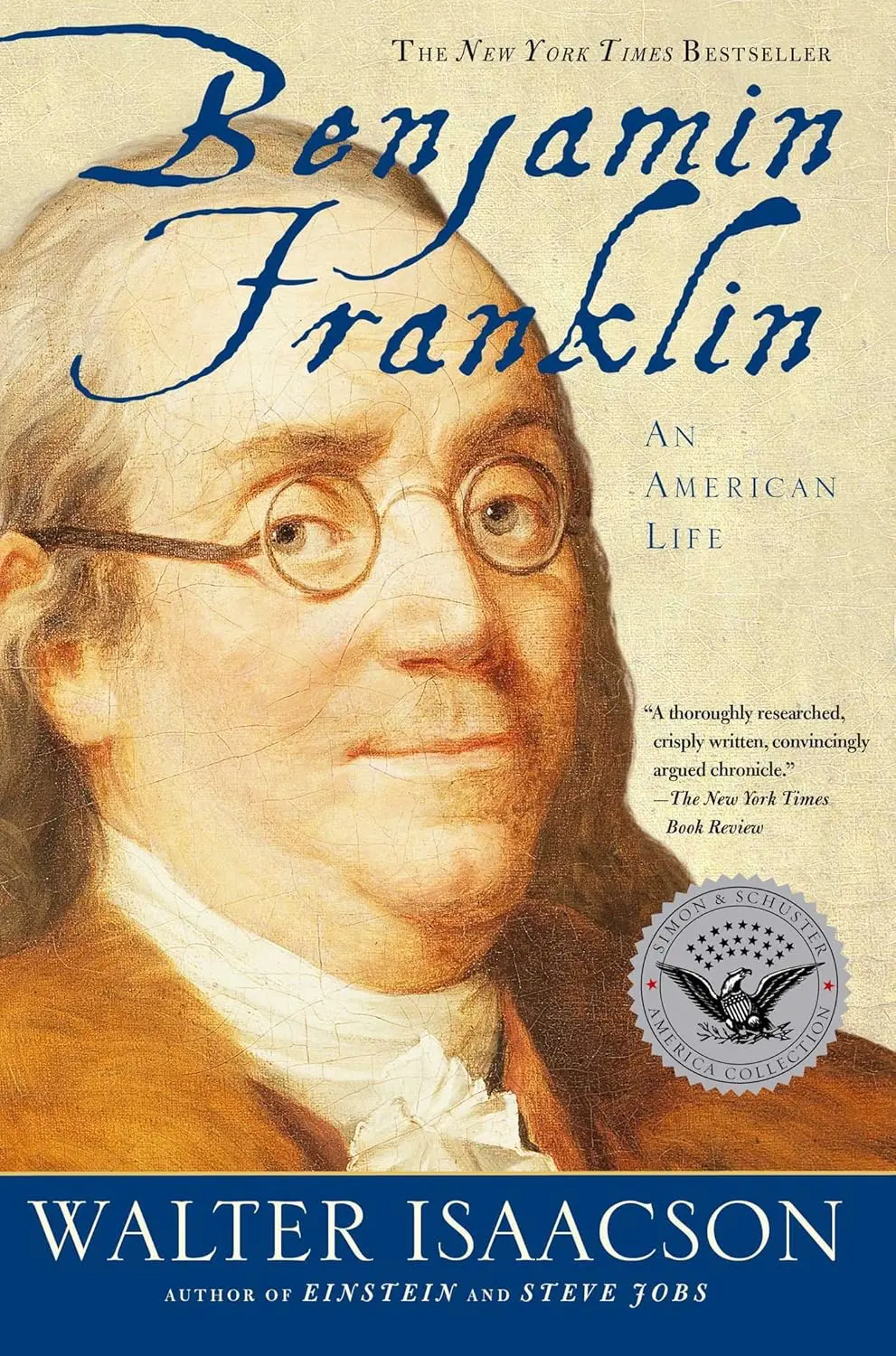
Benjamin Franklin ran away from his apprenticeship in Boston at 17, arrived in Philadelphia with almost nothing, and over the next several decades became a successful printer, publisher, inventor, scientist, diplomat, and political leader. Walter Isaacson’s biography covers all of it with the thoroughness you would expect from the biographer of Steve Jobs and Einstein.
Franklin’s career as a printer and publisher is where the founder parallels are strongest. He started the Pennsylvania Gazette, turned it into the most widely read newspaper in the colonies, and then launched Poor Richard’s Almanack, which became a bestseller. He was an early practitioner of what we would now call content marketing: publishing useful information that attracted an audience, which he then monetized through advertising and distribution deals.
He was also a systematic self-improver. His famous list of 13 virtues, which he tracked weekly in a notebook, was essentially a personal OKR system 250 years before the term existed. He formed the Junto, a club of tradesmen who met weekly to discuss ideas and help each other, which functioned like a modern mastermind group or founder community.
As a diplomat in France during the Revolutionary War, Franklin demonstrated skills that any business negotiator would recognize: reading the room, building relationships before asking for favors, using humor to defuse tension, and understanding what the other side needed in order to say yes.
Isaacson does not hagiographize Franklin. The biography covers his vanity, his complicated relationships with his son and various women, and his willingness to compromise on slavery for political expediency. Franklin comes across as a fully human figure: brilliant, charming, ambitious, and flawed.
For founders, Franklin’s story is relevant because he was a builder across multiple domains simultaneously: businesses, civic institutions, scientific experiments, and political systems. He did not specialize. He applied the same pragmatic, experimental approach to everything.
Elon Musk, Tim Ferriss, and Charlie Munger have recommended this book. At about 590 pages, it is a substantial read. Isaacson’s writing is clear and well-paced, and the narrative moves quickly despite the length. It is the most complete single-volume biography of Franklin available.
