
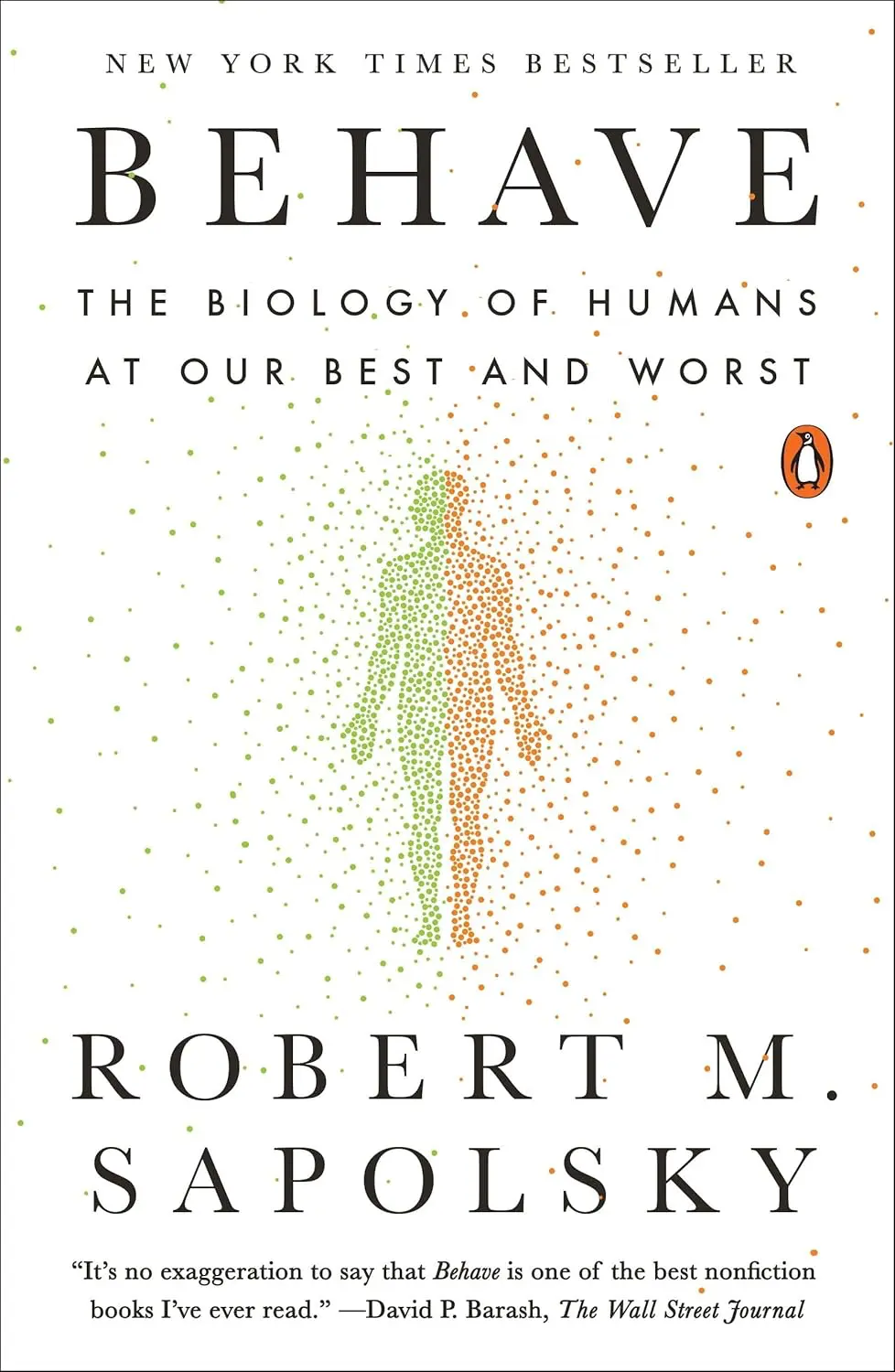
Behave is Robert Sapolsky’s attempt to explain human behavior by examining every level of biological causation simultaneously. Sapolsky, a neuroendocrinologist at Stanford who spent decades studying stress in baboons, structures the book as a series of concentric time frames around a single action. What happened in the brain one second before the behavior? What happened in the hormonal system hours before? What sensory input arrived that morning? What neuroplastic changes happened in the preceding months? What was the person’s childhood environment? What culture did they grow up in? What evolutionary pressures shaped the species?
Each chapter covers one time frame and the biology within it. The neuroscience chapters explain how the prefrontal cortex (responsible for impulse control and decision-making) interacts with the amygdala (responsible for fear and emotional reactions). The endocrinology chapters cover how testosterone, cortisol, and oxytocin influence behavior (Sapolsky is careful to debunk popular oversimplifications: testosterone doesn’t cause aggression; it amplifies whatever social behavior is already dominant). The developmental chapters cover how childhood stress physically changes brain architecture. The evolutionary chapters cover the biological roots of cooperation, competition, tribalism, and morality.
The book’s greatest strength is its insistence that no single level of explanation is sufficient. Behavior is always the product of genes and environment and hormones and brain structure and culture and evolutionary history, all interacting at once. Sapolsky is consistently critical of explanations that reduce behavior to any single cause, whether that’s “it’s genetic” or “it’s cultural” or “it’s a choice.”
For founders, the practical value is indirect but real. Understanding why people behave the way they do, why teams form in-groups and out-groups, why stress degrades decision-making, why first impressions are so sticky, and why people resist change even when the evidence is clear, makes you a better leader, a better negotiator, and a better product designer.
The writing is dense but surprisingly funny. Sapolsky has a gift for explaining complex biology with wit and clarity. At over 700 pages, the book is long, and some chapters require concentration. But it is probably the most comprehensive single-volume explanation of human behavior currently available.
