
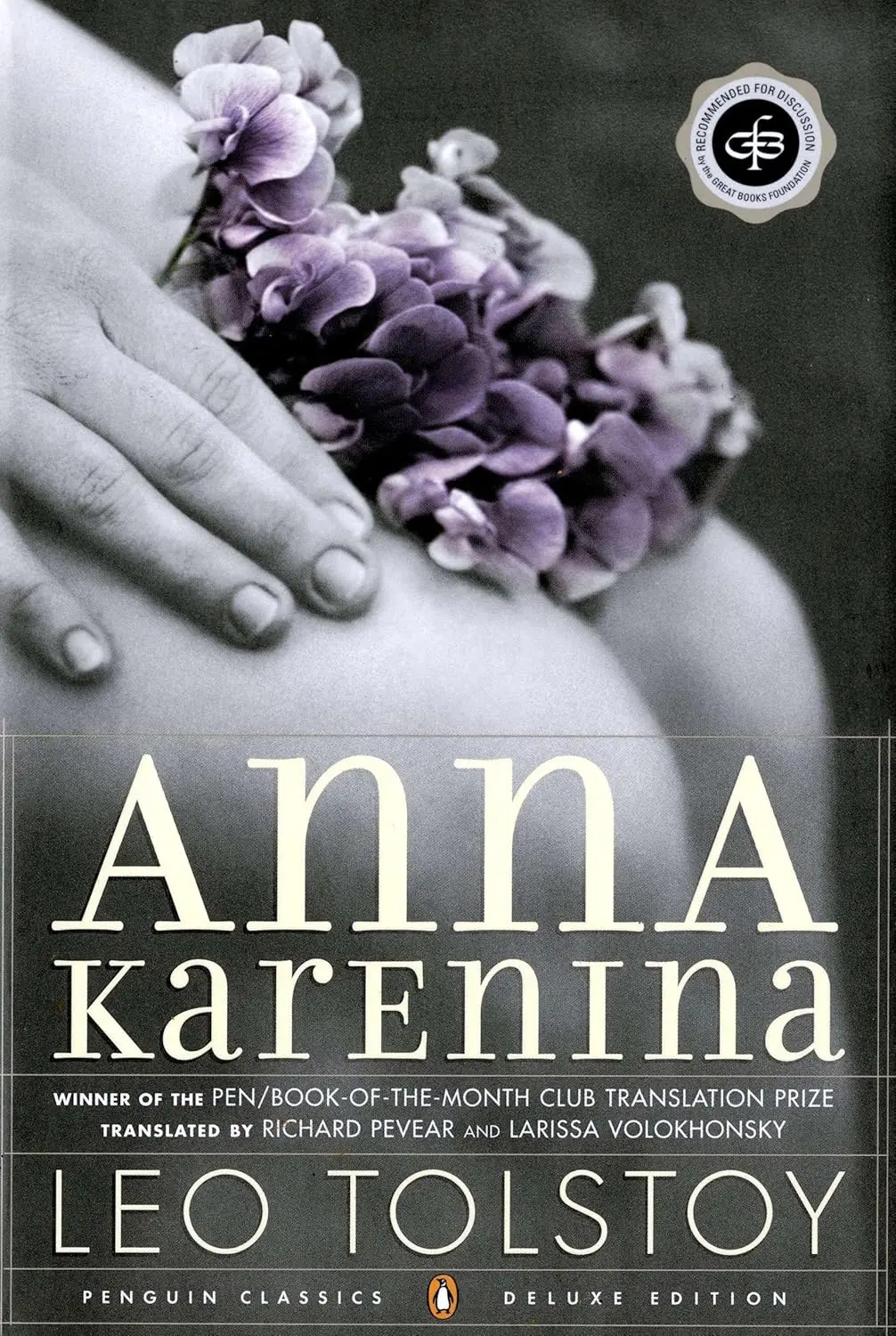
Anna Karenina opens with one of literature’s most quoted lines about happy and unhappy families, then spends 800 pages proving how true it is. The novel follows two main storylines in parallel. Anna Karenina, married to a high-ranking government official, falls in love with Count Vronsky, a dashing cavalry officer. Their affair and its social consequences form one half of the book. The other half follows Levin, a landowner who struggles with questions about work, faith, and what makes life worth living, and whose courtship of Kitty Shcherbatskaya provides a counterpoint to Anna’s story.
Tolstoy writes both storylines with equal care and detail. Anna’s sections are a study of how passion, social pressure, and jealousy interact to destroy a person from the inside. Tolstoy doesn’t moralize; he just tracks the emotional logic of Anna’s situation with the precision of a psychologist, showing how each decision narrows her options until she feels trapped.
Levin’s sections, which some readers find slower, are Tolstoy working through his own questions about life’s meaning. Levin mows hay alongside his peasants, struggles with the gap between theory and practice, argues about political reform at dinner parties, and eventually arrives at a faith that is less about theology than about the daily experience of being alive. These passages are some of the most honest writing about the search for purpose that exists in any language.
For founders and readers dealing with questions about how to live, the Levin sections are the more directly useful half of the novel. His struggle to reconcile ambition with contentment, to find work that feels meaningful, and to figure out what he actually believes rather than what he’s supposed to believe will feel familiar to anyone at a similar crossroads.
The Pevear and Volokhonsky translation is the most widely recommended for contemporary readers. The novel is long but well-paced. Unlike War and Peace, it has no large-scale battle scenes or philosophical essays to break the narrative. It moves like a realist novel from start to finish, and the character work is among the best in all of fiction.
