
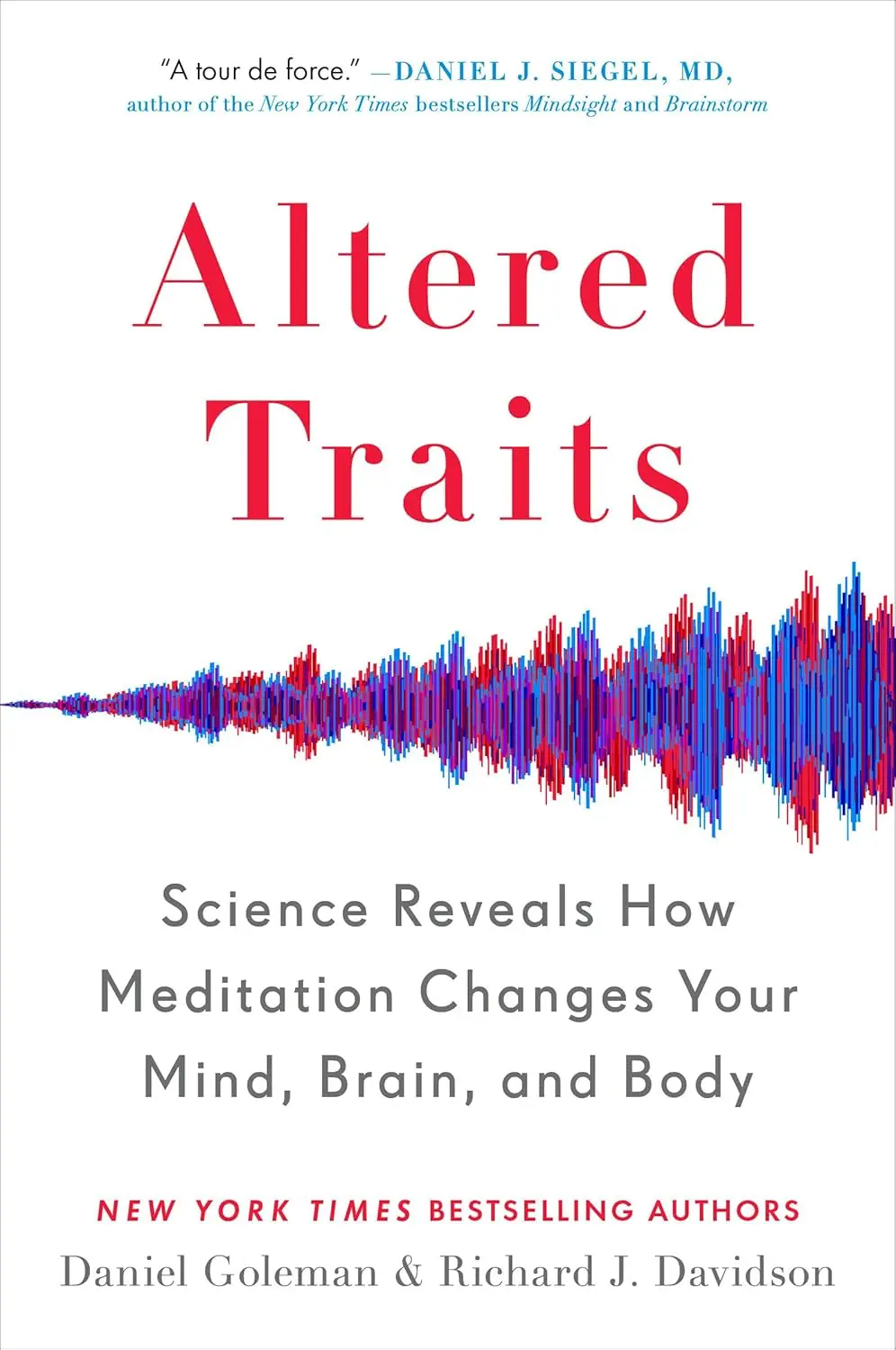
Daniel Goleman and Richard Davidson have been friends since graduate school at Harvard in the 1970s. Both traveled to India to study meditation, and both came back with the same hypothesis: that meditation could produce lasting changes in personality and brain function, not just temporary pleasant states. In the decades that followed, Goleman became the bestselling author of Emotional Intelligence, and Davidson became a leading neuroscientist at the University of Wisconsin-Madison, where he built one of the world’s foremost brain imaging laboratories. Altered Traits is the book they had been wanting to write for forty years.
The authors went through more than 6,000 published studies on meditation. Most of them, they found, had serious methodological problems: small sample sizes, no control groups, self-reported outcomes, or poorly defined meditation protocols. Out of the full body of research, Goleman and Davidson identified roughly 60 studies that they considered rigorous enough to draw conclusions from. The book is built on those studies.
Their findings are organized by duration of practice. At the beginner level (under 100 hours of total practice), the research supports real but modest benefits: reduced stress reactivity, improvements in attention, and some reduction in inflammatory markers. After about 1,000 hours of practice, the effects become more pronounced and more durable. Long-term practitioners (over 10,000 hours) show changes that are qualitatively different, including altered default-mode network activity, unusual gamma wave patterns, and structural changes in brain regions associated with empathy and emotional regulation.
The most remarkable chapters focus on expert meditators, Tibetan monks and yogis who have logged between 12,000 and 62,000 hours of practice. Davidson’s lab has scanned many of their brains, and the data is striking. These practitioners show levels of gamma wave activity that are unlike anything previously recorded in neuroscience, and their brains respond to compassion meditation with patterns of neural synchrony that scientists had not observed before.
Goleman and Davidson make a careful distinction between “altered states” (the temporary experiences that occur during a meditation session) and “altered traits” (the lasting changes in brain and behavior that persist when you are not meditating). Most of the popular claims about meditation conflate the two. The book argues that the real value of meditation lies in the traits, the permanent shifts in how a person perceives, reacts, and relates to the world.
The book is critical of the mindfulness industry’s tendency to oversell the science. The authors point out where popular claims outrun the evidence and where more research is needed. This skepticism makes the book more credible, not less.
Peter Attia has recommended the book. For anyone interested in performance, decision-making, or managing the psychological demands of high-pressure work, Altered Traits offers the most honest and data-grounded case for meditation currently in print.
