
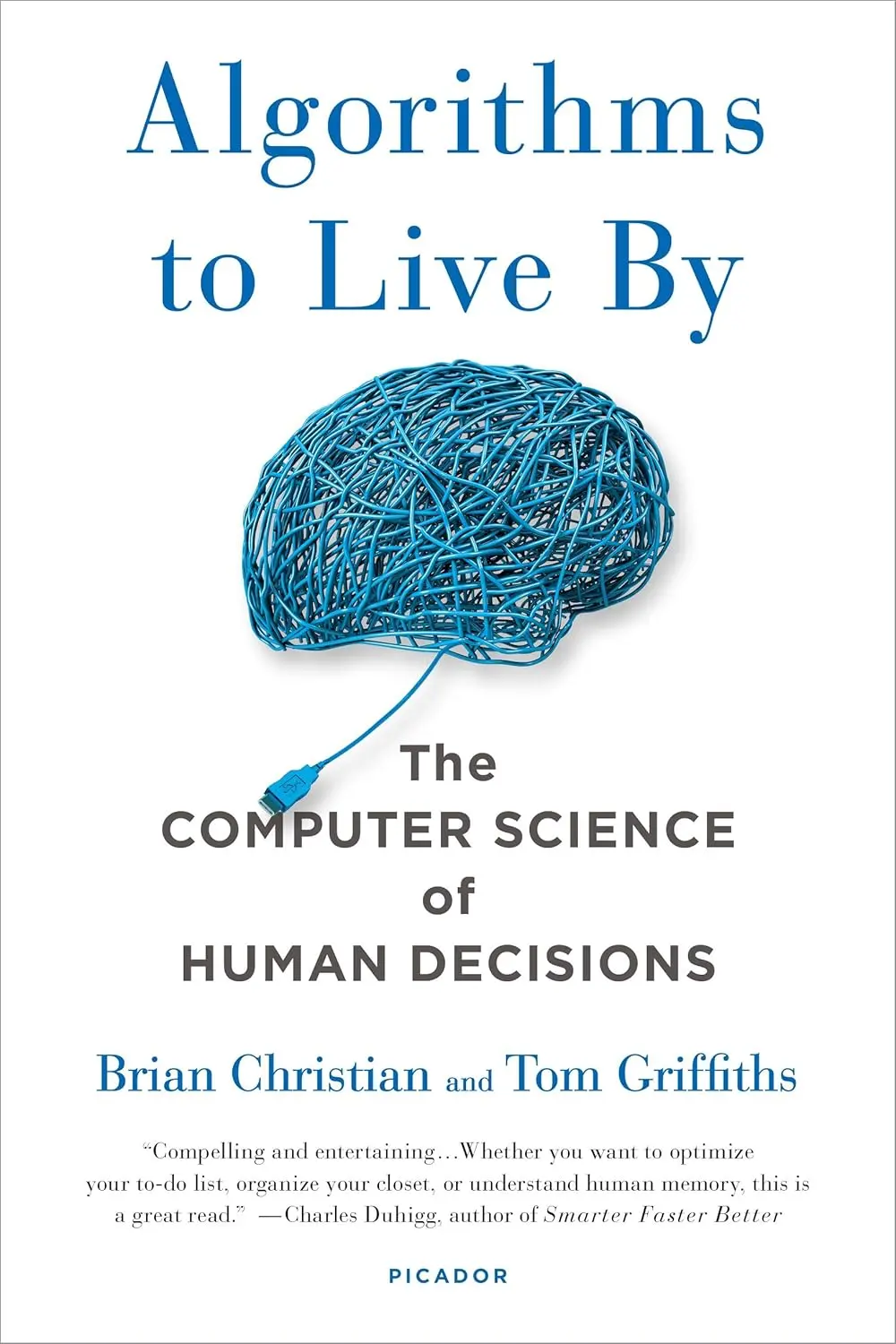
The book’s premise is that many everyday decisions have formal equivalents in computer science, and that the solutions computer scientists have developed can help humans make better choices.
The optimal stopping chapter covers the “secretary problem” (also called the 37% rule): when evaluating options sequentially (apartments, job candidates, romantic partners), the best strategy is to spend the first 37% of your time exploring without committing, then commit to the first option that is better than everything you have seen. This is mathematically optimal, and it gives you a concrete answer to the question “when do I stop looking?”
Other chapters cover sorting (should you organize everything or just search when you need something?), caching (why it makes sense to keep frequently used items close and rarely used items far away, in both computers and kitchens), scheduling (when to prioritize the shortest tasks first and when to prioritize the most important ones), and the explore/exploit trade-off (how much time should you spend trying new things versus doing what you already know works?).
Christian and Griffiths write well and explain the computer science concepts without requiring a technical background. The analogies between algorithms and human decisions are illuminating rather than forced. Each chapter addresses a genuine decision-making challenge and offers a quantitative framework for thinking about it.
For founders, the explore/exploit chapter is probably the most directly useful. Early in a company’s life, you should explore: try different markets, messaging, and features. As you learn what works, you should exploit: focus on what produces results and cut the experimentation. The math behind this trade-off clarifies a decision that most founders make by instinct.
At about 370 pages, the book is well-paced. It won several “best of” lists when published in 2016 and remains one of the most creative applications of technical thinking to everyday life.
