
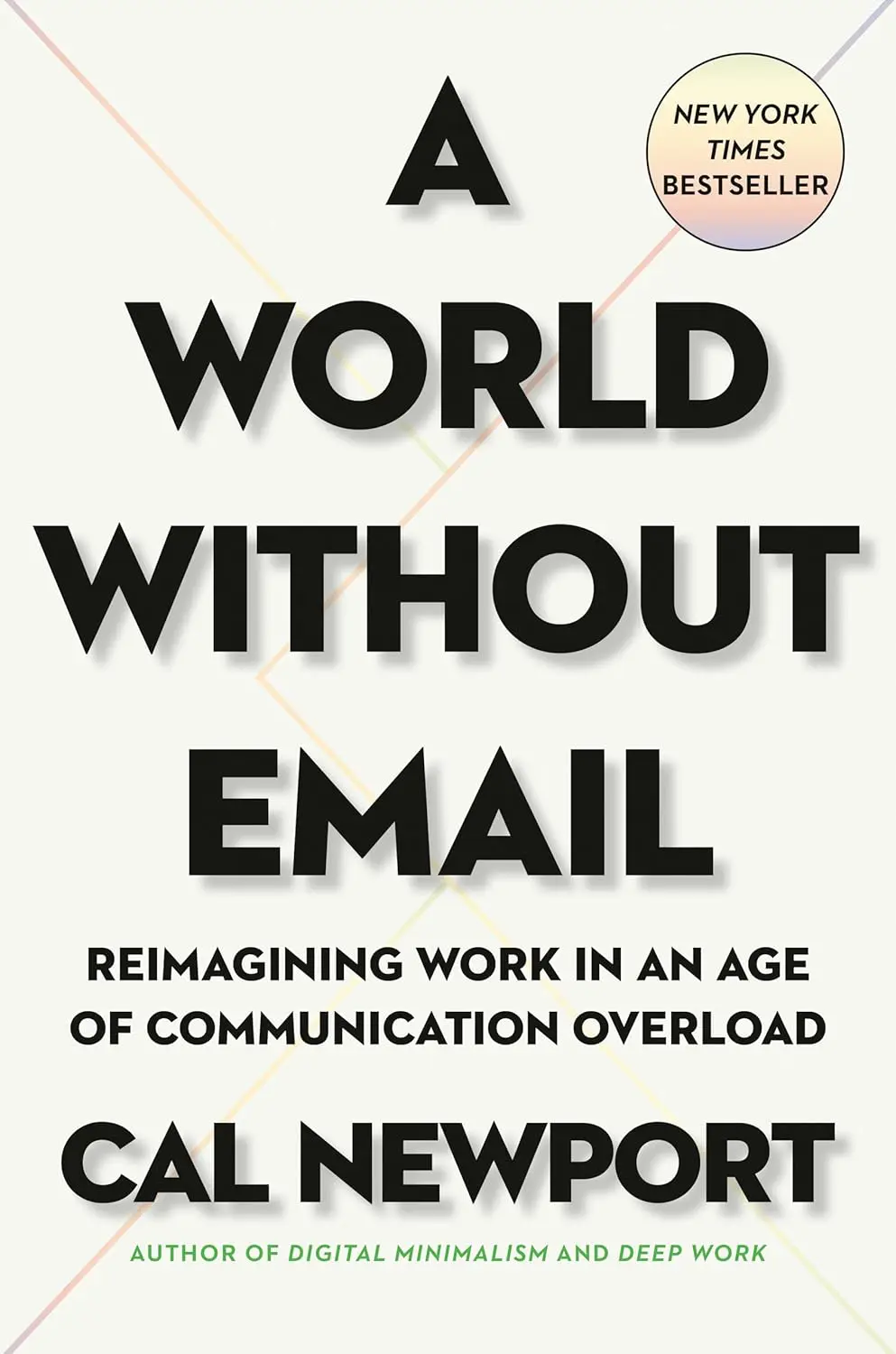
A World Without Email is Cal Newport’s attempt to diagnose why knowledge workers spend so much of their day on email and Slack, and to propose a different way of organizing work. His core argument is that the problem isn’t technology but workflow. Most organizations default to what he calls the “hyperactive hive mind,” a workflow where tasks are coordinated through unstructured, real-time messaging. This approach is easy to adopt but terrible for productivity, because it requires constant inbox monitoring that fragments attention all day long.
Newport traces the history of how email took over the workplace, not because anyone decided it was the best way to work, but because it was the easiest tool to adopt and nobody thought about the systemic effects. He cites research showing that the average knowledge worker checks email every six minutes and that the cognitive cost of this constant context-switching is enormous.
The second half proposes alternatives. Newport advocates for what he calls “protocols” and “processes”: structured systems for coordinating work that reduce the need for constant messaging. Examples include shared task boards (like Trello or Kanban systems), office hours for questions that don’t need immediate answers, scheduled check-ins instead of ad-hoc threads, and clear ownership rules so people know who is responsible for what without having to ask.
For founders building teams, the book is directly relevant. The earlier you establish structured communication norms, the less likely your team is to drift into the hyperactive hive mind pattern. Newport’s advice on separating execution from communication, meaning people should have long blocks of uninterrupted time to do actual work, is especially important for companies where the product depends on deep thinking.
The book is more academic in tone than Newport’s other work, and some readers find it slower-paced. But the underlying analysis is solid, and the practical recommendations are specific enough to implement. If your team spends more time in Slack than doing their actual jobs, this book explains why and what to do about it.
