
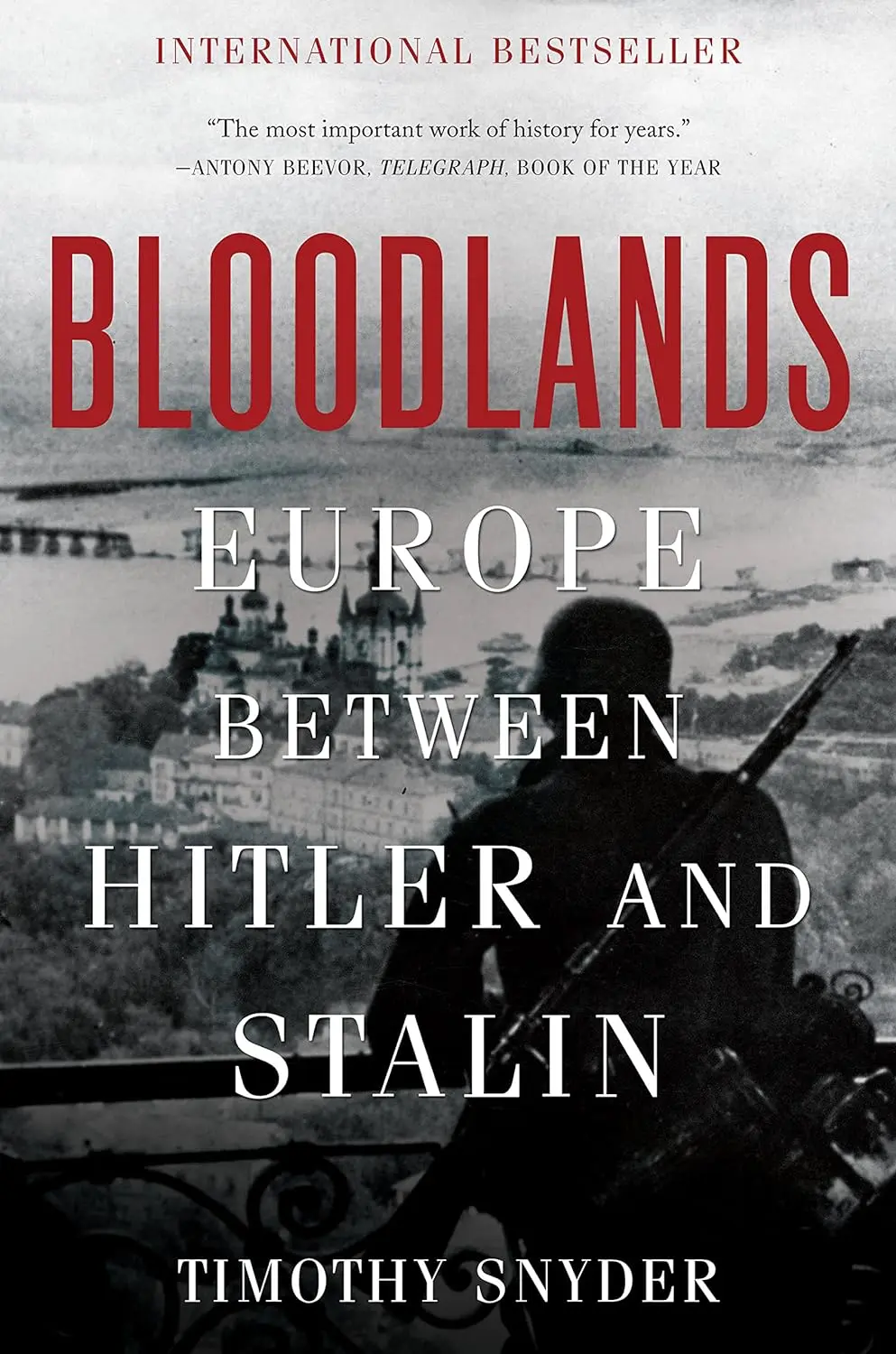
Timothy Snyder is a professor of history at Yale who reads and speaks multiple Eastern European languages, a qualification that matters because most of the events in this book took place in countries whose archives were inaccessible to Western scholars for decades. Bloodlands covers the period from 1933 to 1945 and focuses on a specific geography: Poland, Ukraine, Belarus, the Baltic states, and the western edge of Russia. This is the territory where Hitler’s and Stalin’s regimes overlapped, and where the majority of their civilian victims died.
Snyder’s argument is that the standard way people understand these atrocities, as separate events caused by separate regimes, misses the central reality. The Soviet engineered famine in Ukraine in 1932-33, which killed roughly 3.3 million people, happened in the same region where the Nazis would later shoot over a million Jews in open-air massacres. Stalin’s Great Terror of 1937-38, which killed approximately 700,000 people in the Soviet Union alone, preceded and in some ways set the stage for Nazi mass killing in occupied Eastern Europe. The two regimes fed off each other. When Germany invaded the Soviet Union in 1941, the Nazis used the infrastructure of Soviet repression, including camps, lists, and informants, to identify and kill Jews, Romani people, and political targets.
The book insists on counting the dead as individuals, not statistics. Snyder opens with the Ukrainian famine and describes what starvation actually looks like in a community: parents abandoning children, neighbors stealing corpses for food, villages going silent. He moves through Stalin’s execution quotas, the Nazi-Soviet joint destruction of Poland, the deliberate starvation of Soviet prisoners of war by the Wehrmacht, and the Holocaust as it unfolded in the east, largely through mass shootings rather than gas chambers.
Snyder’s point is not to equate the two regimes morally, though critics have accused him of doing so. His point is that you cannot understand either regime’s crimes without understanding the other’s. The interaction between Nazism and Stalinism produced a level of violence that neither system would have generated on its own. Poland, caught between both, lost a higher percentage of its population than any other country in the war.
The book is dense and demanding, but Snyder writes clearly. He avoids academic jargon and keeps the narrative grounded in specific people and places. It won the Hannah Arendt Prize for Political Thought and was named a book of the year by multiple publications.
For readers interested in how political systems produce atrocities, how propaganda enables mass violence, and what happens to populations trapped between competing totalitarian powers, Bloodlands is an essential and difficult read. Understanding how ideologies justify mass death is as relevant now as it was in 1945.
