
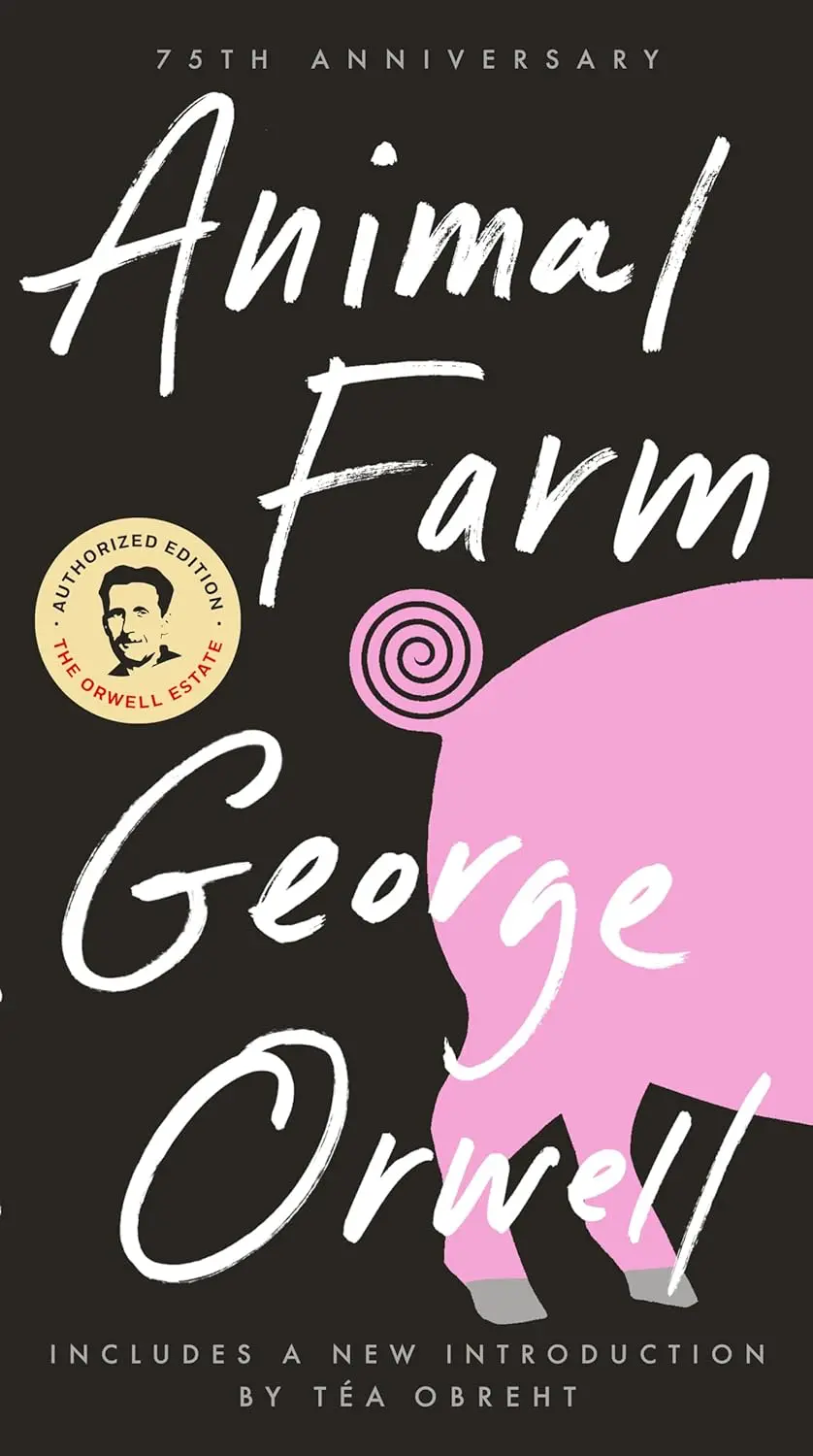
George Orwell finished Animal Farm in 1944, during the height of the Allied partnership with the Soviet Union. The timing made it nearly unpublishable. Several London publishers rejected it because Britain was allied with Stalin and nobody wanted to print an anti-Soviet satire. It finally came out in August 1945, just as the war ended, and became a bestseller almost immediately.
The plot is deceptively simple. The animals on Manor Farm, led by two pigs named Napoleon and Snowball, revolt against their drunken, neglectful owner Mr. Jones. They establish their own self-governing society based on a set of commandments, the most important being “All animals are equal.” Within months, the pigs begin consolidating power. Snowball is driven off the farm. Napoleon installs himself as leader. The commandments get quietly rewritten. The other animals work harder than they ever did under Jones, but the food rations shrink. By the end, the pigs are walking on two legs, wearing clothes, and drinking whiskey with the neighboring farmers. The final commandment reads: “All animals are equal, but some animals are more equal than others.”
Orwell was not writing about animals. He was writing about the Russian Revolution and its aftermath. Old Major, the elderly boar who inspires the revolution, maps onto Marx and Lenin. Napoleon is Stalin. Snowball is Trotsky. Boxer the workhorse, who keeps saying “I will work harder” until the pigs sell him to a glue factory, represents the working class that powers every revolution and gets betrayed by every one.
But the book outlasted the specific historical moment it was written about, and that is what makes it worth reading seventy-plus years later. The mechanics Orwell describes, the gradual rewriting of history, the leader who claims every success and blames every failure on an invisible enemy, the slow normalization of things that would have been unthinkable a year earlier, show up in organizations, political movements, and companies. The allegory is about the Soviet Union, but the pattern is universal.
The writing is deliberately plain. Orwell wanted the book to be understood by anyone, and he stripped out every unnecessary word. There is no showing off. The sentences are short, the vocabulary is basic, and the effect is devastating precisely because Orwell trusts the story to do the work without rhetorical decoration.
Animal Farm is taught in schools everywhere, but it reads differently when you have actually watched an organization go sideways. Founders who have seen a company’s culture rot from the top, or watched a promising team descend into politics and self-dealing, will recognize every stage of the farm’s decline.
