
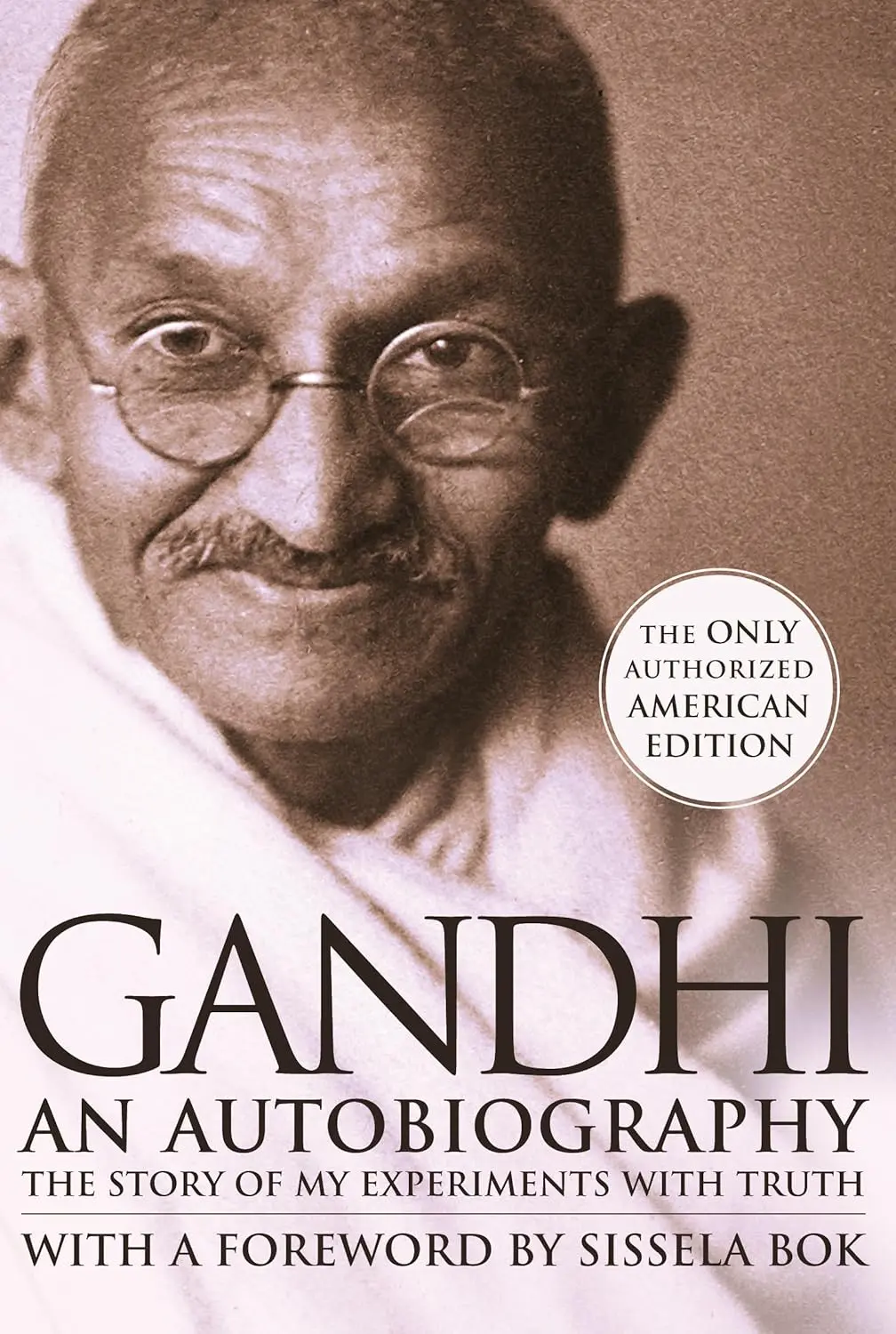
Gandhi wrote this autobiography in weekly installments for his Gujarati-language journal Navajivan between 1925 and 1929. He was in his mid-fifties, already the most prominent leader of Indian independence, but the book barely touches on the political campaigns he is known for. Instead, it traces the inner development that made those campaigns possible.
The autobiography begins with Gandhi’s childhood in Porbandar, his early marriage at thirteen, and his departure for London to study law. The London chapters describe a shy vegetarian teenager trying to navigate English society, joining the Vegetarian Society, and reading the Bhagavad Gita for the first time in English. The South Africa chapters, which cover his twenty-one years there, describe the racial humiliation that radicalized him (being thrown off a train for sitting in first class, despite holding a valid ticket) and his gradual development of satyagraha, the principle of nonviolent resistance.
What makes the book unusual is its relentless honesty about failure. Gandhi writes about his sexual desires as a teenager, his shame at eating meat secretly, his inability to control his temper, and the difficulty of living up to the principles he publicly advocated. He describes experiments with diet (fruitarianism, raw food, fasting) that sometimes harmed his health. He describes his celibacy vow and the struggle to maintain it. He treats his entire life as a series of experiments, tested against the standard of truth, with the results reported honestly whether they succeeded or failed.
The writing is plain and unadorned. Gandhi was not trying to produce literature. He was trying to show that the practices he advocated, nonviolence, truthfulness, simplicity, self-discipline, were not abstractions but daily disciplines that required constant effort and tolerated no shortcuts. The book’s power comes from this specificity. Gandhi does not describe principles in the abstract. He describes what happened when he tried to live them.
Tim Cook has recommended the book. For anyone interested in principled leadership, the autobiography offers a model that is almost the opposite of the “move fast and break things” ethos. Gandhi moved slowly, broke nothing, and changed the world by stubbornly refusing to act in ways that contradicted what he believed.
