
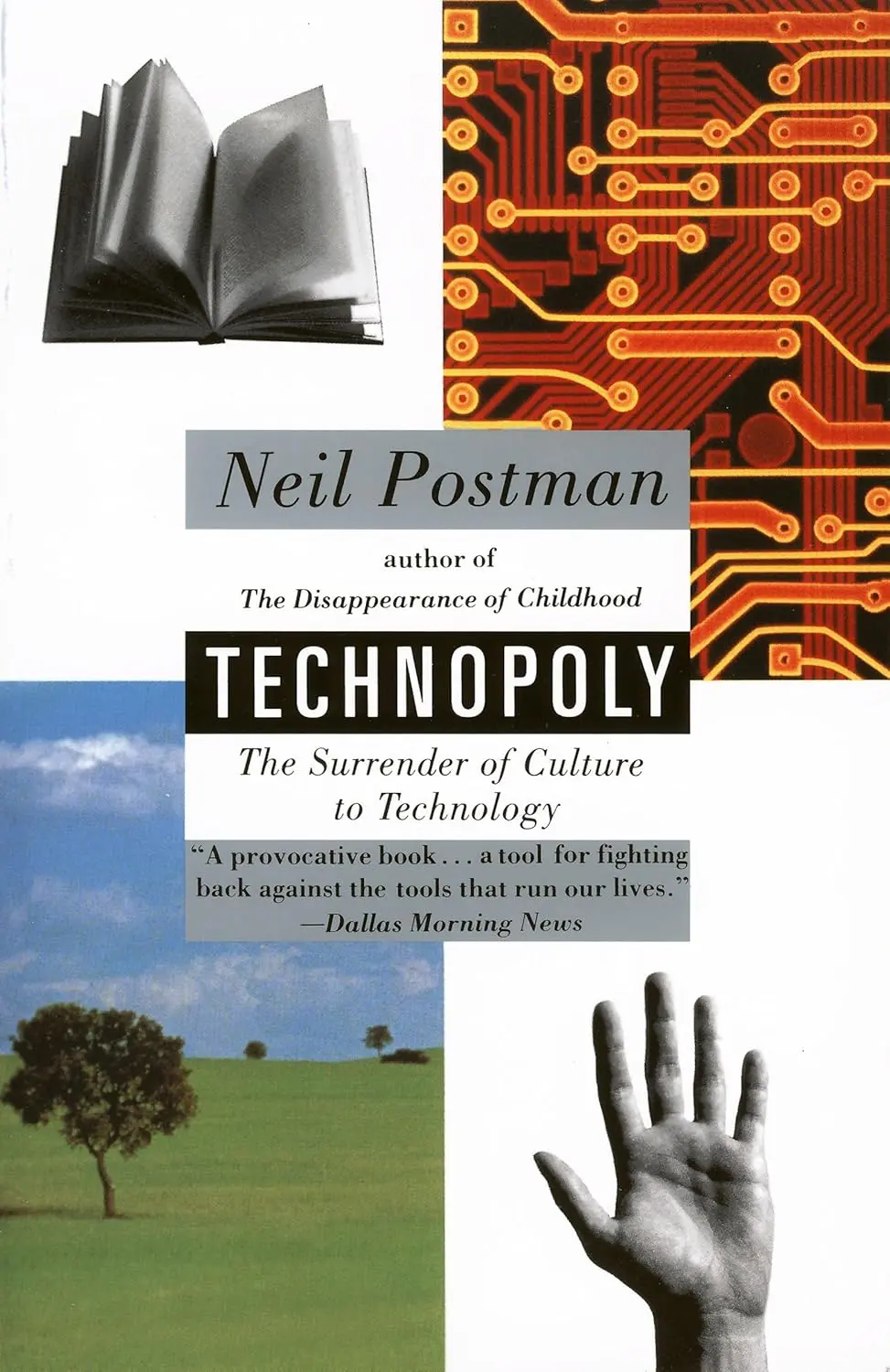
Neil Postman published Technopoly in 1992, before the commercial internet, before smartphones, before social media. The fact that his arguments feel more relevant now than they did then says something about the quality of his thinking.
Postman identifies three stages in the relationship between culture and technology. In tool-using cultures, technology serves human purposes without fundamentally altering the culture’s values or institutions. In technocracies, technology begins to reshape social life but still operates within a framework of older traditions and beliefs. In a technopoly, technology becomes the culture’s operating system. Every institution, from education to medicine to politics, reorganizes itself around technological imperatives. Questions of meaning, purpose, and value get replaced by questions of efficiency and measurability.
Postman argues that America had become a technopoly by the time he was writing. He traces this through education (where standardized testing replaced judgment about what education is for), medicine (where diagnostic machinery displaced the doctor-patient relationship), and public discourse (where information overload destroyed the ability to distinguish between what matters and what doesn’t).
The chapter on information is the most prescient. Postman writes that the problem of the modern age is not too little information but too much, and that without cultural mechanisms for filtering, sorting, and assigning meaning to information, the result is not better-informed citizens but confused ones. He coined the concept of “information glut” and argued that technology companies were flooding the world with data without providing the tools for making sense of it.
Postman was not anti-technology. He was anti-unconsciousness about technology. His point was that every technology comes with trade-offs, and that societies that adopt new technologies without asking what they will gain and what they will lose are not making a choice. They are being made by one.
Tristan Harris has cited Postman’s work as foundational to his thinking about technology ethics. For anyone building technology products, Technopoly raises questions that most product teams never ask: not “can we build this?” but “should we?” and “what will be lost if we do?” The book is short, clearly written, and more unsettling now than when it was published.
