
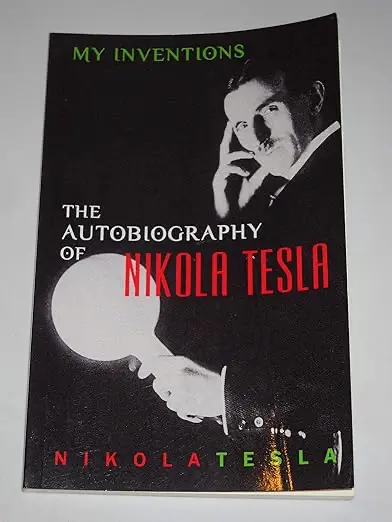
Nikola Tesla wrote these autobiographical articles for Electrical Experimenter magazine in 1919, when he was 63 and largely broke. The man who had invented the alternating current motor, built the first hydroelectric power plant at Niagara Falls, and held hundreds of patents was living in a New York hotel, feeding pigeons, and watching other people profit from ideas he had originated.
The autobiography covers Tesla’s early life in Smiljan, Croatia (then part of the Austro-Hungarian Empire). He describes a childhood marked by intense sensory experiences and what sounds, by modern standards, like an extraordinary capacity for visualization. Tesla could build and test machines entirely in his mind, rotating them, modifying them, and running them for weeks to check for wear, all before drawing a single blueprint. He claimed that his mental models were so detailed that they were indistinguishable from physical objects.
The chapters on the alternating current motor describe the moment of insight that Tesla considered the most important of his life. While walking in a park in Budapest in 1882, reciting Goethe’s Faust, the design for a rotating magnetic field appeared fully formed in his mind. He drew it in the dirt with a stick. That visualization became the basis for the AC induction motor, which remains the standard for electrical power transmission worldwide.
Tesla’s writing reveals a mind that operated very differently from most inventors. He did not tinker. He did not build prototypes to test ideas. He designed complete systems mentally and then built them, expecting them to work on the first attempt. This approach produced extraordinary results (the AC motor, the Tesla coil, early radio technology, remote control) and also extraordinary failures, including his Wardenclyffe Tower project for wireless power transmission, which consumed years and enormous funding before being abandoned.
The autobiography is short, covering Tesla’s life only through his early career. It says almost nothing about his famous rivalry with Thomas Edison or about the “War of Currents” between AC and DC power. What it provides instead is a firsthand account of how a singular inventor thought, which makes it valuable as a document of creative process rather than as a comprehensive biography.
Larry Page, co-founder of Google, has cited Tesla as an inspiration. The autobiography, compiled from the original 1919 magazine articles, has been continuously republished in various editions. At roughly 100 pages, it can be read in an afternoon, and the descriptions of Tesla’s visualization practice alone make it worth the time for anyone interested in how breakthrough ideas actually form.
