
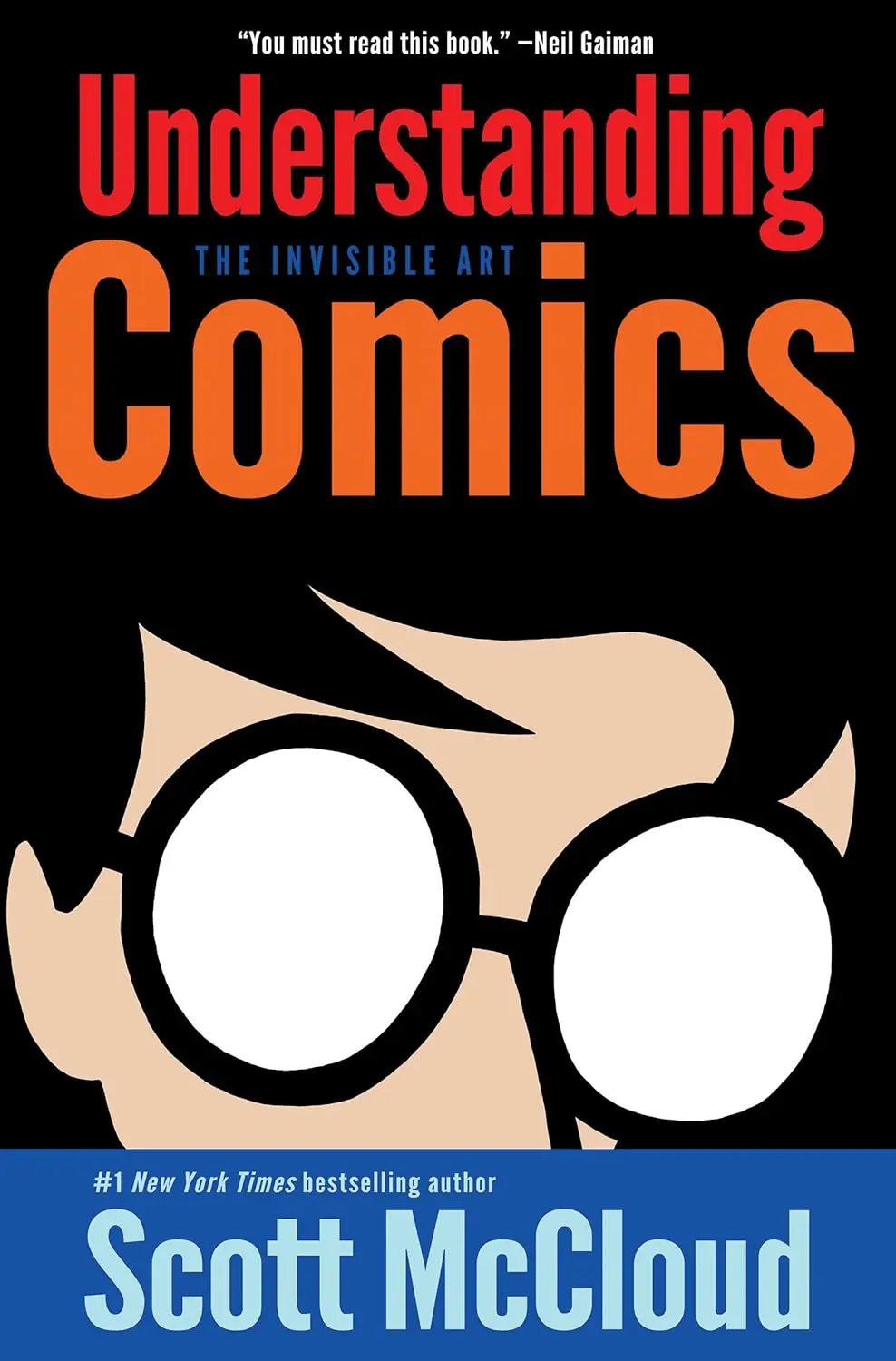
A cartoon version of Scott McCloud walks the reader through a 215-page argument about what comics are, how they work, and why they matter. The argument is delivered entirely in comic form. Every page is drawn. Every concept is illustrated with the technique being discussed. It is a book about comics that is itself a comic, and this is not a gimmick. It is the point.
McCloud starts with definition. What is a comic? Not superhero stories. Not newspaper strips. Those are genres, not the medium itself. McCloud defines comics as “juxtaposed pictorial and other images in deliberate sequence,” which is broad enough to include Egyptian hieroglyphics, the Bayeux embroidery, and Japanese manga alongside Spider-Man. The definition matters because it frees the discussion from genre assumptions and lets McCloud analyze the medium on its own terms.
The strongest sections cover closure, the mental process by which a reader fills in the gap between two panels. McCloud shows that the space between panels is where the reader’s imagination does most of the work. A panel showing a man swinging an axe, followed by a panel showing a scream, creates a murder without depicting one. The reader’s mind supplies the violence. McCloud categorizes six types of panel transitions and shows how different comics traditions use them differently. American comics favor action-to-action transitions. Japanese manga uses more aspect-to-aspect transitions, creating mood rather than advancing plot.
The sections on visual iconography explain why cartoon characters are often more relatable than realistic ones. A simple circle with two dots for eyes can represent anyone. A photorealistic face represents only itself. McCloud calls this amplification through simplification: the less specific a face is, the more people can project themselves into it.
The book was published in 1993 and has been assigned in art schools, design programs, communication courses, and film schools worldwide. It has influenced people who never intend to draw a comic, because its insights about visual storytelling, reader participation, and the relationship between words and images apply to any medium that combines them.
McCloud followed it with Reinventing Comics (2000), about the future of the medium, and Making Comics (2006), about craft. Understanding Comics remains the essential one, the book that changed how people think about visual communication by demonstrating it on every page.
