
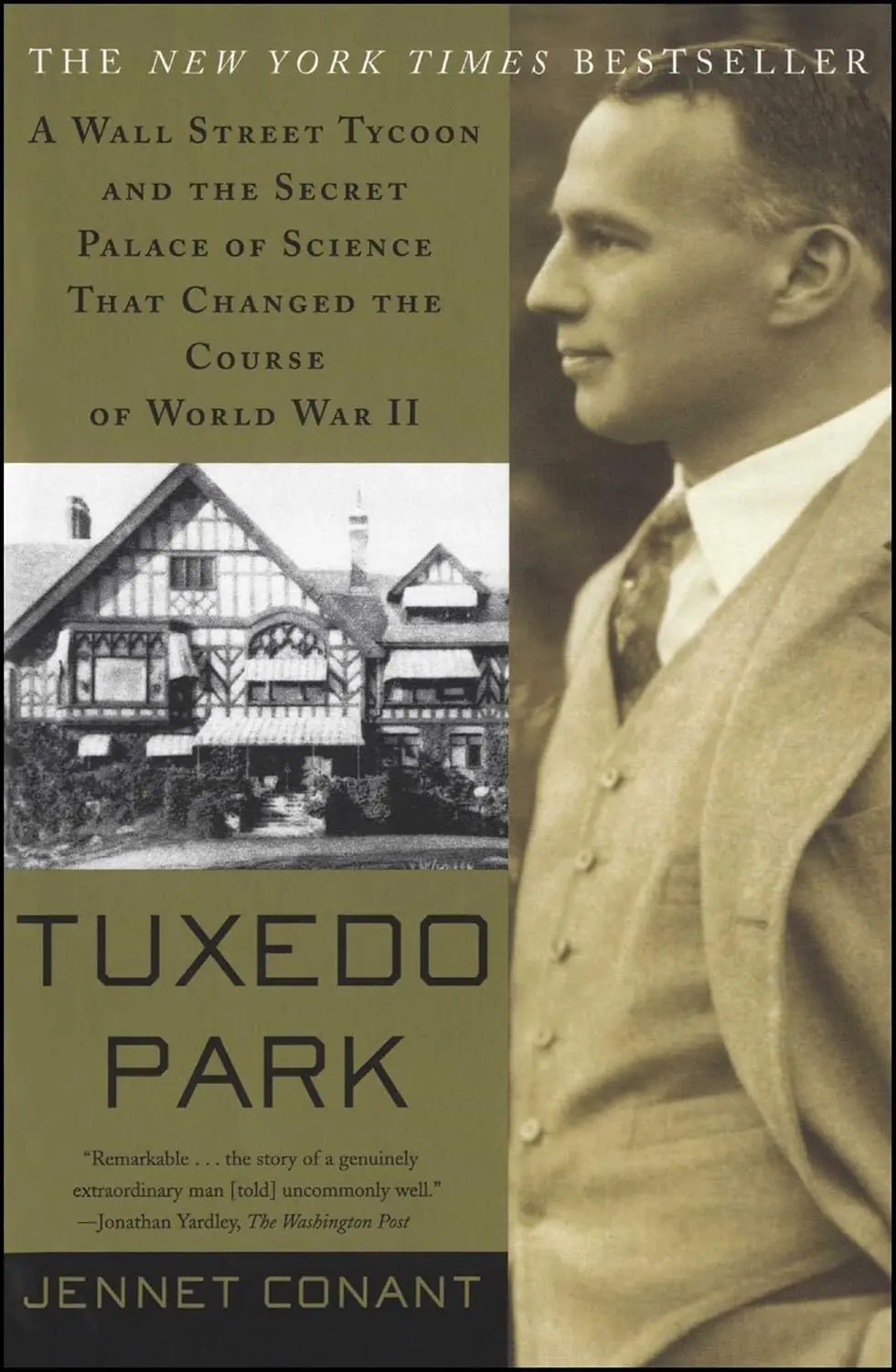
Alfred Lee Loomis made his fortune the hard way: he saw the 1929 crash coming, shorted the market, and walked away rich while everyone else was ruined. He could have spent the rest of his life playing golf. Instead, he built a laboratory in a mansion in Tuxedo Park, an exclusive enclave north of New York City, and began recruiting the best physicists in the world to work there.
Jennet Conant, who also wrote The Irregulars and 109 East Palace, reconstructs Loomis’s double life as a financier and an amateur scientist. Loomis was not trained as a physicist, but he had the money to hire people who were, and the intelligence to contribute meaningfully to their work. His lab at Tuxedo Park hosted Albert Einstein, Niels Bohr, Enrico Fermi, and other luminaries of twentieth-century physics. He treated them well: the mansion had a bowling alley, a swimming pool, and a full staff.
When World War II began, Loomis turned his attention and his connections to the military problem that mattered most: radar. The British had developed radar technology but did not have the industrial capacity to mass-produce it. Loomis, working through MIT’s Radiation Laboratory (which he helped establish and fund), organized the American effort to develop and manufacture microwave radar, which proved decisive in the Battle of the Atlantic and the Allied bombing campaigns.
Conant writes narrative history with a journalist’s pacing. The book moves between Wall Street deal rooms, Tuxedo Park dinner parties, MIT laboratories, and wartime Washington. Loomis is a fascinating subject precisely because he does not fit any standard category. He was not a professional scientist, a military officer, or a government official. He was a wealthy amateur who happened to be brilliant, connected, and motivated by curiosity rather than profit.
The story has an interesting coda. Loomis’s personal life, including an affair that ended his marriage and alienated his sons, gets honest treatment. Conant does not idealize him. She presents a portrait of a complicated man whose public contributions were extraordinary and whose private behavior was ordinary in its selfishness.
Tuxedo Park was published in 2002 and remains relatively unknown compared to other World War II histories. Loomis himself is largely forgotten, which is strange given that radar arguably contributed as much to the Allied victory as the atomic bomb. The book is a corrective to that forgetting.
