
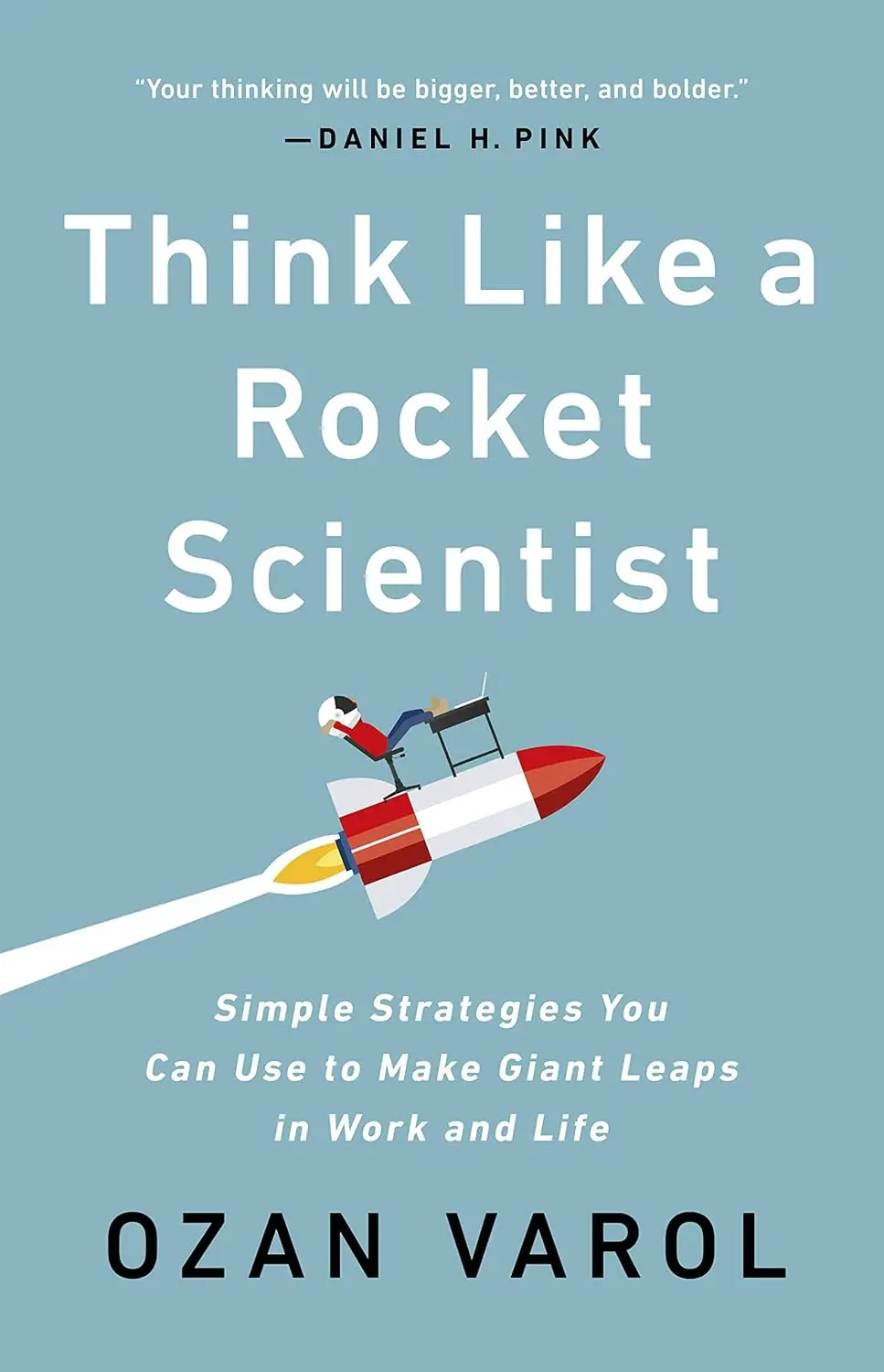
Ozan Varol was on the operations team for the 2003 Mars Exploration Rover mission. He helped put a robot on another planet. Then he went to law school, became a professor, and spent years thinking about what made the problem-solving approach at NASA different from the approach he saw everywhere else.
The difference, he concluded, was not intelligence. It was method. Rocket scientists think from first principles rather than by analogy. They question assumptions that everyone else takes as given. They design for failure rather than pretending failure will not happen. They use thought experiments to test ideas before committing resources. These are not personality traits. They are habits that can be learned.
The book is organized around three stages of thinking. Launch: the practices that generate new ideas and frame problems correctly. First principles thinking, which means breaking a problem down to its fundamental truths rather than reasoning from what has been done before. Thought experiments, which let you test hypotheses without building anything. Reframing, which means asking whether you are solving the right problem.
Accelerate: the practices that refine and test ideas. Killing your darlings, which means being willing to abandon an idea you love when the evidence says it is wrong. Testing to learn rather than testing to validate, which means designing experiments that can actually disprove your hypothesis. Balancing risk and uncertainty, which are different things.
Achieve: the practices that bring ideas to completion. Handling failure productively, which at NASA means conducting post-mortems on every mission, successful or not. Thinking about second-order effects, which means asking not just what will happen but what will happen because of what happens.
Varol writes clearly and uses examples from NASA, business, and daily life. He is good at making abstract thinking strategies concrete. The Mars Rover examples are the most distinctive content. Hearing how actual rocket scientists debugged problems on a spacecraft 35 million miles away, where every test takes twelve minutes to get a response because of the speed of light, makes the thinking methods feel earned rather than theoretical.
The book was published in 2020 and has been recommended by figures including Adam Grant and Daniel Pink. It sits in the growing category of books that extract problem-solving methods from specialized fields and apply them broadly. Whether you are designing a spacecraft or deciding how to hire your next employee, the underlying question is the same: are you thinking from first principles, or are you copying what someone else did?
