
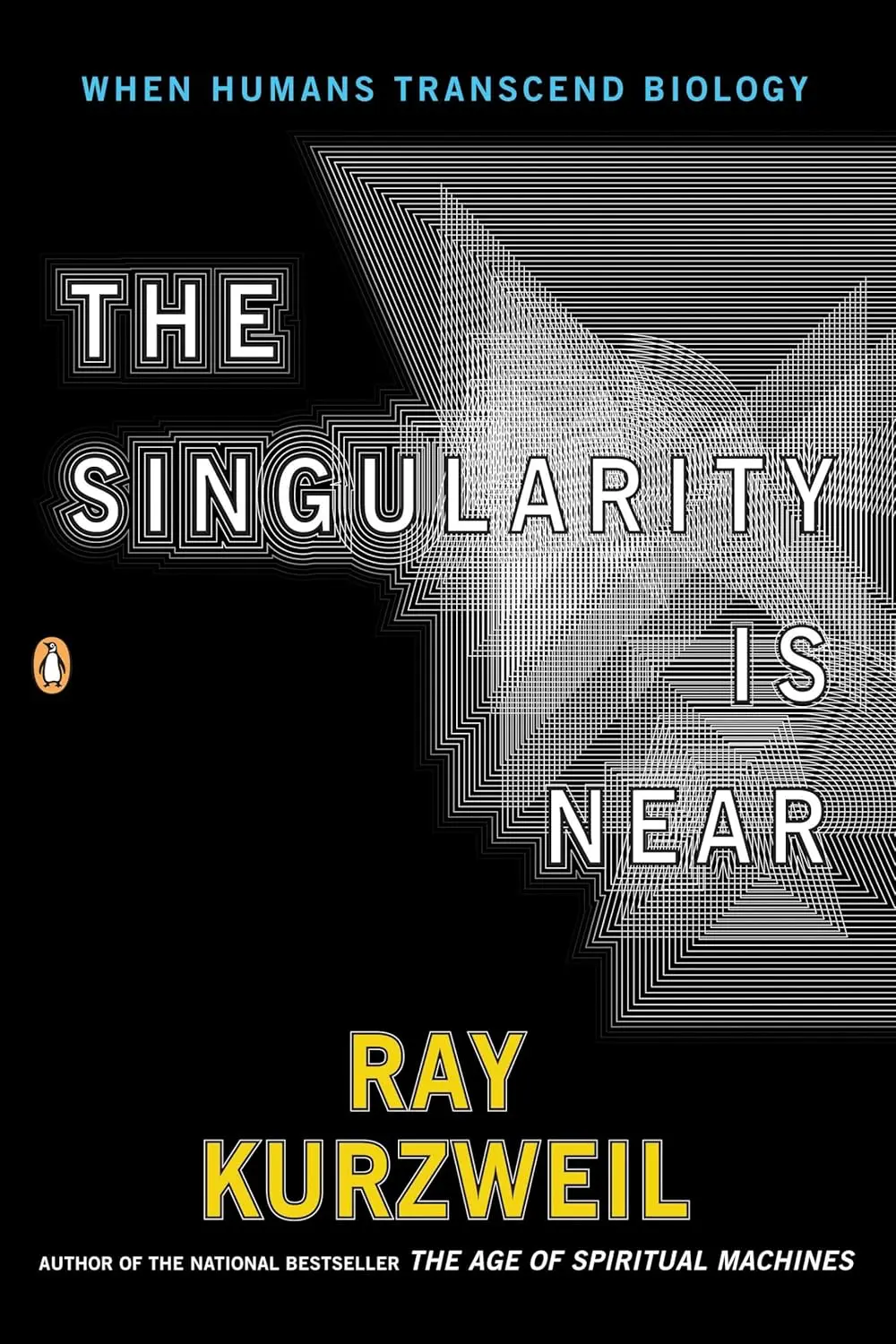
Ray Kurzweil has been predicting the future of technology since 1990, when he published The Age of Intelligent Machines. His track record is unusually good. He predicted the rise of the internet, the defeat of a chess champion by a computer, the proliferation of portable devices, and the timing of the human genome project. He was often wrong on details but right on trajectories, which is more than most futurists can claim.
The Singularity Is Near, published in 2005, is his most comprehensive and most ambitious prediction: that the exponential growth of computing power, combined with advances in genetics, nanotechnology, and robotics, will produce artificial superintelligence by roughly 2045. At that point, the rate of technological change will become so fast that human life will be irreversibly altered. Kurzweil calls this moment the Singularity.
The argument rests on what Kurzweil calls the law of accelerating returns. Technological progress is exponential, not linear. Computers get faster at a compounding rate. Genetic sequencing costs drop at a compounding rate. The number of internet-connected devices grows at a compounding rate. Because humans think linearly but technology grows exponentially, we consistently underestimate how much change is coming.
Kurzweil’s predictions for the period between 2005 and 2045 include: computers passing the Turing test (AI that is indistinguishable from a human in conversation), nanotechnology capable of manipulating matter at the molecular level, radical life extension through genetic engineering and nanobots in the bloodstream, and the merger of human and machine intelligence through brain-computer interfaces. Some of these now seem more plausible than they did in 2005. Others remain firmly speculative.
The book is long, dense, and filled with charts and data supporting the exponential growth thesis. Kurzweil is a thorough researcher and backs his claims with more empirical evidence than most futurists provide. He also addresses counterarguments systematically, which gives the book more intellectual weight than a typical futurist manifesto.
Critics have attacked both the timeline and the concept. Some argue that the Singularity assumes continued exponential growth in computing, which faces physical limits. Others argue that intelligence is not the kind of thing that can be measured on a single scale, and that surpassing human capability in specific tasks is different from achieving general superintelligence. Still others find the whole framework quasi-religious, replacing heaven with the Singularity and God with superintelligent AI.
Kurzweil joined Google in 2012 as a director of engineering. His subsequent book, The Singularity Is Nearer, was published in 2024. Whether or not the Singularity arrives on schedule, the exponential growth framework has proven useful for understanding technology trends, and the book remains the most detailed statement of the case.
