
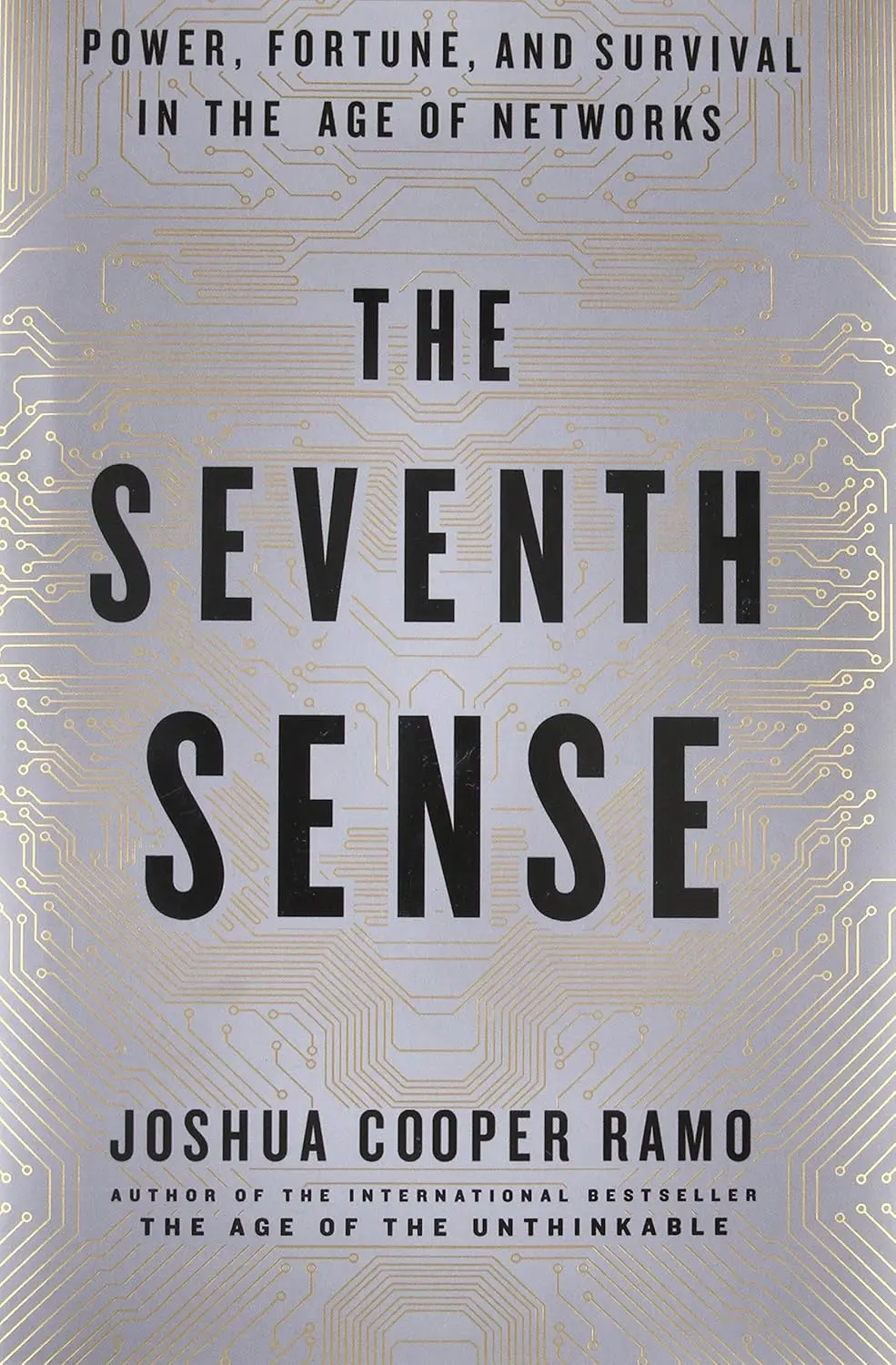
Joshua Cooper Ramo asks a question that sounds abstract but is not: can you see the network? Not just the internet. The networks of finance, information, biology, and power that connect everything to everything else and that produce effects no one predicted because nobody was looking at the connections.
Ramo’s argument is that a new kind of perception is needed for a networked world. He calls it the Seventh Sense, borrowing from the idea that some people develop an intuition for how networks behave: where power concentrates, where vulnerabilities appear, how contagion spreads, why some nodes matter more than others. This is not a technical skill. It is a way of seeing, and the people who have it, Ramo argues, will dominate the coming era the way that people with scientific literacy dominated the industrial era.
The book covers a wide range of applications. Financial networks and how the interconnectedness of global markets made the 2008 crisis inevitable. Cyberwarfare and how the same connectivity that enables commerce enables attack. Terrorism and how small networks can inflict damage disproportionate to their size. Artificial intelligence and how networked machine learning produces outcomes that no individual machine could achieve. In each case, Ramo argues that the network itself is the force that matters, not the individual nodes within it.
Ramo is a former journalist and a member of Starbucks’ board of directors who studied extensively with Henry Kissinger. His perspective blends geopolitics, technology, and business strategy. He writes in a style that is ambitious and occasionally grandiose, making large claims about historical transitions that invite skepticism. The comparison of our current moment to the Enlightenment or the Industrial Revolution is the kind of framing that either excites or annoys, depending on the reader.
The strongest sections are the specific examples: how network analysis was used to disrupt terrorist cells, how cyber attacks on critical infrastructure could cascade across interconnected systems, how the design of network protocols determines who has power in the digital economy. These concrete cases make the abstract framework useful.
The weakest sections are the prescriptive ones. Ramo suggests that leaders need to become “gatekeepers” who control access to networks, but the specifics of how to do this remain vague. The book is better at describing the world it sees than at telling you what to do about it.
The Seventh Sense was published in 2016. Some of its predictions about network-driven disruption, particularly around cyberattacks and AI, have played out. The book sits in the same territory as books by Niall Ferguson and Parag Khanna, combining big-picture historical analysis with a Silicon Valley sensibility about technology’s role in reshaping power.
