
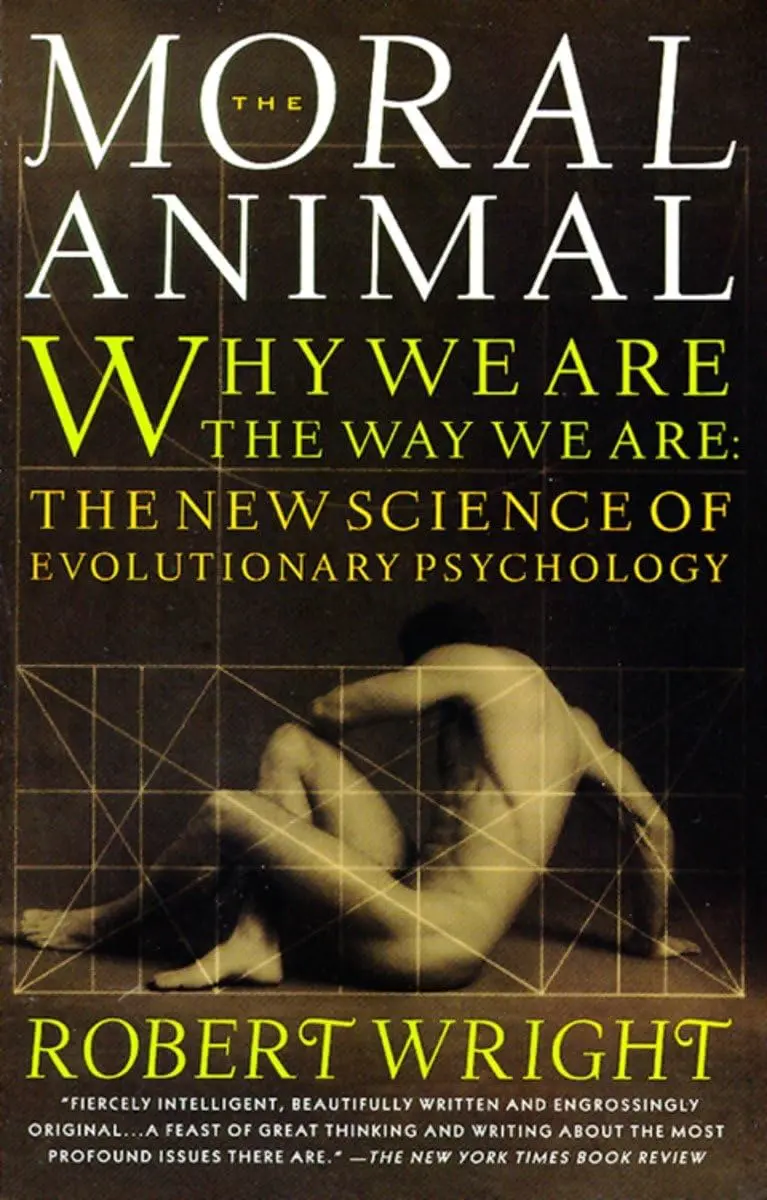
Charles Darwin married his cousin Emma Wedgwood, fathered ten children, suffered from chronic illness, and spent decades agonizing over whether to publish his theory of natural selection. Robert Wright uses Darwin’s personal life as a running illustration for the very theory Darwin proposed: that human behavior, like human anatomy, was shaped by millions of years of natural selection.
The Moral Animal was published in 1994, when evolutionary psychology was still a controversial and somewhat disreputable field. Wright, a journalist and author rather than a scientist, made the discipline accessible and intellectually serious for a general audience. The book covers sexual selection (why men and women have different mating strategies and what that means for jealousy, infidelity, and pair bonding), reciprocal altruism (why people cooperate and what triggers betrayal), status hierarchies (why humans are obsessed with rank), and self-deception (why the unconscious mind hides our real motivations from our conscious mind).
Wright builds each argument from first principles. Why are humans jealous? Because in the ancestral environment, a man who was not jealous risked investing resources in another man’s offspring, and a woman who was not jealous risked losing a partner’s resources to a rival. These pressures, operating over hundreds of thousands of years, shaped emotional circuits that still fire today even when the original context has disappeared. You feel jealousy in a world with paternity tests and divorce courts because your emotional hardware was designed for a world without them.
The Darwin biography provides the human texture. Wright traces how Darwin’s own marriage, his rivalries with other scientists, his anxieties about status and reputation, and his strategic delays in publishing all fit the patterns that evolutionary psychology would later describe. Darwin, the man who explained human nature, was himself a case study in human nature.
The book has been praised and criticized in roughly equal measure. Praise: Wright writes clearly, argues carefully, and treats the material with the seriousness it deserves. Criticism: evolutionary psychology can be used to justify existing social arrangements as “natural,” and Wright does not always guard against this sufficiently. The field has also become more methodologically rigorous since 1994, and some of the specific claims Wright presents as established have been challenged or refined.
Wright went on to write Nonzero and The Evolution of God, both of which extend the evolutionary framework into larger questions about cooperation and religion. The Moral Animal remains his most focused and probably his best book.
