
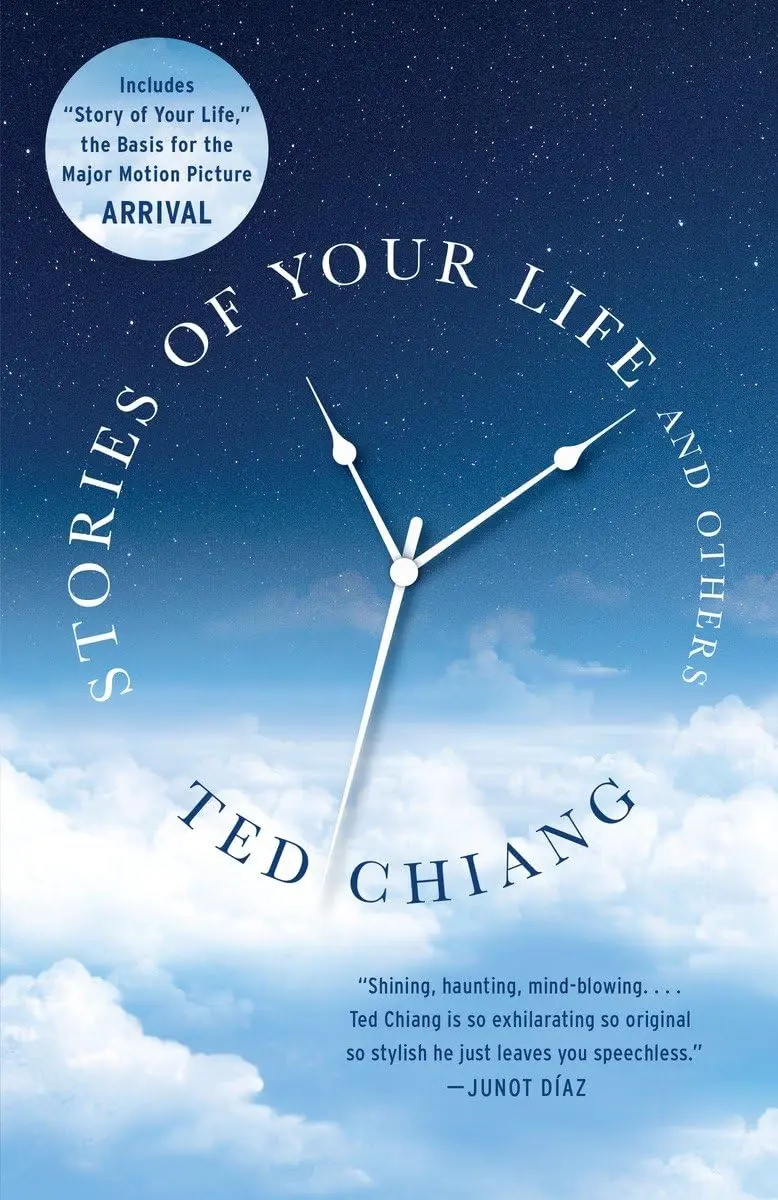
Ted Chiang publishes rarely. Between 1990 and 2002, when this collection came out, he had published eight stories. That is not a misprint. Eight stories in twelve years. Each one won or was nominated for major science fiction awards. The ratio of awards to output is staggering, and it makes sense once you read the work.
Each story takes a single speculative premise and follows it with complete intellectual honesty. “Tower of Babylon” imagines what happens when the builders of the biblical tower actually reach the vault of heaven. “Understand” follows a man whose intelligence is artificially amplified until he can see patterns invisible to everyone around him, and explores what happens to human connection when one person’s mind outpaces the species. “Division by Zero” examines what a mathematician does when she proves that mathematics is inconsistent, meaning the entire edifice of formal logic is built on nothing.
“Story of Your Life” is the collection’s centerpiece. A linguist is called in to communicate with aliens who have arrived on Earth. As she learns their language, she discovers that it encodes a different relationship to time: one in which the future is as accessible as the past. Learning the language changes how she experiences her own life. The story was adapted into Denis Villeneuve’s film Arrival in 2016, though the film, while excellent, cannot fully capture the story’s interior quality.
Chiang does not write like most science fiction authors. There are no space battles, no dystopias, no heroes. The stories are quiet, cerebral, and emotionally precise. A story about a device that eliminates the experience of beauty asks what beauty is for. A story about golems and the nature of naming asks whether language creates reality or describes it.
The prose is clean to the point of transparency. Chiang does not call attention to his sentences. He calls attention to his ideas, and the sentences exist to deliver them with minimum friction. This sounds cold, but the effect is the opposite. Because the writing never gets in the way, the emotional payload of the ideas hits directly.
Chiang later published a second collection, Exhalation, in 2019, which is equally strong. But Stories of Your Life and Others came first and contains the story that made him famous. If you read one collection of short fiction in your life, this is a reasonable choice.
