
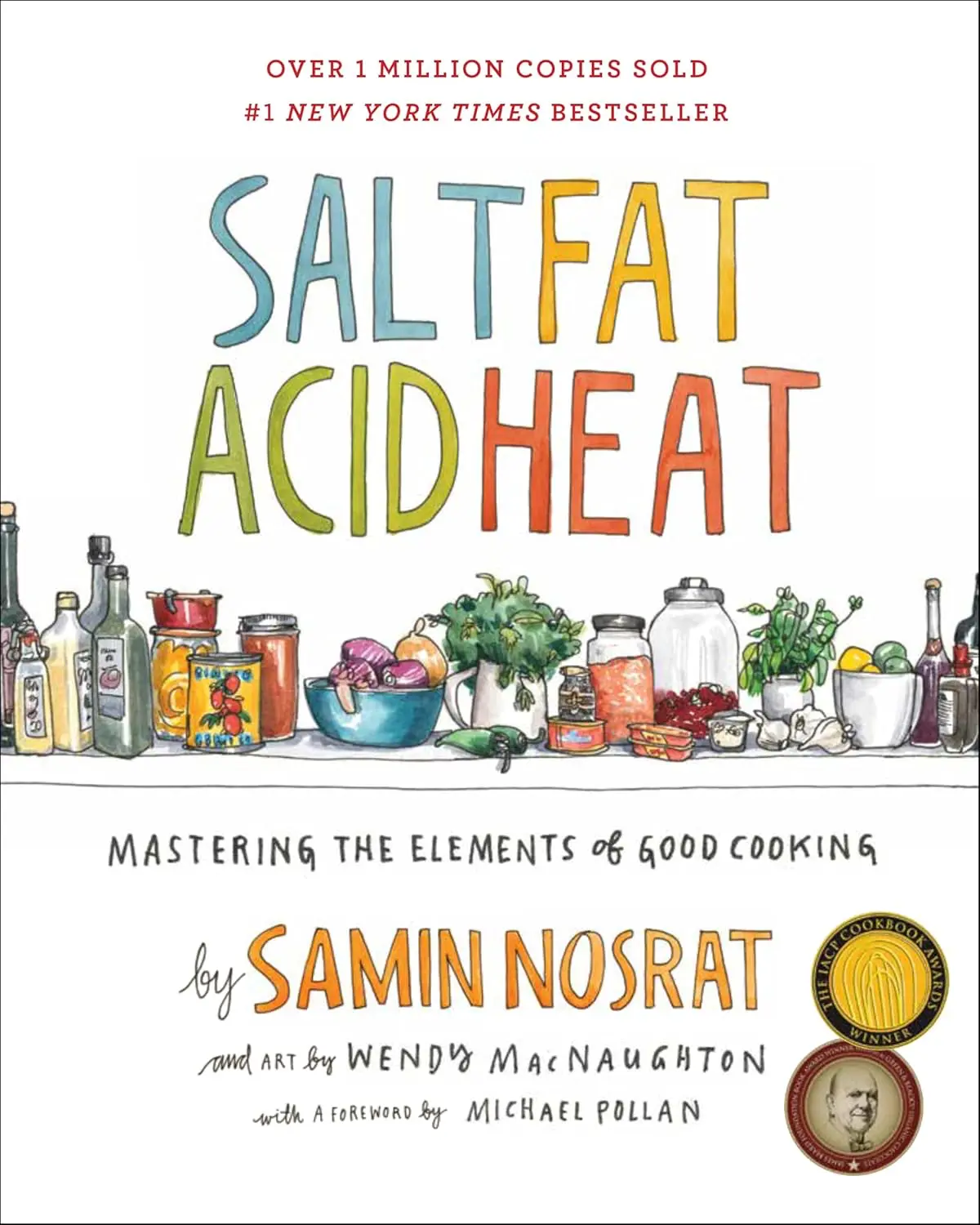
Most cookbooks are organized by dish: appetizers, mains, desserts. Samin Nosrat organized hers by principle. The book has four main sections, one for each element. Salt, which brings out flavor and affects texture. Fat, which carries flavor and creates richness. Acid, which provides brightness and balance. Heat, which transforms raw ingredients through methods ranging from gentle poaching to aggressive searing. Learn how these four elements work, and you can cook anything without a recipe.
Nosrat learned this framework at Chez Panisse, Alice Waters’s restaurant in Berkeley, where she started as a busser and worked her way up through the kitchen. The Chez Panisse approach emphasizes ingredients and technique over elaborate preparations, and Nosrat carries that philosophy through the book. She is less interested in teaching you to replicate a specific dish than in teaching you to understand what is happening when food cooks and what to do when it goes wrong.
The salt section explains why professional restaurant food tastes different from home cooking (restaurants use more salt, applied at the right moments). The fat section covers not just how much fat to use but which fats work best for which purposes: butter for flavor, olive oil for fruity richness, animal fats for depth. The acid section explains the role of vinegar, citrus, and fermented ingredients in waking up dishes that taste flat. The heat section covers the difference between dry heat and wet heat, why resting meat after cooking matters, and how to tell when something is done without using a thermometer.
The illustrations by Wendy MacNaughton are a significant part of the book. Infographics showing which acids pair with which cuisines. Charts mapping different fats by flavor and smoke point. Diagrams of heat transfer methods. The visual design makes the information scannable in a way that text alone would not.
The book won the James Beard Award for General Cooking in 2018. Netflix adapted it into a four-part series in which Nosrat travels to Italy, Japan, Mexico, and back to California, exploring each element in its cultural context. The series has a 100% rating on Rotten Tomatoes.
Nosrat writes with infectious warmth. She is encouraging without being patronizing, specific without being fussy, and genuinely funny in places where food writing rarely is. The book has been credited by many home cooks with changing their relationship to cooking, from following instructions to understanding what they are doing and why.
