
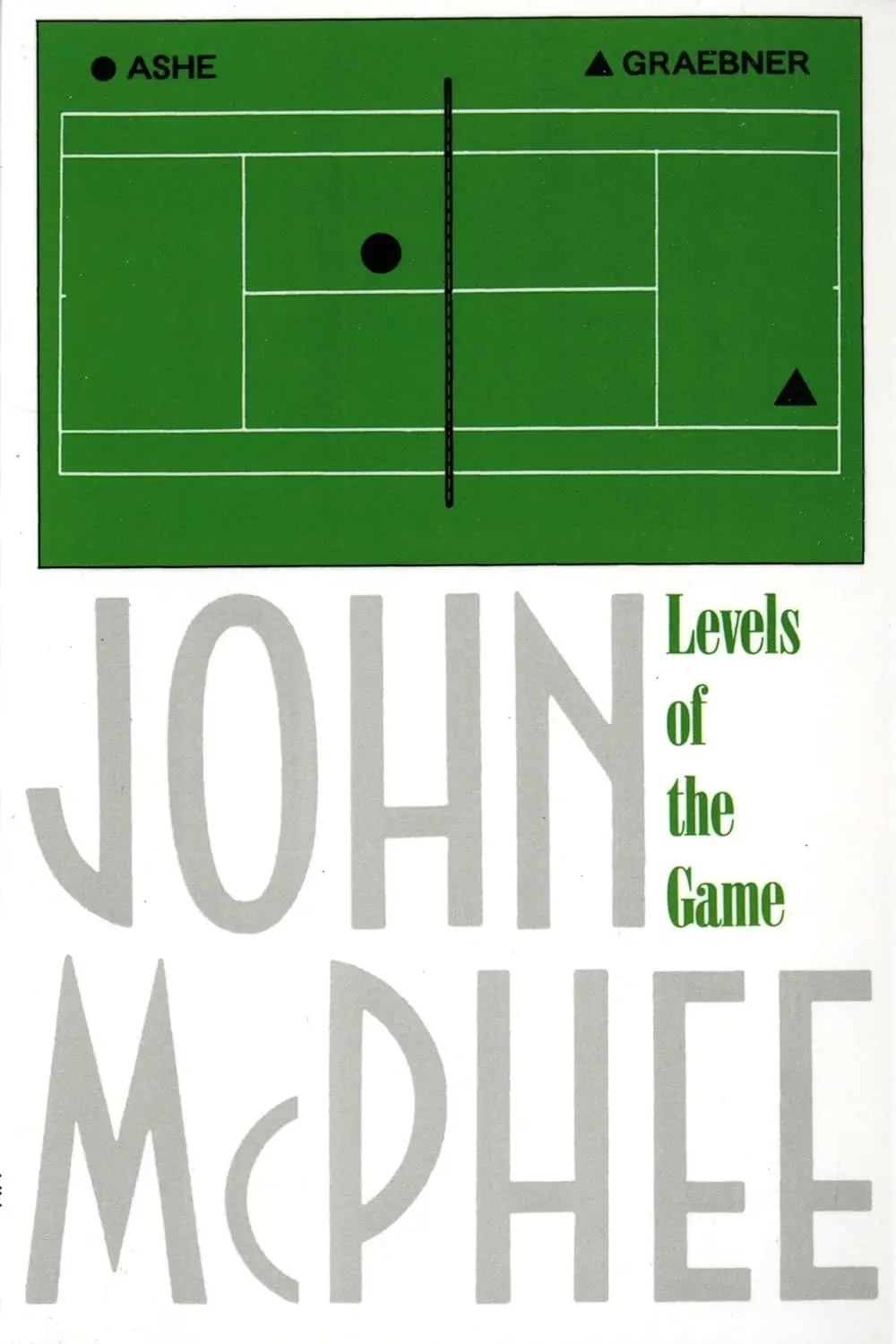
The match was a semifinal at the 1968 U.S. Open, the first Open in the tournament’s history. Arthur Ashe, a Black man from Richmond, Virginia, who learned tennis on segregated public courts, against Clark Graebner, a white country-club player from Cleveland with a big serve and a conventional game. Ashe won.
John McPhee, who was already established as one of the best nonfiction writers in America, saw something in this match that went beyond tennis. He spent time with both players, interviewed them extensively, and constructed a book that moves between the points of the match and the lives that produced the two men on the court.
The structure is the book’s genius. McPhee narrates each point of the match, describing the shots, the strategies, the momentum shifts. Between points, he cuts to biography. Ashe’s childhood in Jim Crow Virginia, where he was not allowed to play in the city tournament because of his race. Graebner’s upbringing in comfortable suburban Ohio, where tennis was a family activity and competition was expected. The biographical sections do not just explain how each man plays. They explain why.
Ashe plays with improvisation and risk. He takes chances on shots that seem reckless but are actually calculated. Graebner plays with power and discipline. He relies on his serve and his fitness and does not deviate from patterns that have worked before. McPhee links these styles to everything else about the two men: their politics, their temperaments, their relationships with authority, their experience of race in America.
The racial dimension is present throughout but never heavy-handed. McPhee does not editorialize. He presents. Ashe describes what it was like to compete in a sport where virtually everyone else was white, where the country clubs that hosted tournaments would admit him as a player but not as a member. Graebner, to his credit, is aware of the disparity and uncomfortable with it. Neither man is reduced to a symbol.
The book was published in 1969 and runs about 150 pages. McPhee’s prose is precise, unhurried, and beautiful in the way that only writers who have eliminated every unnecessary word can achieve. Levels of the Game has been praised by writers, athletes, and readers who do not care about tennis at all, because it is really a book about how two people become who they are and what happens when they meet.
