
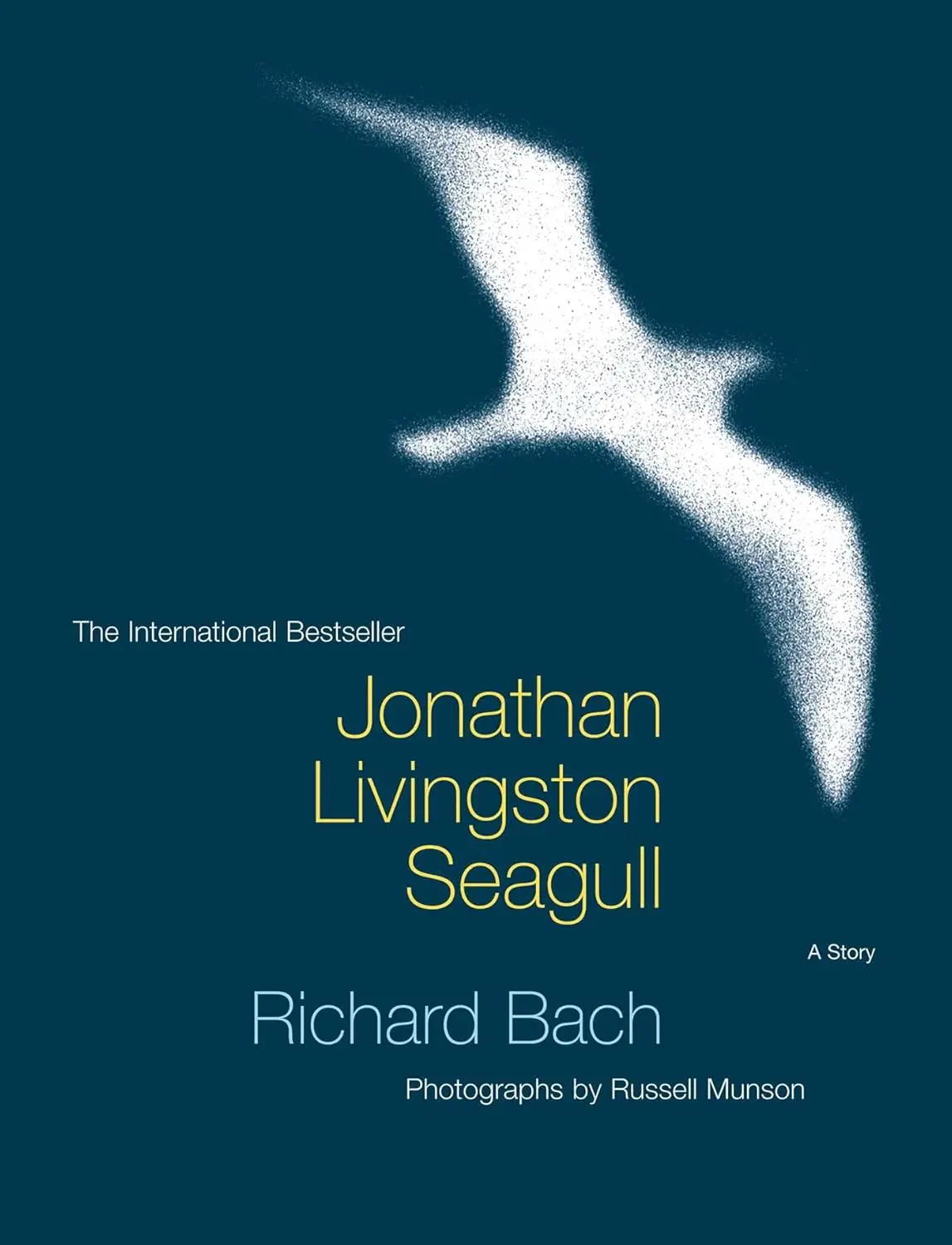
Jonathan Livingston Seagull is a seagull who does not want to fly for food. He wants to fly for the sake of flying. He practices dives, rolls, and speeds that no other gull attempts. His flock considers this deviant behavior and exiles him. He flies alone, gets better, and eventually reaches a higher plane of existence where other outcast gulls have been perfecting their flight for centuries.
That is the entire plot. The book is under 100 pages, and many of those pages are photographs of seagulls in flight by Russell Munson. The text is spare, almost skeletal. Sentences are short. Chapters are short. The whole thing reads like a parable that has been compressed until only the essential elements remain.
Richard Bach was a former Air Force pilot who wrote the book in the late 1960s. It was rejected by eighteen publishers before Macmillan finally accepted it in 1970. The initial print run was modest. Then it caught fire. By 1972 it was the bestselling book in America. It stayed on the New York Times bestseller list for 38 weeks. Total sales have exceeded 44 million copies worldwide.
The book arrived at the right cultural moment. The early 1970s were peak years for spiritual seeking in America. Jonathan’s rejection of the flock’s conformity and his pursuit of personal transcendence resonated with readers who were questioning institutions, traditions, and conventional expectations. The seagull became a symbol of individual freedom.
The writing style divides people sharply. Some readers find it beautiful in its simplicity. Others find it empty. The philosophical content is not deep. Jonathan learns to fly higher, to love his flock despite their rejection, and to teach others what he has learned. The message is essentially that you should pursue excellence, ignore the crowd, and keep practicing. These are not original ideas. But Bach delivers them with a conviction and economy that clearly connected with tens of millions of readers.
A fourth part, written decades later and included in some editions as “The Complete Edition,” extends the story past Jonathan’s transcendence. It is less well-regarded than the original three parts.
The book’s influence is hard to measure precisely because it is the kind of book people do not cite. They just absorb it. If you have ever heard someone talk about following their passion and ignoring the critics, there is a nonzero chance they read Jonathan Livingston Seagull at some point and forgot where the idea came from.
