
Every institution exists, in part, because organizing people is expensive. Companies exist because the cost of coordinating workers inside a firm is lower than coordinating them through the open market. Newspapers exist because gathering and distributing news required infrastructure that individuals could not afford. Political parties exist because mobilizing voters requires permanent organizations with staff and budgets.
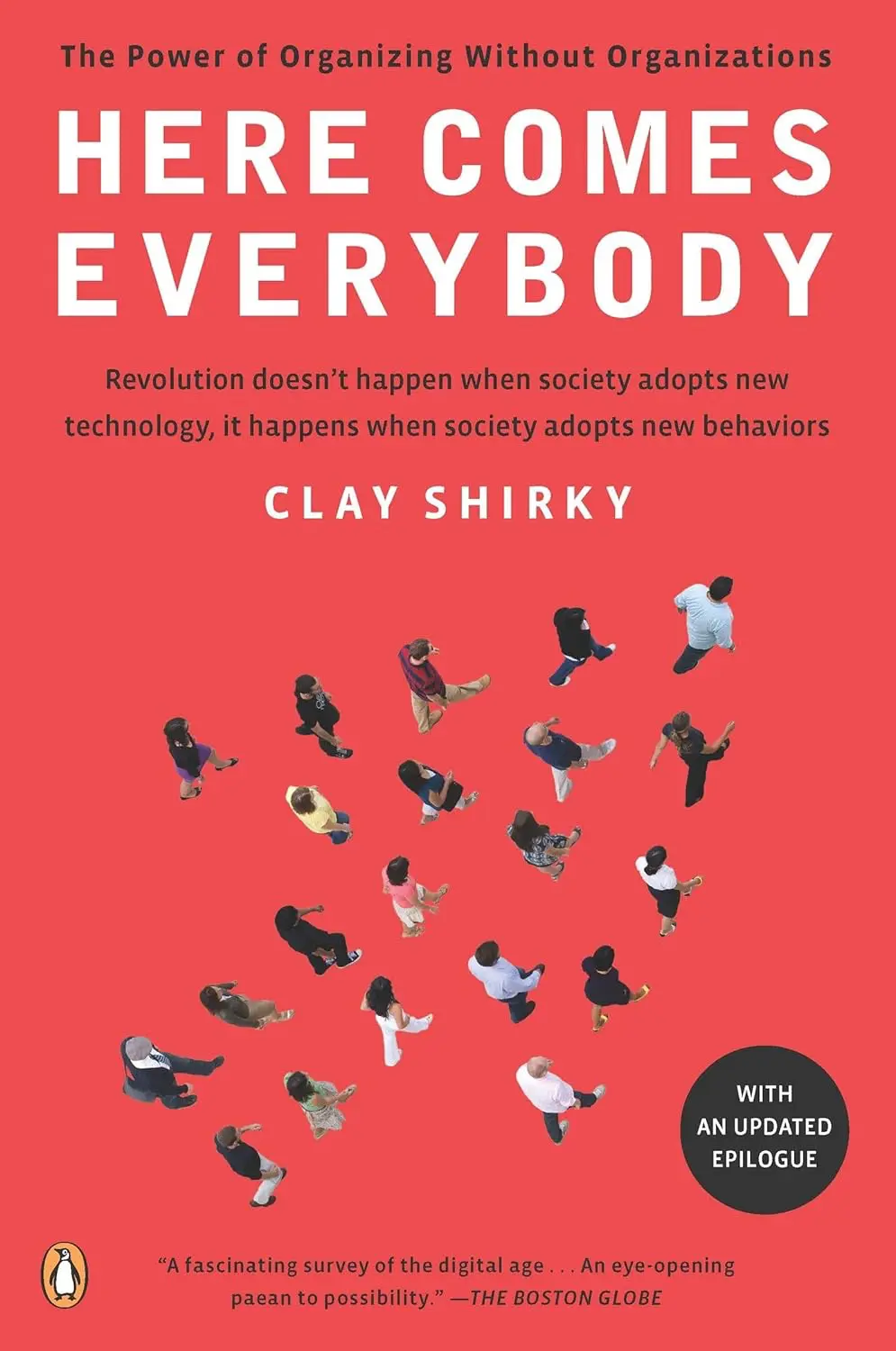
Clay Shirky’s argument: the internet has collapsed the cost of group coordination to near zero. When it becomes trivially easy for people to find each other, communicate, and act together, many of the institutions that existed to manage that coordination become unnecessary. Or at least, they lose their monopoly on it.
Shirky illustrates this with a range of examples from the mid-2000s. A woman in New York loses her phone in a taxi. She posts about it online, and a campaign to get it back goes viral, eventually involving the NYPD and national media. A group of photographers on Flickr organizes itself around a shared interest and produces a body of work that rivals professional publications. Wikipedia, which has no editors in the traditional sense, produces an encyclopedia that is competitive with Britannica.
The framework Shirky offers is useful. He distinguishes between sharing (the easiest form of group action, requiring almost no coordination), cooperation (which requires changing your behavior to sync with others), and collective action (which requires group commitment and sometimes sacrifice). Each level is harder to achieve, and most online groups stall at sharing. The ones that reach collective action, like open-source software projects or political movements, are the ones that actually change things.
Published in 2008, some of the specific examples feel dated. The book spends time on platforms and tools that no longer dominate. But the underlying analysis has aged well. Shirky correctly predicted that lowering coordination costs would not just replicate existing institutions online but would produce entirely new forms of organization. Wikipedia is not an online encyclopedia the way a digitized library is an online library. It is something genuinely new.
Shirky writes clearly and with genuine enthusiasm for his subject. He is an optimist about the internet’s potential but not a naive one. He acknowledges that lowering coordination costs also makes it easier to organize for destructive purposes. The same tools that enable flash mobs and citizen journalism enable harassment campaigns and conspiracy networks.
The book was widely assigned in communications and media courses and remains a useful starting point for understanding how the internet reshaped group behavior.
