
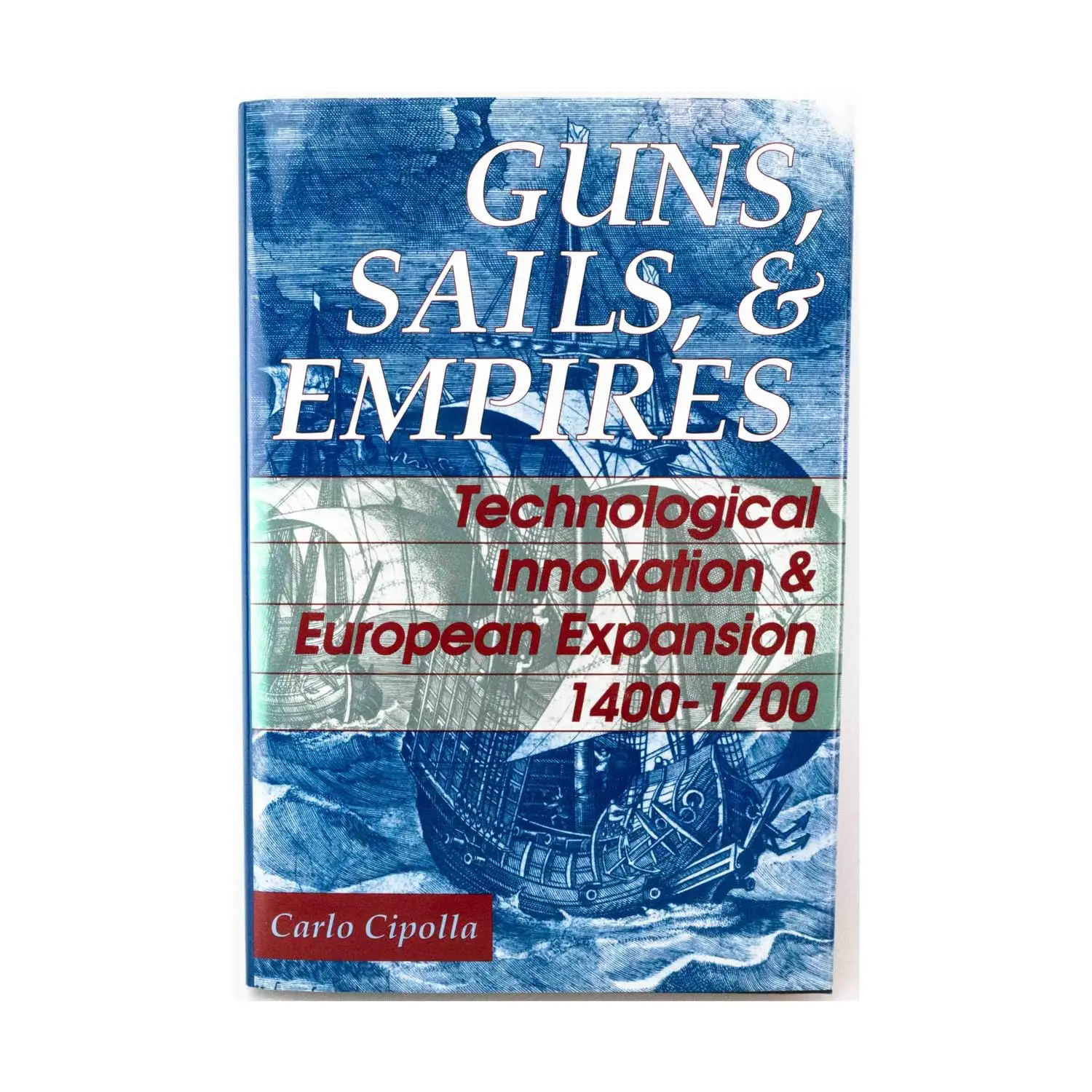
How did Europeans, who in 1400 controlled no significant territory outside their own continent, come to dominate most of the world’s coastlines by 1700? Carlo Cipolla’s answer is specific and technical: they figured out how to put cannons on ships.
This sounds like a simplification, and in some ways it is. But Cipolla, an economic historian at the University of California at Berkeley, builds a careful case that the combination of naval artillery and ocean-going sailing vessels was the specific technological advantage that made European expansion possible. Other civilizations had guns. Other civilizations had ships. Nobody else combined them as effectively as the Portuguese and Spanish did in the fifteenth century, and the Dutch, English, and French did in the sixteenth and seventeenth.
The book is short, under 200 pages, and reads like a long essay rather than a comprehensive history. Cipolla traces the development of European naval gunnery from the early, clumsy experiments with shipboard cannons to the fully developed broadside warships that could devastate coastal defenses and merchant fleets. He explains why Asian and Middle Eastern powers, despite having access to gunpowder weapons (which were invented in China), did not develop naval artillery to the same degree. The answer involves differences in military tradition, shipbuilding techniques, and the economic incentives facing different maritime cultures.
Cipolla writes with the precision of an economist and the clarity of someone who respects the reader’s time. He does not romanticize European expansion. The book is about technology and its consequences, not about destiny or cultural superiority. He notes repeatedly that the Chinese, Indian, and Ottoman civilizations were in many ways more sophisticated than their European counterparts. The Europeans’ advantage was narrow and specific: they could destroy things from the water more effectively than anyone else.
The book was first published in 1965 and has been reprinted multiple times. It belongs to a tradition of historical writing that explains large outcomes through specific mechanisms rather than grand narratives. If Guns, Germs, and Steel covers the last 13,000 years in broad strokes, Guns, Sails, and Empires covers 300 years with a magnifying glass.
It is not widely known outside academic circles, which is a shame. For anyone interested in how technology shapes power, and how small technical advantages can compound into global dominance, Cipolla’s short book is one of the sharpest treatments available.
