
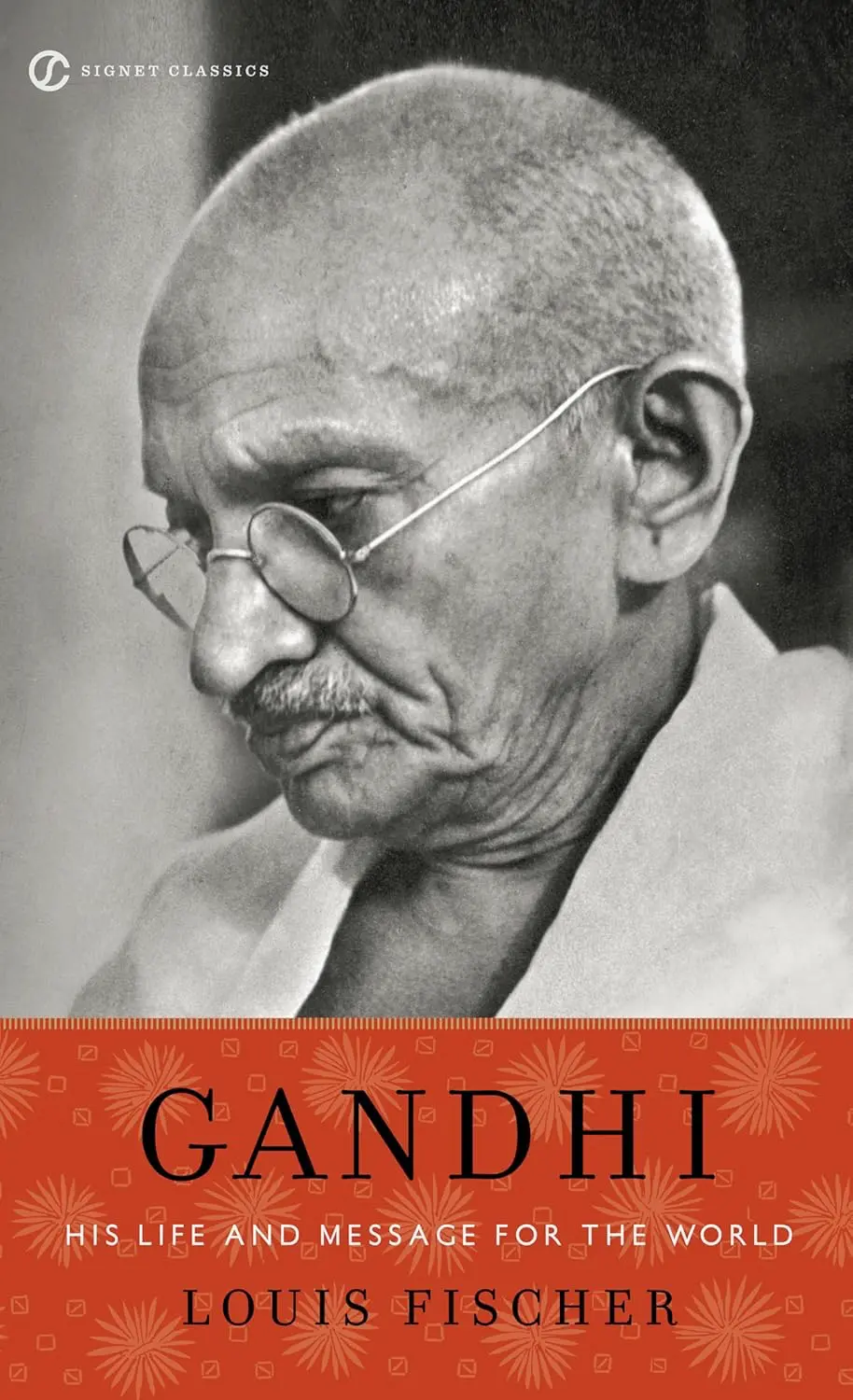
Louis Fischer met Gandhi multiple times during the 1940s, while covering the Indian independence movement as a journalist. When Gandhi was assassinated in 1948, Fischer had both the personal knowledge and the reporting background to write a biography quickly and well. The result, published in 1954, runs under 200 pages and has remained in print ever since.
The biography follows Gandhi from his birth in 1869 in Porbandar, India, through his studies in London, his formative years in South Africa where he first developed his philosophy of nonviolent resistance, and his return to India where he became the central figure in the struggle against British colonial rule. Fischer traces how a shy, unremarkable law student evolved into someone capable of mobilizing millions of people through the force of moral example rather than military power.
Fischer writes about the Salt March of 1930, where Gandhi walked 240 miles to the sea to make salt in defiance of British monopoly laws, an act so simple and so symbolically powerful that it drew international attention and embarrassed the British government. He covers the Quit India movement, the negotiations with Mountbatten over partition, and Gandhi’s final days, when he was fasting to stop Hindu-Muslim violence in a newly independent but violently fractured nation.
The portrait is admiring but not uncritical. Fischer acknowledges Gandhi’s difficult relationships with his family, particularly with his eldest son, Harilal, who became an alcoholic and publicly converted to Islam partly to wound his father. He discusses the controversies around Gandhi’s experiments with celibacy, which involved sleeping beside young women to test his self-control, a practice that troubled even some of his closest followers.
The writing is journalistic: clear, direct, and more interested in events than in psychological analysis. Fischer does not attempt the kind of deep interior portrait that a modern biographer might. He lets Gandhi’s actions carry the argument. The effect is a book that reads quickly and leaves you with the essential facts of one of the twentieth century’s most consequential lives.
Richard Attenborough’s 1982 film Gandhi, which won the Academy Award for Best Picture, was partly based on Fischer’s biography and on Fischer’s earlier, longer work, The Life of Mahatma Gandhi.
