
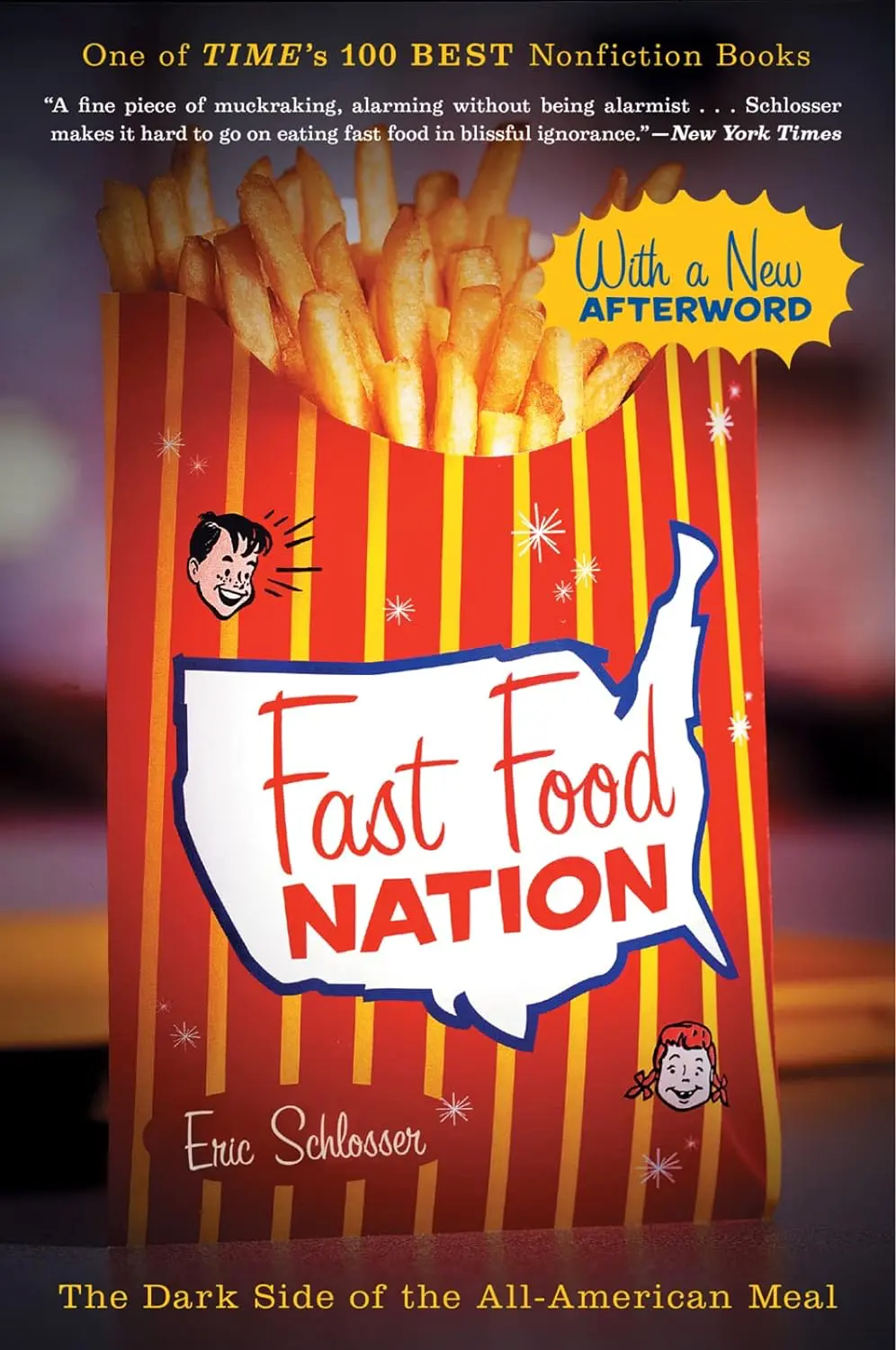
Eric Schlosser did not set out to write a polemic. He set out to trace how a hamburger gets from a cow to a drive-through window, and what he found along the way turned the book into something closer to an indictment.
The investigation starts in Colorado Springs, where the modern fast food industry was essentially invented. Schlosser profiles the founders, Carl Karcher and the McDonald brothers, and traces how their innovations in speed, standardization, and franchising reshaped not just how Americans eat but how food is produced, how workers are treated, and how entire communities are organized around the highway strip.
The meatpacking chapters are the hardest to read. Schlosser spent time in slaughterhouses and processing plants where workers, many of them undocumented immigrants, operate in conditions that have barely improved since Upton Sinclair wrote The Jungle in 1906. Injury rates are among the highest of any industry. Workers describe losing fingers, suffering repetitive motion injuries, and being pressured to continue working through pain. The companies have systematically fought unionization and safety regulation.
The flavor chapter is unexpectedly fascinating. Schlosser visits the flavor factories of New Jersey, where a handful of companies create the artificial flavors that make fast food taste the way it does. A strawberry milkshake from a fast food chain contains no strawberries. The flavor comes from a chemical compound engineered in a lab. Schlosser describes the process in enough detail to make you look at a French fry differently.
The agricultural chapters trace how fast food chains’ demand for uniformity has consolidated the farming industry. A few companies control the majority of beef, chicken, and potato production. Independent farmers and ranchers have been squeezed out or reduced to contract workers on their own land. The consolidation happened gradually and mostly out of public view.
Schlosser writes with the controlled intensity of an investigative reporter who knows that the facts are damning enough without embellishment. The book was a bestseller and was compared to The Jungle and Silent Spring as a work of journalism that changed public attitudes toward an industry. Whether it changed the industry itself is debatable. The fast food business is larger now than when Schlosser wrote the book. But the conversation it started about industrial food, worker safety, and corporate agriculture has not stopped.
