
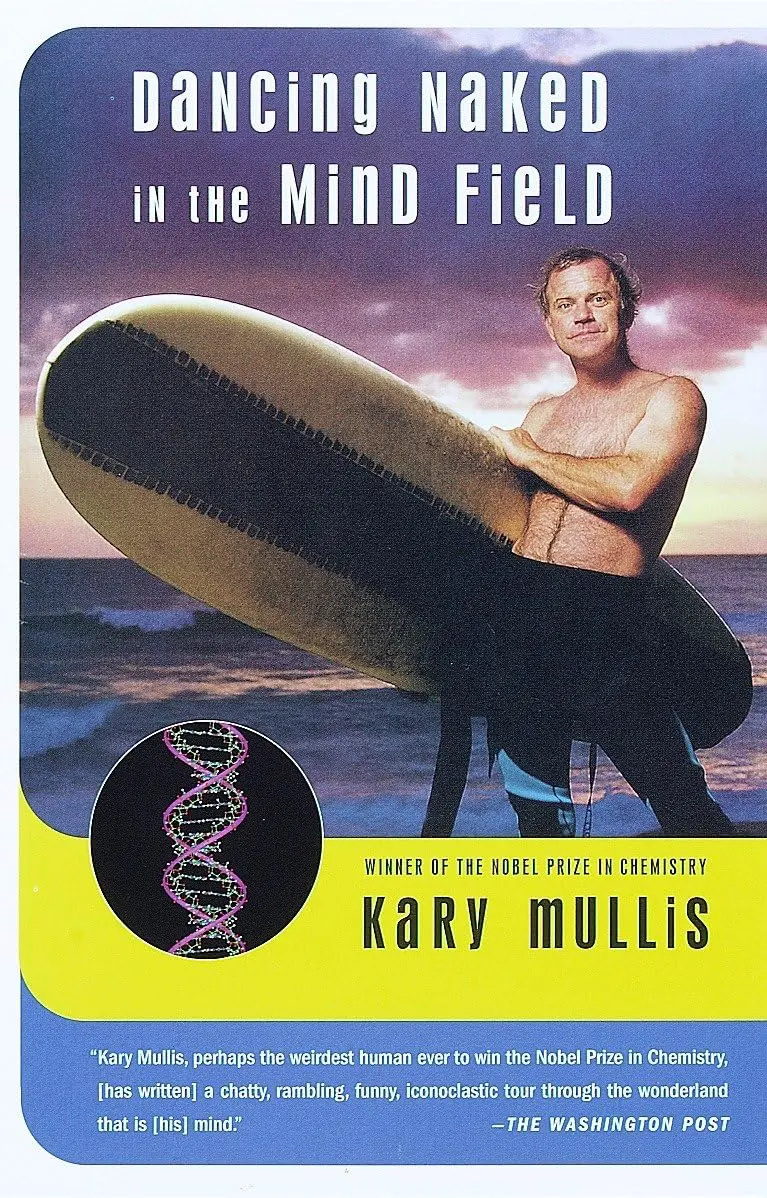
Kary Mullis invented the polymerase chain reaction while driving through the mountains of Northern California one night in 1983. PCR is the technique that allows scientists to copy and amplify tiny fragments of DNA, making modern genetics, forensic science, and COVID testing possible. He won the Nobel Prize for it in 1993. None of this prepared the Nobel committee for what Mullis would do next.
Dancing Naked in the Mind Field is a collection of essays that range from the brilliant to the baffling, sometimes within the same paragraph. Mullis writes about the scientific method with genuine insight, arguing that most published research is driven by funding incentives rather than curiosity, and that the peer review system punishes originality. He writes about the O.J. Simpson trial, where he was retained as an expert witness on DNA evidence but never called to testify. He writes about his childhood in rural South Carolina, where he built rockets and nearly blew himself up multiple times.
Then things get strange. Mullis defends astrology, arguing that behavioral science has wrongly ignored the configuration of planets at the time of birth. He describes an encounter with what appeared to be a glowing raccoon at his cabin in Mendocino County that may or may not have been an extraterrestrial. He expresses skepticism about whether HIV causes AIDS, a position that was controversial when the book was published in 1998 and has since been thoroughly contradicted by decades of research.
The book is impossible to categorize. It is part memoir, part manifesto, part provocation. Mullis writes with the confidence of a man who has been proven right once in a way that changed the world and has concluded that this gives him license to be right about everything else. Sometimes he is. His critique of how the scientific establishment funds research and suppresses dissent remains sharp. His observations about the difference between evidence and consensus are worth reading. His description of the moment he conceived PCR is one of the best accounts of scientific insight ever written.
Other times he is spectacularly wrong, and the wrongness is not innocent. His HIV skepticism, in particular, was harmful. People who refused treatment because of claims like his died of AIDS.
The New York Times Book Review called the book a joyous autobiography of an extraordinary chemist’s nervous system. Arthur C. Clarke called it mind-stretching. Mullis died in 2019 at age seventy-four. He remains one of the most complicated figures in modern science: a genuine genius whose judgment outside his area of expertise was, to put it generously, unreliable.
