
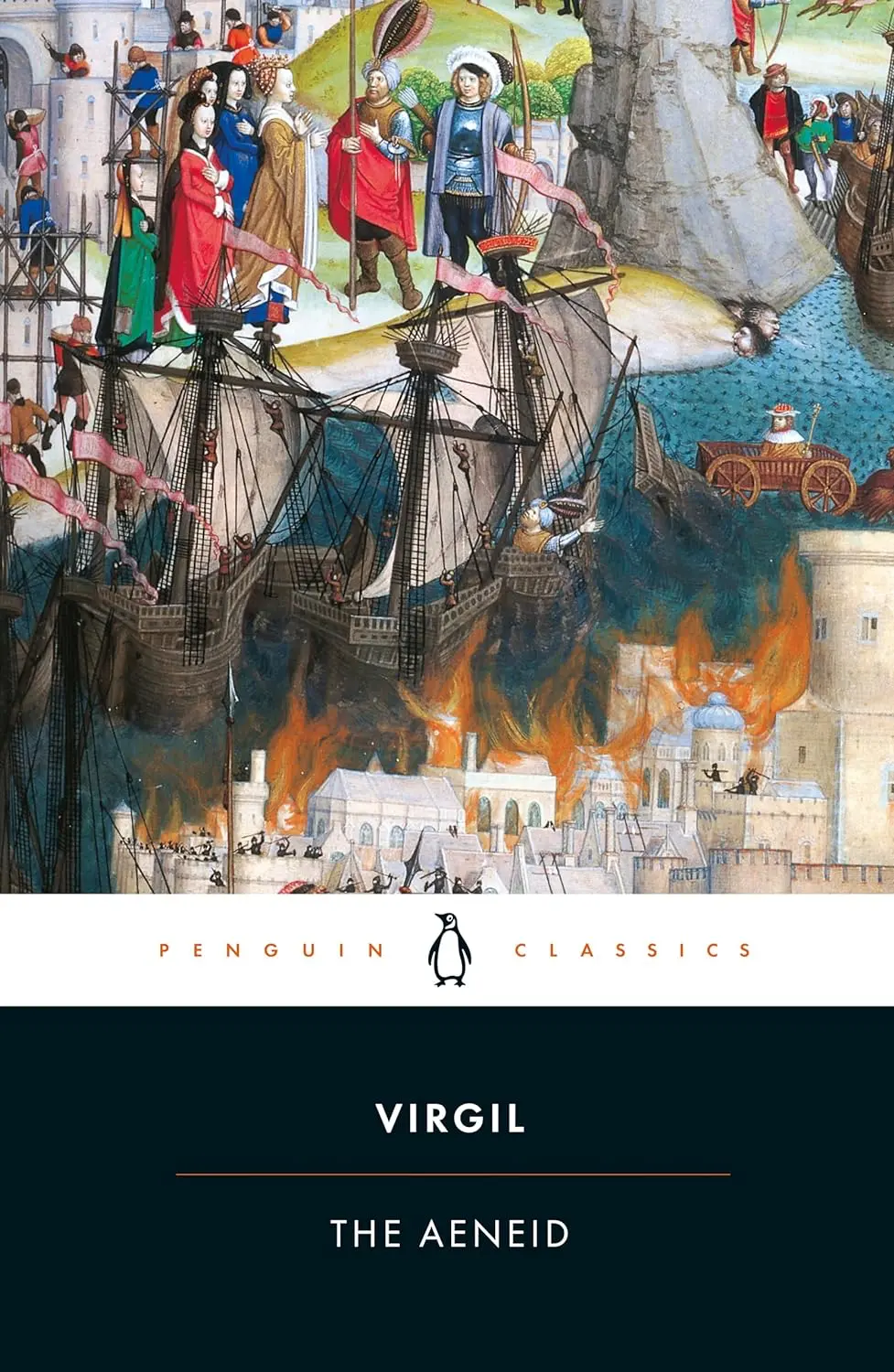
Aeneas is a Trojan warrior who survives the destruction of Troy and sets out across the Mediterranean with a fleet of refugees. His mission, given by the gods, is to reach Italy and establish the civilization that will eventually become Rome. The journey takes years, passes through storms, underworld descents, a doomed love affair with Dido, Queen of Carthage, and a war in Italy that occupies the final third of the poem.
Virgil wrote the Aeneid between 29 and 19 BC, during the reign of Augustus, Rome’s first emperor. The poem was a political project as much as a literary one. Augustus needed a founding myth that tied Rome’s origins to divine destiny, and Virgil provided it. Aeneas is Augustus’s mythological ancestor, and the poem’s arc, from the ruins of one civilization to the founding of another, mirrors the narrative Augustus wanted Romans to believe about their own empire.
But Virgil was too good a poet to write propaganda. The Aeneid is full of ambivalence. Aeneas is dutiful rather than heroic. He does what the gods command, but the cost is visible in every book. He abandons Dido, who kills herself. He wages war in Italy against people who have done nothing wrong. He kills a defeated enemy in the poem’s final lines in an act of rage that contradicts everything he claims to stand for. Virgil presents the founding of Rome as both glorious and terrible, and the tension between those two readings has kept scholars arguing for two thousand years.
The Fagles translation (Penguin, 2006) is probably the most readable modern English version, though the Fitzgerald translation remains popular. The Latin original is written in dactylic hexameter, a rhythmic structure that English cannot reproduce, so every translation involves trade-offs between accuracy and readability.
The poem has influenced virtually every major Western writer since. Dante made Virgil his guide through Hell in the Divine Comedy. Milton’s Paradise Lost borrows its structure. T.S. Eliot called Virgil the classic of all Europe. The Aeneid also generated what may be history’s most famous piece of literary criticism: the question of whether Virgil intended the poem as a celebration of empire or a critique of it, which has never been settled.
Virgil died in 19 BC before finishing final revisions. He reportedly asked that the manuscript be burned. Augustus overruled him. The poem survived and has been in continuous circulation for over two thousand years. At this point it is less a book than an institution, and reading it still produces the vertigo of encountering a voice that feels both ancient and contemporary.
