
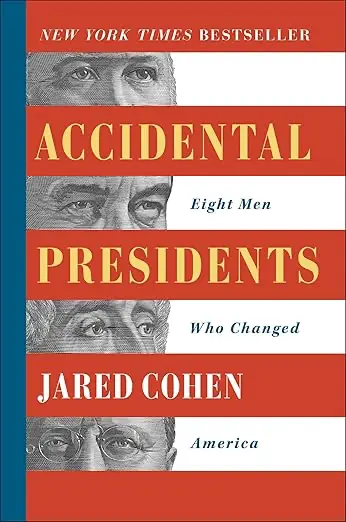
Eight times in American history, a vice president has taken over the presidency because the sitting president died. John Tyler after William Henry Harrison. Andrew Johnson after Abraham Lincoln. Chester Arthur after James Garfield. Theodore Roosevelt after William McKinley. Calvin Coolidge after Warren Harding. Harry Truman after Franklin Roosevelt. Lyndon Johnson after John F. Kennedy. Gerald Ford after Richard Nixon (though Nixon resigned rather than died).
Jared Cohen tells each story in sequence, and what comes through is how little planning went into any of these transitions. Vice presidents were often chosen for political convenience, to balance a ticket geographically or ideologically, with little thought given to whether they could actually run the country. Tyler was so unexpected as a successor that critics called him “His Accidency.” Truman had met with Roosevelt fewer than a dozen times before inheriting the presidency and the decision of whether to drop the atomic bomb.
The most gripping chapters cover the transitions that changed policy direction. Andrew Johnson, a Democrat from Tennessee, took over after Lincoln’s assassination and dismantled much of what Lincoln had fought for, setting back Reconstruction by decades. Theodore Roosevelt, whom party bosses had put in the vice presidency specifically to sideline him, became one of the most active and popular presidents in American history. Truman, a former haberdasher from Missouri with no foreign policy experience, ended up shaping the post-war international order.
Cohen is a good storyteller. He reconstructs the hours and days surrounding each death with the pacing of a thriller, drawing on letters, diaries, and contemporary accounts. The constitutional ambiguity around presidential succession, which was not clarified until the Twenty-Fifth Amendment in 1967, adds genuine tension to several of the transitions. When Harrison died in 1841, there was genuine debate about whether Tyler was actually the president or merely the acting president.
The book raises a question that is easy to overlook in hindsight: how much of what we consider the natural arc of American history was actually the result of one person dying at one particular moment? If McKinley had lived, there would have been no trust-busting, no national parks system, no Panama Canal under Roosevelt’s aggressive leadership. If Kennedy had lived, the Vietnam War might have played out differently. These are counterfactuals, impossible to resolve. But Cohen makes a strong case that the accidents of succession mattered as much as the elections themselves.
