
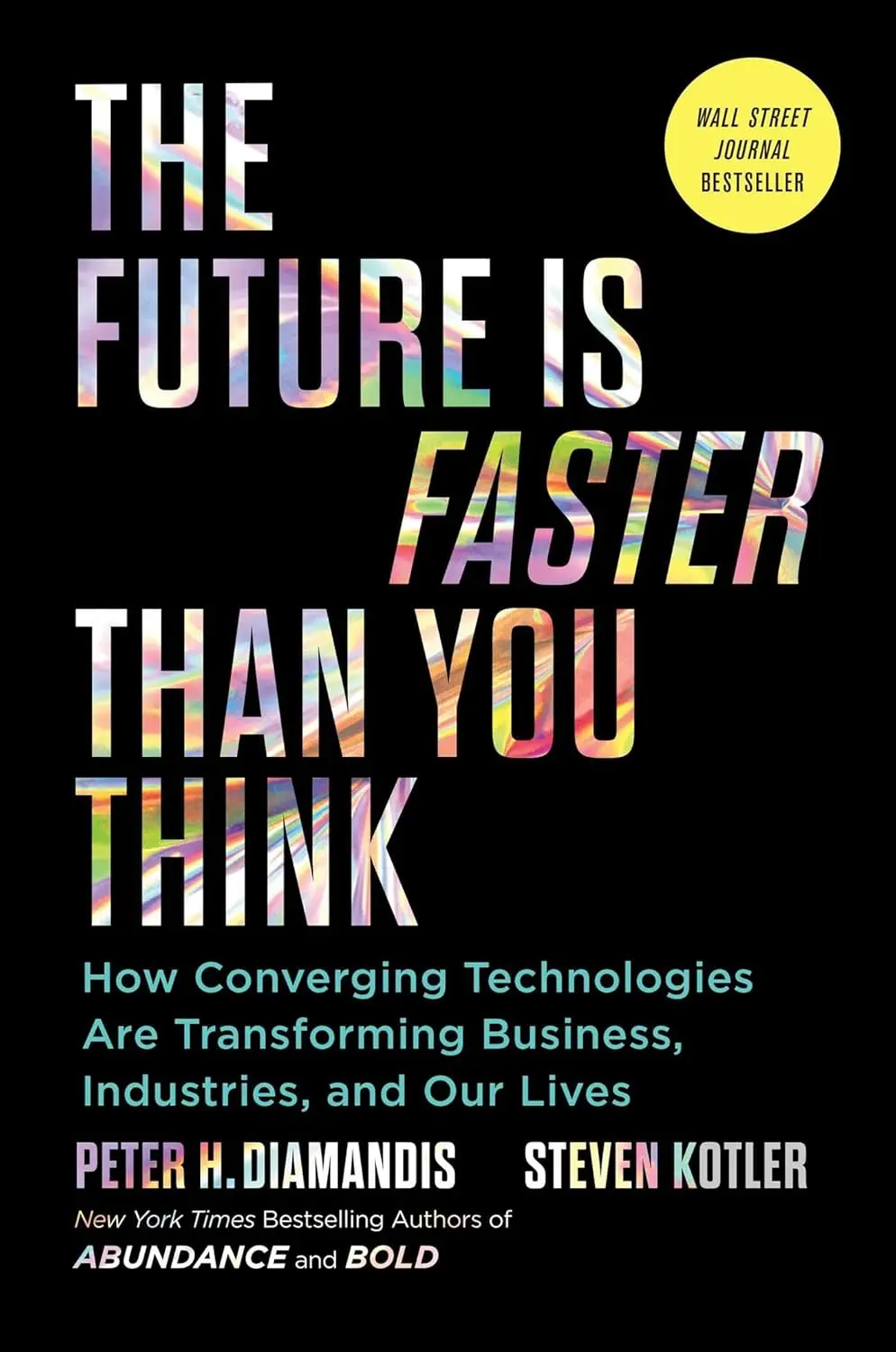
Peter Diamandis is the founder of the X Prize Foundation and Singularity University. Steven Kotler is a journalist who writes about peak performance and technology. Together they have produced a series of books about exponential change, and this one is their attempt to map what happens when multiple exponential technologies collide.
The core argument: individual technologies like artificial intelligence, robotics, sensors, 3D printing, blockchain, and augmented reality are each advancing on their own exponential curves. When two or more of these curves intersect, the pace of change compounds. Self-driving cars are not just an automotive technology. They combine AI, sensors, mapping, connectivity, and battery technology. When all of those improve simultaneously, the timeline for disruption shortens in ways that linear thinking cannot predict.
The book is organized by industry. There are chapters on transportation, retail, advertising, entertainment, healthcare, food production, and finance. Each chapter follows the same rough structure: here is how the industry works today, here are the technologies that are converging to change it, and here is what the industry might look like in ten to twenty years.
Some of the predictions are compelling. The healthcare chapter describes a future where AI diagnostics, gene editing, and continuous sensor monitoring fundamentally alter how disease is detected and treated. The transportation chapter lays out how flying taxis, autonomous vehicles, and hyperloop-style systems could reshape urban geography. The food chapter covers cultured meat and vertical farming in enough detail to understand why investors are paying attention.
Other predictions will strike skeptical readers as overheated. Diamandis is a self-described optimist, and the book occasionally reads like a pitch deck for the future. Timelines for adoption tend to be aggressive. Regulatory, political, and cultural barriers get mentioned but are not weighted heavily. If you read this alongside a book like Vaclav Smil’s work on energy transitions, which emphasizes how slowly complex systems actually change, the tension between the two perspectives is instructive.
The book was published in 2020. Some of its near-term predictions have already been partially validated by the speed of AI development since then. Others, particularly around autonomous vehicles and flying cars, have not materialized on the timeline the authors projected.
Diamandis and Kotler write clearly and with energy. The book is accessible to non-technical readers and covers enough ground to function as a survey of where technology-driven disruption is heading, even if you discount the timelines by a factor of two or three.
