
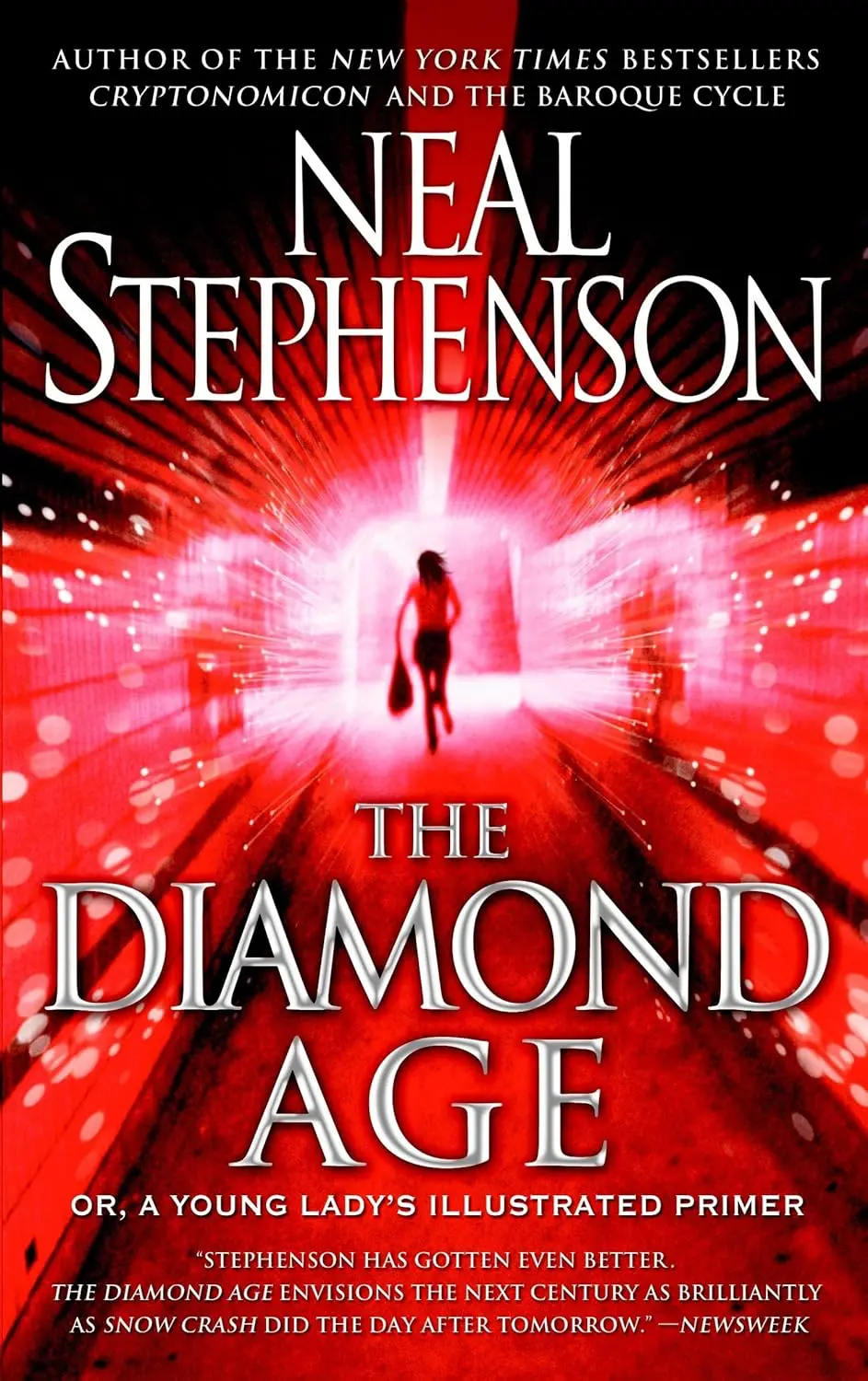
Somewhere in the future, nanotechnology has made material scarcity mostly irrelevant. You can fabricate almost anything from a matter compiler. But social hierarchies have not disappeared. They have reorganized around culture, education, and tribal affiliation. The neo-Victorians, one of the dominant phyles (Stephenson’s word for post-national cultural groups), have concluded that the key to maintaining their status is not wealth but the quality of the minds they produce.
John Percival Hackworth, a nano-engineer working for the neo-Victorians, is commissioned to build the Young Lady’s Illustrated Primer, an interactive book designed to educate a single child. The Primer is a full AI tutor, disguised as a fairy tale, that adapts its story to the child’s circumstances and teaches her to think critically, solve problems, and resist authority when authority is wrong. Hackworth builds it for his patron’s granddaughter, then secretly makes a copy for his own daughter. The copy is stolen and ends up with Nell, a four-year-old girl living in poverty with an abusive mother and a rotating cast of dangerous men.
The novel follows Nell as she grows up with the Primer. The book becomes her teacher, her protector, and her guide to a world that would otherwise consume her. The fairy tale it tells her adapts in real time to the challenges she faces, teaching her exactly what she needs to know at each stage. When she needs to learn self-defense, the story provides it. When she needs to learn to read social cues, the story provides that too.
Stephenson is doing two things at once. The surface is a gripping adventure story set in a richly imagined future. Underneath, he is asking what education should actually be. The Primer does not teach by lecturing. It teaches by creating situations that require the student to figure things out. It does not protect Nell from difficulty. It prepares her for it. This is a specific and deliberate philosophy of education, closer to Montessori or Socratic method than to anything in a standard classroom.
The book won the Hugo Award for Best Novel in 1996. It has aged better than most 1990s science fiction, partly because its central questions about education, technology, and class are even more relevant now than when it was published. In an era of AI tutors and personalized learning, the Primer no longer feels like speculation. It feels like a prototype.
The novel shares a fictional universe with Cryptonomicon and The Baroque Cycle, though it works entirely as a standalone.
