
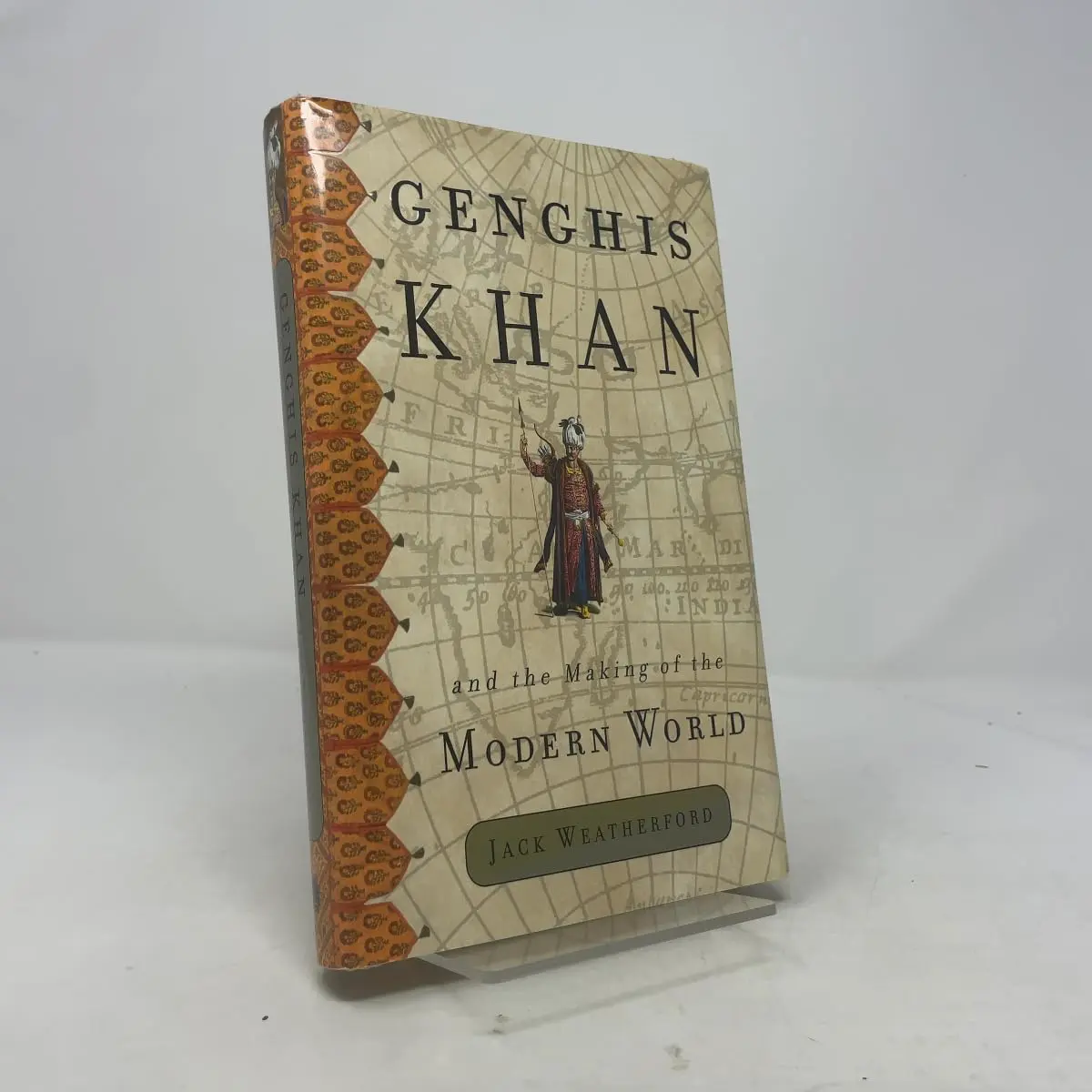
Most people know Genghis Khan as a destroyer. Jack Weatherford, an anthropologist at Macalester College, went to Mongolia to find out what actually happened. He spent years in the field, studying Mongolian sources that had been suppressed during the Soviet era and only became accessible after 1990. The book that resulted reads like a corrective to centuries of bad press.
Temujin, the boy who would become Genghis Khan, was born around 1162 into a nomadic clan on the Mongolian steppe. His father was poisoned by a rival tribe when Temujin was nine. His family was abandoned by their clan. He grew up poor, hunted, and briefly enslaved. By the time he died in 1227, he controlled an empire that stretched from Korea to Hungary, the largest contiguous land empire in human history.
Weatherford argues that the Mongol Empire was far more sophisticated than Western histories have allowed. Khan banned the kidnapping of women, abolished inherited aristocratic titles, and distributed spoils based on merit rather than birth. He established freedom of religion across the empire at a time when European rulers were conducting crusades and inquisitions. He created a continent-spanning postal relay system that allowed messages to cross Asia in days. He promoted trade by protecting merchant caravans along what would become the Silk Road.
The military tactics get detailed treatment. Khan developed blitzkrieg-style warfare centuries before the term existed, using speed, deception, intelligence networks, and psychological operations to defeat armies many times larger than his own. He adopted technologies from every conquered civilization and integrated them immediately. Gunpowder, siege warfare, navigation tools, all of it was absorbed and deployed within a single generation.
Weatherford connects the Mongol conquests to the emergence of the modern world. The unification of Asia and eastern Europe under one governing system accelerated the exchange of goods, ideas, technologies, and diseases. The Black Death, which reshaped European civilization, traveled along Mongol trade routes. So did printing, gunpowder, and the compass.
The writing is narrative-driven and moves quickly. Weatherford is an anthropologist, not a military historian, so he spends as much time on governance, law, and culture as on battles. The result is a portrait of a leader whose methods were brutal by any standard but whose legacy includes institutions and innovations that shaped centuries.
The book spent years on the New York Times bestseller list and remains the most widely read popular history of the Mongol Empire in English.
