
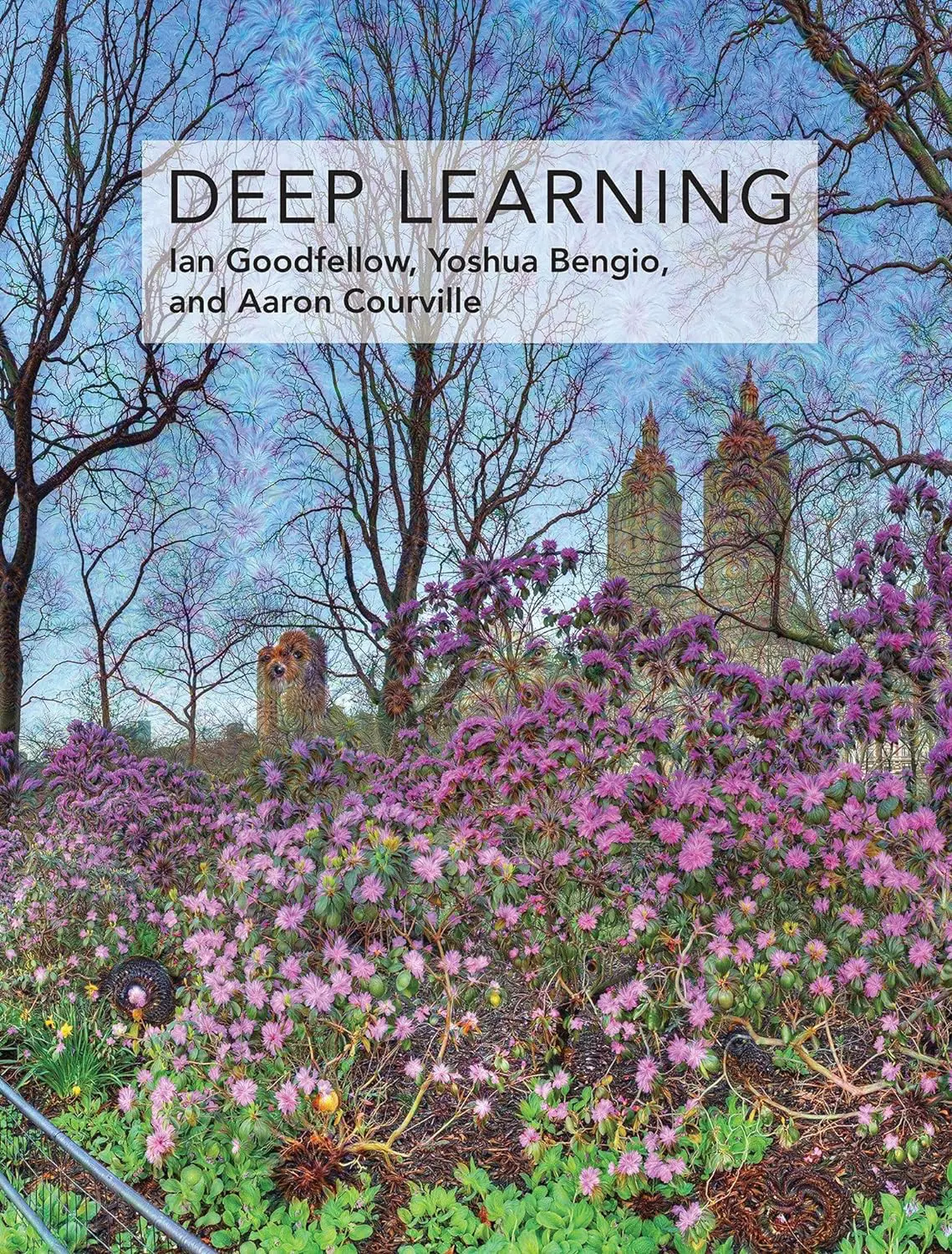
If you want to understand deep learning at a technical level, this is where most people start. And where many people stall, because the book assumes a solid background in linear algebra, probability, statistics, and numerical computation. The first several chapters are dedicated to reviewing these prerequisites, which tells you something about the intended audience.
Ian Goodfellow invented generative adversarial networks (GANs). Yoshua Bengio won the Turing Award in 2018 for his work on deep learning. Aaron Courville is a professor at the University of Montreal. Between them, they have shaped much of the field’s theoretical foundation. The book compiles what they know into a single volume.
The structure moves from foundations to applications. Part one covers the math: linear algebra, probability, information theory, numerical methods. Part two explains the core machine learning concepts: feedforward networks, regularization, optimization, convolutional networks, recurrent networks, sequence modeling. Part three gets into more advanced topics: autoencoders, representation learning, generative models, and the structured probabilistic framework that underpins much of modern deep learning.
The writing is precise but not hostile. Given the subject matter, the authors do a reasonable job of explaining ideas in plain terms before formalizing them in equations. That said, if you have never taken a course in calculus or linear algebra, you will hit a wall. This is not a pop-science overview. It is a textbook, written for graduate students and working researchers.
The book was published in 2016, which in AI years is a long time ago. Certain developments, particularly the transformer architecture that powers GPT and similar large language models, are not covered because they had not yet been published. But the fundamentals the book teaches are still the fundamentals. Backpropagation, gradient descent, regularization, and the core network architectures are unchanged, and understanding them is a prerequisite for understanding what came after.
The full text is available for free on the authors’ website (deeplearningbook.org), which has made it one of the most widely accessed AI textbooks in the world. The physical copy, published by MIT Press, has become a standard reference on the shelves of AI labs and computer science departments.
For anyone trying to move beyond surface-level AI hype and understand what these systems actually do, this book is the entry point. It is not easy. But the difficulty is honest. The subject itself is hard.
