
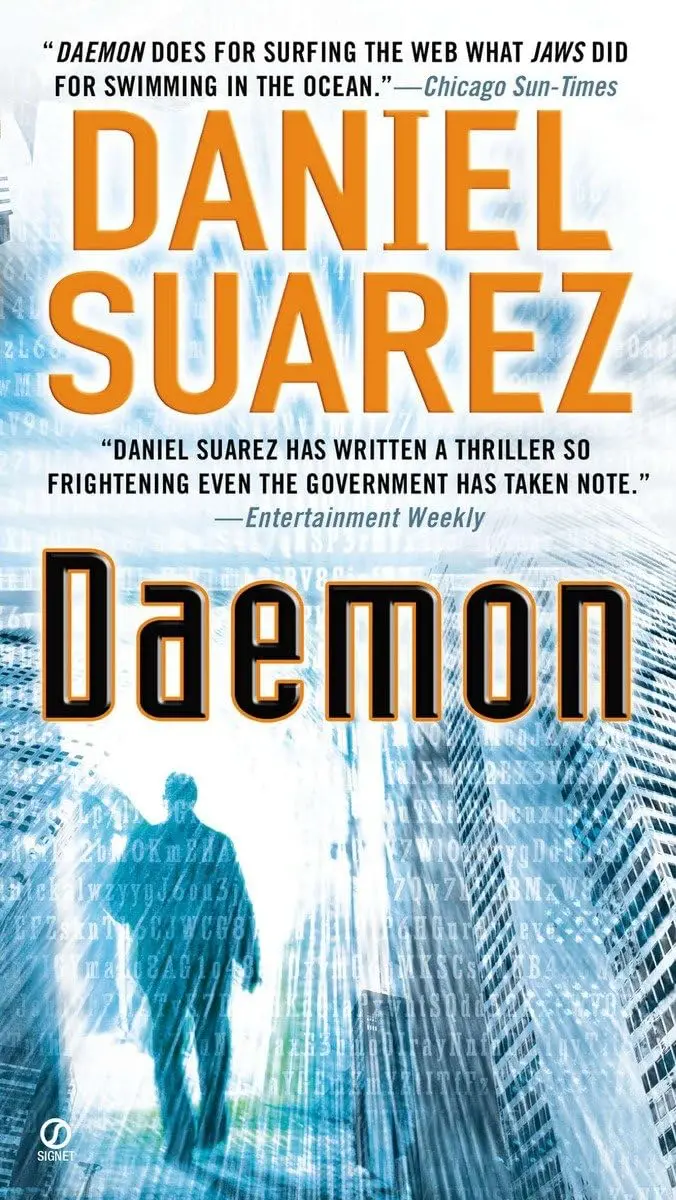
Matthew Sobol is a genius game designer who dies of brain cancer. Upon his death, a distributed software program he wrote, the Daemon, activates. It is autonomous, self-spreading, and designed to restructure society from the ground up. It recruits human operatives through dark-web channels. It takes control of automated systems. It kills people who try to stop it. And it operates according to a set of rules that Sobol programmed before he died, which means nobody can negotiate with it or shut it down, because its creator is already gone.
Daniel Suarez was a software consultant, not a professional novelist. He wrote Daemon in his spare time and could not find a publisher. Every major house rejected it. He self-published in 2006, and it spread through tech circles by recommendation. Executives at companies like Cisco and Lockheed passed copies around. Eventually Dutton picked it up and published it traditionally in 2009.
The reason it caught fire in tech is that the technology in the book is almost entirely real. Suarez does not invent fictional devices. The Daemon uses existing systems: botnets, RFID tags, GPS tracking, social media manipulation, autonomous vehicles, drone swarms. Each element existed, at least in prototype, at the time of writing. Suarez just combined them in ways that no one had thought through before.
The plot moves fast. Multiple characters are drawn into the Daemon’s web: a detective investigating the murders, an FBI cybercrime specialist, a journalist, a hacker who gets recruited as an operative. The chapters are short. The pacing feels more like a screenplay than a novel, which makes sense given the book’s cinematic structure.
The sequel, Freedom(TM), completes the story and pushes the political ideas further. Sobol’s Daemon turns out to have a purpose beyond destruction: it is attempting to build a decentralized economy that replaces corporate and government hierarchies with local, self-governing communities connected by technology. Whether this is utopian or terrifying depends on your politics.
The writing is functional rather than literary. Suarez does not reach for poetry. He reaches for accuracy, and in that register he is very good. The book reads like a warning written by someone who understands how systems actually work and is worried about what happens when someone with bad intentions understands them too.
Daemon has been widely recommended among technologists and has been compared to Michael Crichton’s techno-thrillers, though Suarez is more technically rigorous.
