
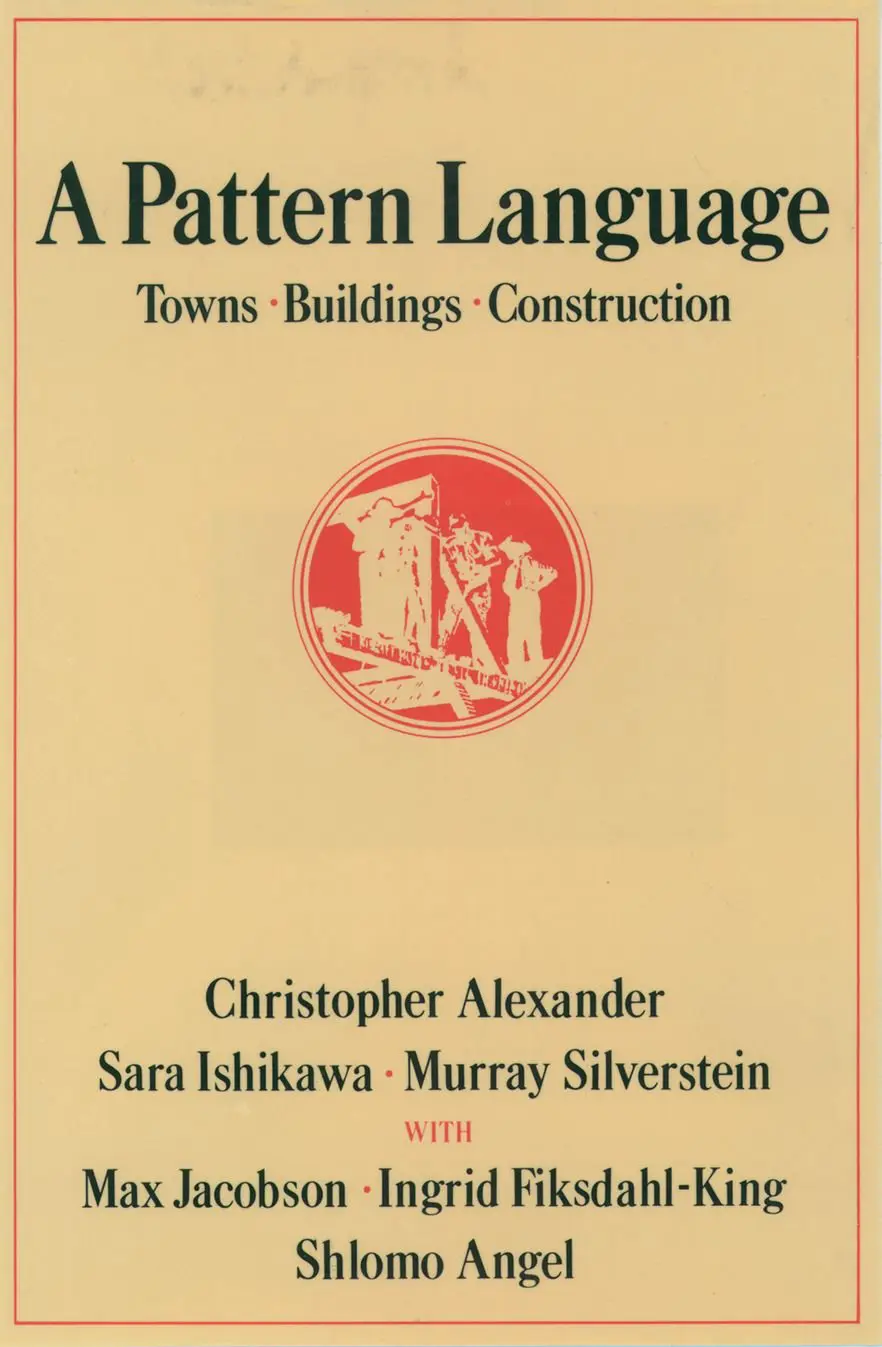
This is not a normal book. It is closer to a reference manual, except that reading it cover to cover is one of the more mind-altering experiences available in nonfiction.
Christopher Alexander was an architect at UC Berkeley who believed that the built environment had become hostile to human life. Modern buildings, he argued, were designed for efficiency and aesthetic novelty rather than for the people who actually used them. Cities were planned around cars rather than pedestrians. Homes were built to look good in photographs rather than to feel good to live in.
A Pattern Language is his attempt to fix this. The book catalogs 253 design patterns, arranged from the largest scale (the distribution of towns across a region) to the smallest (the height of a shelf). Each pattern is presented as a problem, a set of forces that create the problem, and a solution. Pattern 159, “Light on Two Sides of Every Room,” observes that a room lit from only one side feels uncomfortable and suggests that every habitable room should have natural light coming from at least two directions. Pattern 112, “Entrance Transition,” argues that the experience of moving from a public street into a private home should involve a gradual shift, a garden, a change in level, a narrow passage, rather than an abrupt door.
The patterns are numbered and cross-referenced. Each one links to related patterns above and below it in scale. The idea is that you can select the patterns relevant to your project and combine them into a coherent design, the way words combine into a sentence.
The book’s influence extends well beyond architecture. Software engineers discovered it in the 1980s and used Alexander’s pattern concept as the basis for design patterns in programming, which became a standard approach to software architecture. Game designers have used the patterns to think about the experience of moving through virtual spaces. Organizational theorists have applied the concept to the design of workspaces and meeting structures.
Alexander wrote with a confidence that borders on dogmatism. He does not present the patterns as suggestions. He presents them as solutions that produce life in buildings when followed and deadness when ignored. Some architects have found this presumptuous. Others have found it liberating, because it means the book is actually opinionated rather than blandly neutral.
A Pattern Language was published in 1977 and has never gone out of print. It has sold hundreds of thousands of copies worldwide. Alexander died in 2022 at the age of eighty-five.
