
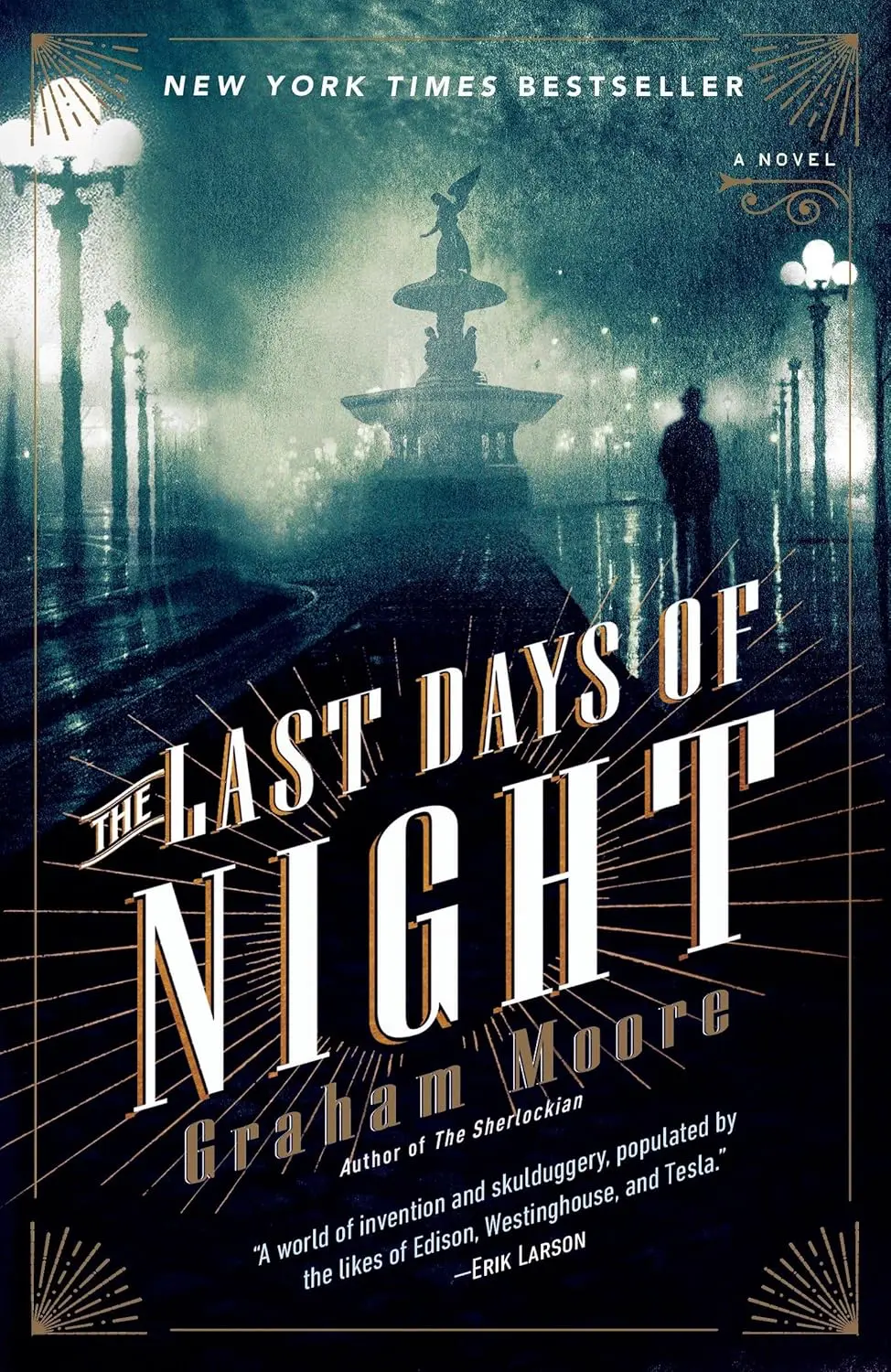
Paul Cravath is twenty-six, green, and completely outmatched. His client, George Westinghouse, is being sued by Thomas Edison for patent infringement. The question at the center of the case: who actually invented the lightbulb? The answer will determine who gets to electrify the United States, a prize worth more money than anyone can count.
Edison has J.P. Morgan’s backing, a team of private spies, newspapers in his pocket, and a reputation for destroying anyone who stands in his way. Westinghouse has Paul. What Paul lacks in experience he makes up for with a compulsion to win that rivals Edison’s own. Over the course of the novel, he crosses paths with Nikola Tesla, a brilliant and eccentric inventor who might hold the key to the entire case, and with Agnes Huntington, an opera singer whose charm conceals a talent for manipulation.
Graham Moore wrote the screenplay for The Imitation Game, which won the Academy Award. He brings a screenwriter’s pacing to this novel. Chapters are short, sometimes only a few pages. Scenes end on cliffhangers. The book moves fast, probably too fast for readers who want to sit with the period detail, but exactly right if you want a story that pulls you through.
The history is real, or close to it. Edison and Westinghouse did fight a vicious war over alternating current versus direct current. Edison did electrocute animals publicly to demonstrate the supposed dangers of Westinghouse’s AC system. Paul Cravath was a real lawyer who went on to found one of the most prestigious law firms in America, Cravath, Swaine & Moore. Tesla was caught between both camps, exploited by both, and ended up with far less than he deserved. Moore takes liberties with timelines and personal details, but the broad strokes are accurate.
The novel opens each chapter with a quote from either a historical figure or a modern tech leader like Steve Jobs or Bill Gates, drawing a line between the Edison-Westinghouse war and modern technology battles. This works better in concept than in execution. After thirty chapters, the quotes start to feel like a device. But the underlying parallel is sound. Patent wars, platform battles, the question of who actually invents something versus who commercializes it, all of it echoes across centuries.
The book became a New York Times bestseller and was optioned for a film adaptation. Gillian Flynn called it mesmerizing. Erik Larson praised its recreation of Gilded Age New York. If you have ever wondered what a startup war looked like before there were startups, this is about as close as historical fiction gets.
