
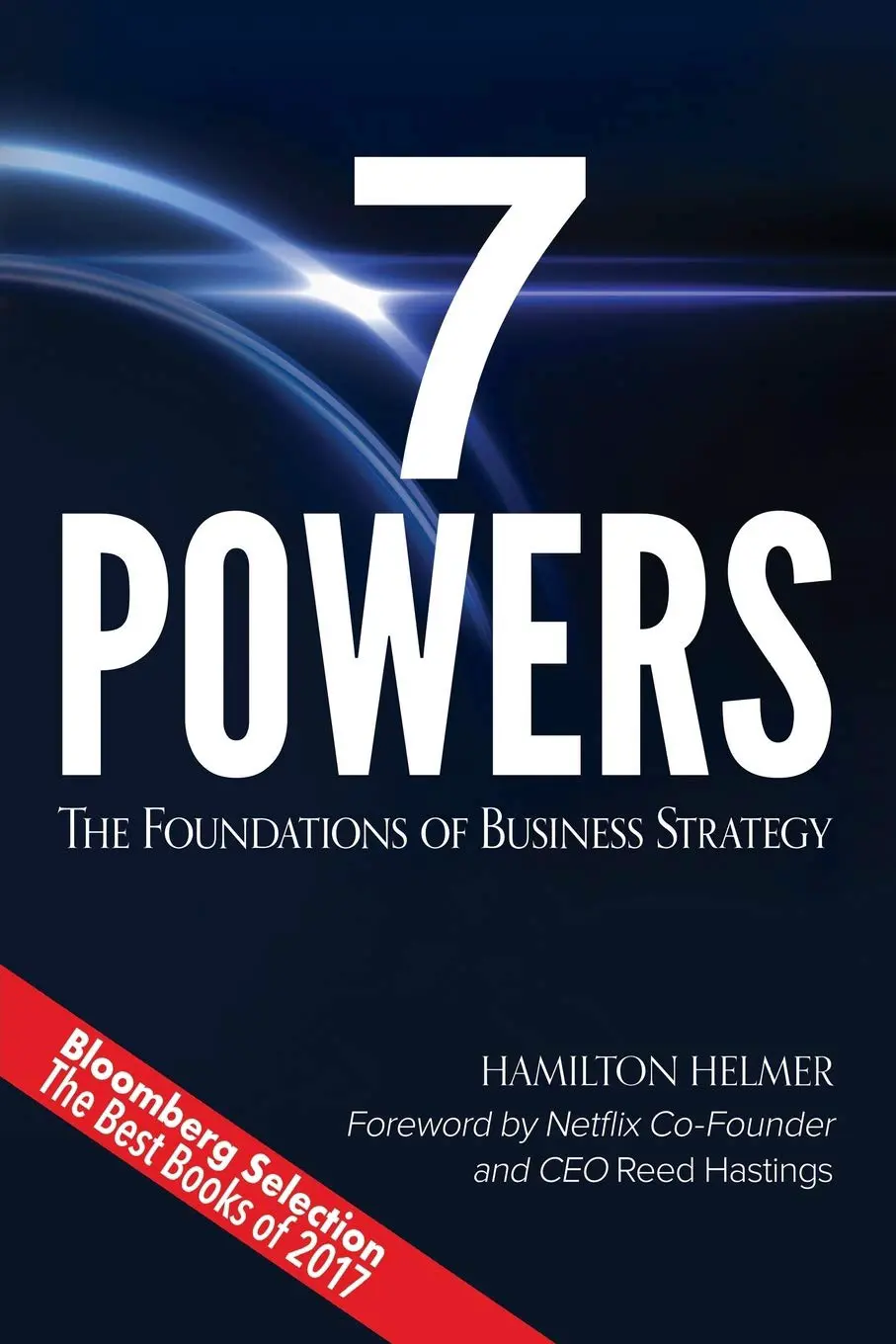
Most strategy books are either too abstract to be useful or too specific to generalize. Hamilton Helmer’s 7 Powers is neither. It identifies seven, and only seven, sources of durable competitive advantage and explains each one with precision.
The seven powers are: scale economies, network economies, counter-positioning, switching costs, branding, cornered resource, and process power. Helmer defines each term carefully and, more importantly, explains the conditions under which each power can be established. Scale economies, for instance, only create lasting advantage when they are structural rather than simply a function of current volume. Network economies only matter when the value to each user increases with the number of other users. This level of specificity separates the book from vague strategy advice about moats and competitive advantages.
Helmer comes to this from practice, not theory. He ran a strategy consulting firm for decades, advising companies like Netflix, Adobe, Spotify, and Hewlett-Packard. He then put his ideas to work as an investor, co-founding Strategy Capital, where his portfolio’s performance has been called one of the most exceptional sustained records in equity investing. Peter Thiel endorsed the book. Patrick Collison of Stripe said it helped him think about strategy differently.
The book is short and dense. It reads more like a textbook than a narrative, which is a strength if you want a framework you can actually apply and a weakness if you want to be entertained. Helmer uses equations and graphs when they add clarity, but the writing stays accessible to non-academics.
One of the most useful ideas in the book is the distinction between a business that is operationally excellent and a business that has power. Operational excellence, executing well on a known playbook, is necessary but not sufficient. Power means you have an advantage that competitors cannot replicate even if they understand your strategy. Many businesses that look successful are actually running on operational excellence alone, which means they are vulnerable the moment a better-resourced competitor decides to copy them.
Helmer also maps each power to the company lifecycle. Some powers, like counter-positioning, can only be established during the early stages. Others, like process power, tend to emerge later. This timing dimension makes the framework actionable in a way that static competitive analysis is not.
The book has become a quiet favorite in Silicon Valley, circulated more through recommendation than marketing.
