
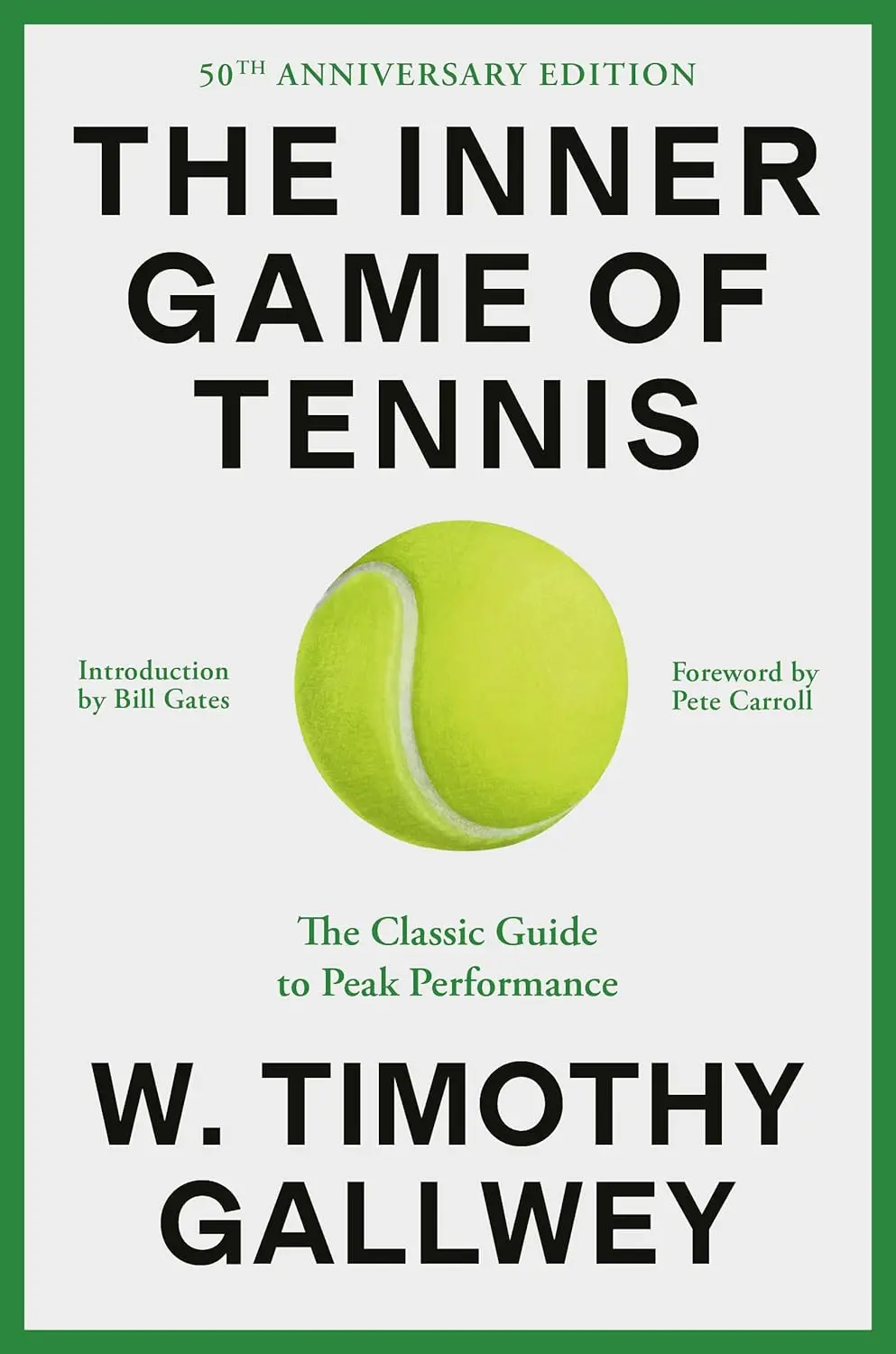
Every game, Gallwey writes, has two parts. The outer game is played against an opponent on the court. The inner game is played inside the mind of the player, against self-doubt, anxiety, and the constant urge to overthink. Most people lose the inner game long before the outer one matters.
Gallwey was a tennis coach at a California club in the early 1970s when he noticed something odd. When he told students to correct their form, they usually got worse. When he asked them to simply observe what their body was doing without trying to change it, they got better. The conscious mind, with its stream of instructions and judgments, was interfering with the body’s ability to learn.
He developed a framework around two selves. Self 1 is the thinker, the critic, the voice that says “keep your elbow up” and “you’re going to miss this shot.” Self 2 is the body itself, which already knows how to learn if you let it. The key to the inner game is getting Self 1 to shut up so Self 2 can do its work.
The practical techniques Gallwey describes are surprisingly concrete. Instead of telling yourself how to hit the ball, watch the seams as it approaches. Instead of judging each shot as good or bad, simply notice where the ball lands. These instructions redirect the conscious mind from evaluation to observation, which clears the path for natural learning.
The book was controversial when it came out. Traditional coaches thought it was mystical nonsense. But Billie Jean King called it her tennis bible. Bill Gates named it one of his five favorite books of all time. Al Gore used its principles to focus his campaign staff. Itzhak Perlman recommended it to young violinists. It has sold over a million copies.
For founders and professionals, the applications are obvious once you see them. The inner critic that sabotages a tennis serve is the same one that freezes you before a pitch meeting, makes you second-guess a product decision, or keeps you up at night replaying a conversation. Gallwey’s techniques for quieting that voice, redirecting attention from judgment to observation, and trusting the competence you have already built, transfer directly to any performance situation.
The 50th anniversary edition includes a new foreword by Bill Gates and an updated preface from NFL coach Pete Carroll.
