
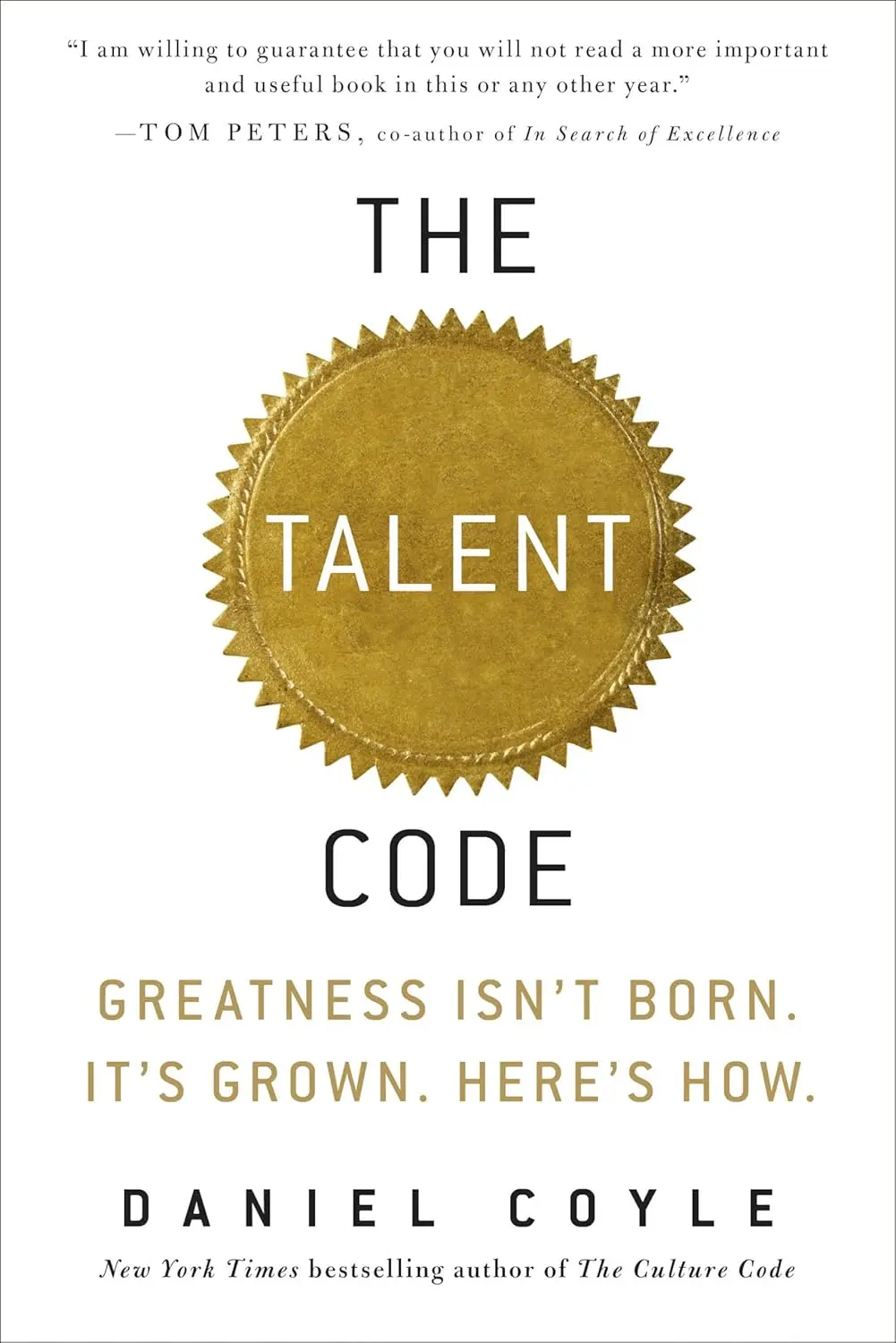
A penniless Russian tennis club with one indoor court has produced more top-twenty women players than the entire United States. A storefront music school in Dallas, Texas, turned out Jessica Simpson, Demi Lovato, and a string of pop stars. A poor British family in a remote village raised three world-class writers. Daniel Coyle wanted to know why.
He spent a year and a half traveling to nine of these talent hotbeds, from the baseball fields of the Caribbean to a classical music academy in upstate New York, and found three elements that kept showing up together: deep practice, ignition, and master coaching.
Deep practice is the most interesting of the three. It is not the kind of practice most people do. It is slow, deliberate, and focused on operating at the edge of your current ability, which means failing constantly. What makes it work, according to the neuroscience Coyle draws on, is myelin. Myelin is a substance that wraps around neural circuits and makes signals travel faster and more accurately. Every time you practice something the right way, struggling and correcting, you add another layer of insulation. Over time, the circuit becomes fast and automatic. Skill, in this model, is not a gift. It is insulation.
Ignition is the motivational trigger that makes someone willing to put in the hours of deep practice. It is usually a specific moment or image that creates a connection between a person’s identity and a future self. Coyle found that it often comes from seeing someone from your own world succeed. When a South Korean golfer won the LPGA Championship, South Korean girls flooded into golf academies. The golfer was not teaching them. She was showing them it was possible.
Master coaching is the third element, and the coaches Coyle studied looked nothing like the motivational speakers most people picture. They were quiet, observant, and gave short, specific corrections. Legendary basketball coach John Wooden, for example, rarely gave speeches. His typical instruction was something like “do some dribbling between shots” or “crisp passes, really snap them.” Error-centered, well-planned, information-rich.
For founders and business builders, the model has direct applications. Getting better at anything, whether it is sales, writing, product design, or public speaking, requires the same ingredients: targeted practice at the edge of your ability, a reason to push through the discomfort, and feedback that is specific rather than general. The book will not make you talented. It will change how you think about what talent actually is.
