
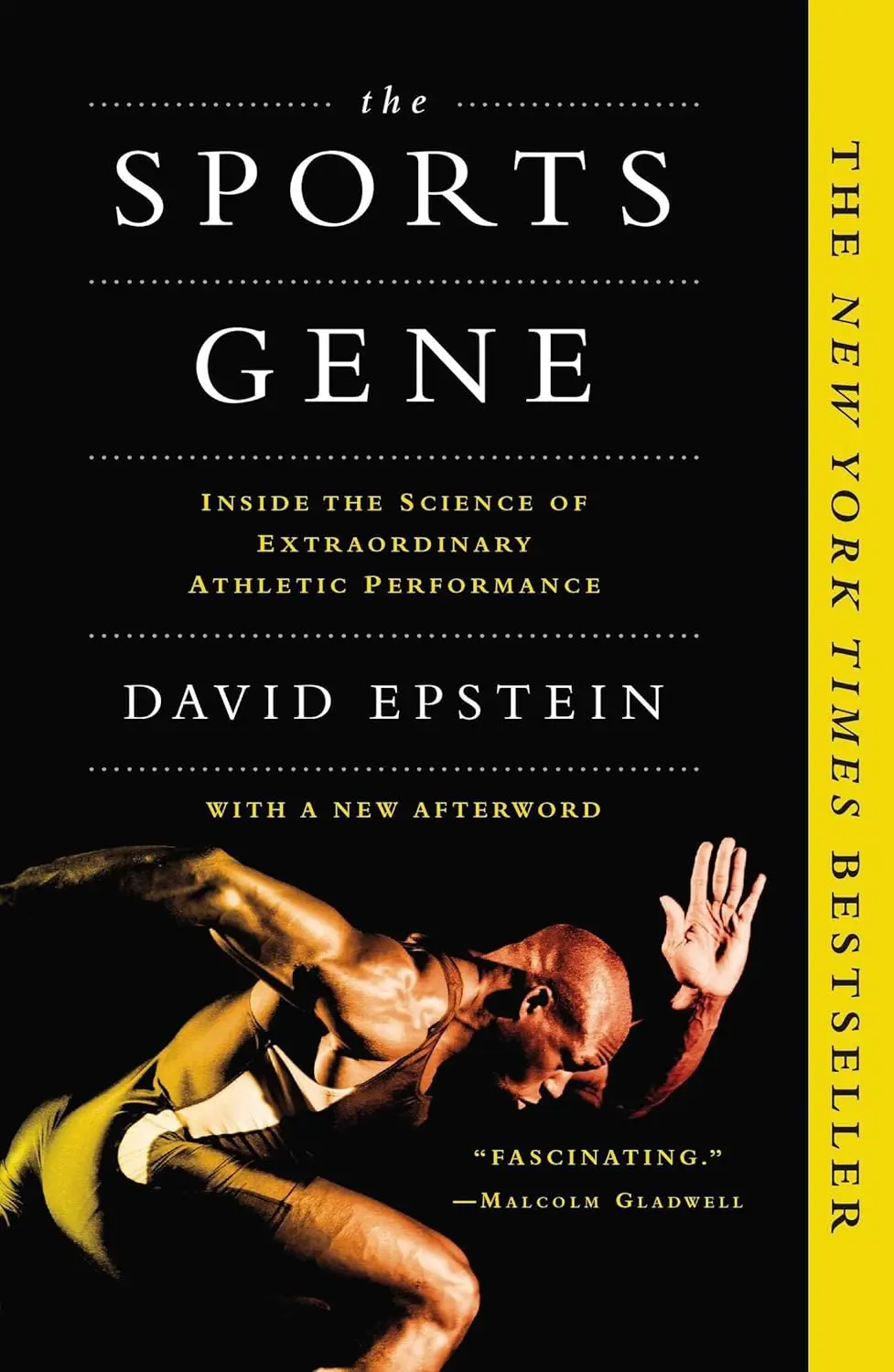
The 10,000-hour rule, popularized by Malcolm Gladwell in Outliers, says that enough deliberate practice will make anyone world-class at anything. David Epstein, then a senior writer at Sports Illustrated, wanted to know if that was actually true. He spent years reporting the answer, and the result is The Sports Gene, which complicates the clean narrative in ways that are both fascinating and useful.
The short version: practice matters enormously, but it is not the whole story. Epstein documents athletes with specific genetic advantages, a high jumper who cleared seven feet on his first attempt ever, baseball players with visual acuity literally off the charts, marathon runners from Kenya’s Rift Valley who grew up running to school at altitude. These athletes did not skip training. But they started with biological advantages that no amount of practice can replicate in someone who lacks them.
The book travels widely. Epstein visits training facilities in Jamaica, altitude camps in Kenya, genetics labs in Europe, and military research sites in the United States. He interviews geneticists, coaches, and athletes. He examines why Jamaicans dominate sprinting (a combination of body type and a national obsession with high school track), why Kenyans dominate distance running (altitude, running culture, lean builds), and why the NBA has become a league of extreme body types (the average NBA player is taller than 99.99 percent of the population).
One of the most interesting chapters explores how people respond differently to the same training stimulus. In controlled studies where every subject does the same exercise program, the range of results is enormous. Some people gain significant cardiovascular fitness. Others, doing identical work, gain almost none. This variation is largely genetic, and it means that the question is not just how hard you train but how your body responds to training.
For readers outside of sports, the book has broader implications. It challenges the idea that talent and effort are neatly separable. It raises questions about how we identify potential, how we allocate resources for development, and whether the same person can be better suited for one pursuit than another. Founders think about these questions all the time, whether they are hiring, choosing markets, or evaluating their own strengths.
Malcolm Gladwell, whose 10,000-hour framework Epstein partially dismantles, called it the most fascinating book he had read in years. The New York Times made it a bestseller. Epstein later wrote Range: Why Generalists Triumph in a Specialized World, which further developed his thinking about talent and specialization.
