
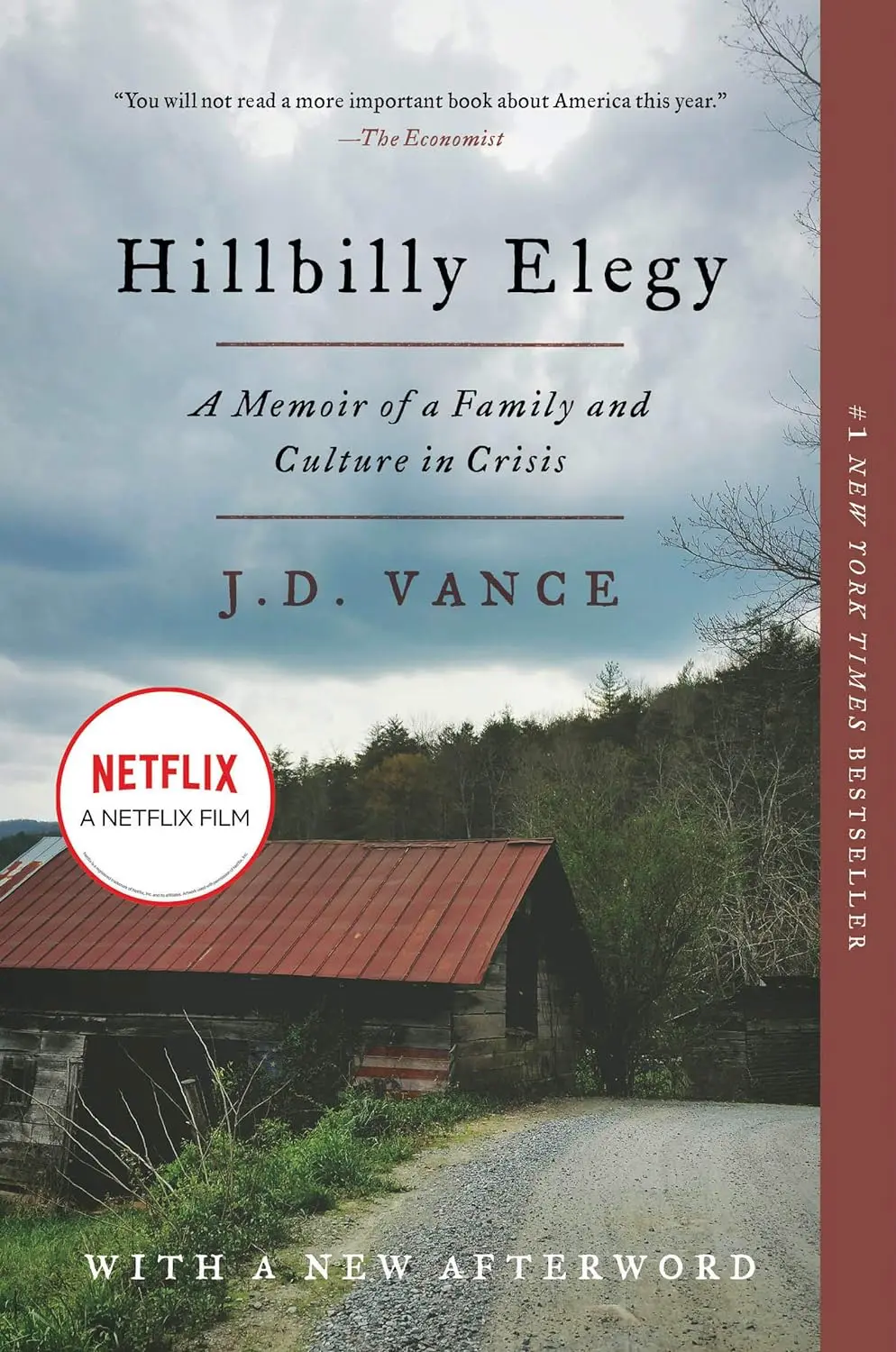
Hillbilly Elegy is a memoir about growing up poor and white in the American Rust Belt. J.D. Vance’s family migrated from the hills of eastern Kentucky to Middletown, Ohio, chasing factory jobs after World War II. For a while, it worked. But as manufacturing collapsed, the community fell apart, and Vance’s family fell with it.
His mother cycled through marriages and drug addictions. His childhood was marked by instability, screaming matches, and the constant threat of eviction. The person who kept him from going under was his grandmother, Mamaw, a woman who could be both terrifyingly violent and fiercely protective. She took him in during his teenage years and pushed him to finish school. He enlisted in the Marines, went to Ohio State, then got into Yale Law School.
The book is part personal story, part cultural commentary. Vance argues that the problems facing poor white communities in Appalachia and the Rust Belt are not purely economic. He points to a culture that, in his view, sometimes discourages personal responsibility and enables destructive behavior. This argument has attracted both praise and significant criticism. Some readers found it honest and overdue. Others, including scholars of Appalachian culture, argued that Vance generalized too broadly from his own experience and underestimated the role of structural economic forces.
Regardless of where you land on those debates, the personal narrative is compelling. Vance describes with raw honesty what it feels like to arrive at an elite institution and realize you have no idea how the world around you works. He did not know what a wine list was. He had never eaten at a sit-down restaurant. The gap between his background and his new environment was not just financial but social, emotional, and psychological.
For entrepreneurs and builders, the book offers a ground-level view of economic decline that most business books never touch. It puts human faces on the statistics about opioid addiction, unemployment, and social fragmentation that shape entire regions of the country. Whether you agree with Vance’s conclusions or not, the book forces you to reckon with the gap between the America that gets venture capital and the America that gets left behind.
The book reached number one on the New York Times bestseller list. It was adapted into a film directed by Ron Howard in 2020. Time Magazine named it one of the most important nonfiction books of the decade. Vance later entered politics, became a U.S. Senator from Ohio, and in 2025 became the Vice President of the United States.
